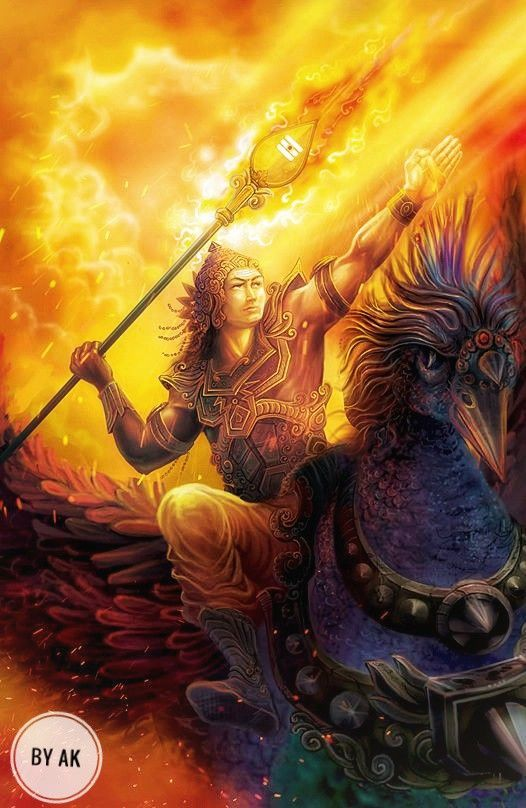
Murugan and Skanda are meant to embody the civilisational unity of Bharat, yet we Hindus choose to quarrel over them. This deity represents two regional manifestations of the same sacred tradition: Skanda in the North and Murugan in the South, united by a shared object of devotion.
Devotees of Skanda in the North would journey to Tamil Nadu to worship at the ancient shrines of Murugan, while devotees of Murugan in the South would undertake pilgrimages to the northern centres of Skanda worship. This is the genius of Hinduism: it permits the localisation of the divine without fragmenting the underlying spiritual tradition. Every region is free to venerate the Divine in its own idiom while simultaneously recognising the legitimacy and sanctity of other manifestations.
Murugan may have occupied a central place in the religious imagination of ancient Tamilakam, but Skanda likewise possesses an ancient and independent place within the Sanskritic tradition. Over the centuries, these traditions were harmoniously syncretised, not through the erasure of one by the other, but through a process of mutual enrichment that remained faithful to Hinduism's enduring civilisational impulse to elevate local traditions into the broader sacred canon.
The Āṟupadai Veedu, the six sacred abodes of Murugan, were developed according to the Agamas (which themselves are of Kashmiri Shaivite origins) under the patronage of the Cholas, Pandyas, and Cheras, who also endowed brahmadeya settlements for Brahmins from the North in the Tamil heartland. This reflects not a civilisation divided between North and South, but one characterised by profound cultural and spiritual exchange.
This is the history of our civilisation: integration through spirituality rather than uniformity. It is unfortunate that we now reduce such a profound legacy to petty regional disputes.
@NarutoUzmaki201@vicky05440463@TTHCollective My point in regards to Rayalaseema:
Language of the rulers always took precedence over the language of the land
But I would say Chittoor had more of a Tamil background
@naredalega@Srinandy https://t.co/tWQIREYGMZ
https://t.co/2ON7naCPPD
(page number 31)
8th century, Anantapur District
https://t.co/kAX5NWVNiv
https://t.co/0YkkU3RqA2
6th century, Kadapa District
https://t.co/HTEaYDQGbx
7th century, Kadapa District
@naredalega@Srinandy https://t.co/tWQIREYGMZ
https://t.co/2ON7naCPPD
(page number 31)
8th century, Anantapur District
https://t.co/kAX5NWVNiv
https://t.co/0YkkU3RqA2
6th century, Kadapa District
https://t.co/HTEaYDQGbx
7th century, Kadapa District
We fabricated and characterised our first semiconductor devices @hackerfabindia today- a PN junction(right) diode and a MOSCAP(left)- both using tools built entirely in house.
There’s obviously a lot of improvement to be made to our process, but it’s only upward from here!
In Telangana, Telugu gets seconds while Urdu gets minutes?
Dear @revanth_anumula and @Bhatti_Mallu why is the language spoken by the overwhelming majority of Telangana's people getting the least visibility on Hyderabad Metro displays?
Local transport should prioritize the local language.
#RespectTelugu #HyderabadMetro
@ANONYMO52826141@naredalega Exactly! By his logic he can even claim Telangana, language of the rulers always took precedence over the language of the land
@Kannada_Pandita Nannayya is not the Telugu's Adikavi and early Telugu literature was largely composed under Chalukya's patronage
Your tone seems to suggest some sort of discomfort with that, shouldn't be a surprise considering the geography they ruled
@TeluguJambuDwip