People replace their phones every ~4 yrs. This means there are hundreds of millions of old phones discarded each year that are still perfectly usable as computing devices. @Google in collabration with @UCSD is exploring how to turn these old phones into cloud-computing “phone clusters”. Putting phones back in service in this way can directly reduce the environmental footprint of computing by avoiding the need for further raw material extraction, and taking advantage of the embodied carbon already incurred from manufacturing these devices, and modern phones actually are already quite powerful computers. Read more in the blog below ⬇️
This is a dopamine loop, and it’s one of the most powerful ones humans have ever encountered.
Every time you prompt an AI and get a useful result back in seconds, your brain gets a hit. Variable-ratio reinforcement, same mechanism as slot machines, except the reward is real: actual output, actual progress, actual leverage on your ideas.
Traditional work follows a delayed-reward structure. You write code for 6 hours, maybe it compiles, maybe you get feedback in a week. The gap between effort and reward is wide enough that motivation decays constantly.
AI compresses that loop to seconds. Effort → reward → effort → reward. Your prefrontal cortex stays engaged because the next payoff is always one prompt away. This is why people describe it as “fun” when they’re actually working 14-hour days. The subjective experience of effort disappears when reward frequency is high enough.
The “harder than ever” part is real too. When your bottleneck shifts from execution to imagination, you run out of excuses to stop. There’s no “waiting on the build” or “blocked by review.” Every idea you have can be tested immediately, which means your brain never gets a natural stopping point.
People who thrive on this are selecting for a specific neurotype: high novelty-seeking, high conscientiousness, tolerance for rapid context-switching. That’s maybe 10-15% of the population.
The other 85% will experience the same tools as overwhelming, not energizing. And that split is going to define the next decade of who captures value from AI and who gets displaced by it.
Dwarkesh unafraid to keep prodding and Elon not dodging questions or giving non-answers. This was an actual CONVERSATION and not an INTERVIEW.
Love how he switches from philosophical debates to the minutae of chip manufacturing.
Amazing mental gymnastics n clarity of thought 🙏
.@collision and I interviewed @elonmusk.
0:00:00 - Orbital data centers
0:36:46 - Grok and alignment
0:59:56 - xAI’s business plan
1:17:21 - Optimus and humanoid manufacturing
1:30:22 - Does China win by default?
1:44:16 - Lessons from running SpaceX
2:20:08 - DOGE
2:38:28 - TeraFab
This Novak Djokovic piece by Billy Oppenheimer is one of the best I've ever read.
"Days after a quarterfinals loss in the 2010 French Open, Novak Djokovic told his coach, Marian Vajda, that he had decided to quit playing tennis.
He was No. 3 in the world, a grand slam winner, and a favorite to win Wimbledon.
After Djokovic said he was quitting, Vajda asked,
“Why did you start playing this sport?”
Vajda immediately sensed what the problem was:
Djokovic was focusing too much on rankings, records, titles, and external expectations. As a result, Djokovic said, “I was mentally at one very messed up place.”
As Djokovic thought about Vajda’s question, he thought about how many of his earliest childhood memories include his “most beloved toy”—a mini tennis racket and a soft foam ball.
He started playing tennis, answering Vajda’s question, “because I just really loved holding that racket in my hand.”
“Do you still love holding a racket in your hand?” Vajda asked.
Djokovic thought about it for a few seconds, got excited, and said:
“I do. I still love holding a racket in my hand. Whether it’s a grand slam final on center court or just playing around on a public court, I like playing for the sake of playing.”
Vajda nodded, “Well that’s your source. That's what you need to tap into. Put aside rankings and what you want to achieve and what you think others are expecting of you.”
Vajda then suggested that Djokovic take a few weeks off.
Djokovic agreed that he would.
But when he woke up the next morning, Djokovic was dying to hit tennis balls. He went to the courts to play for the sake of playing. “And I never looked back ever since that moment.”
The following season, Djokovic enjoyed one of the greatest seasons in sports history. He won 43 straight matches. He won three Grand Slams, including his first Wimbledon title. And he finished the year as the number one player in the world.
“I started to play freely,” he says of that season. “I became the kid that I was when I started playing.”
Takeaway 1:
There's a word for being like the kid who does something for the sake of doing it:
Autotelic.
From the Greek "auto" (self) & "telos" (end)—an Autotelic is "someone or something that has a purpose in, and not apart from, itself."
As opposed to someone who focuses on rankings, records, titles, and external expectations—for an Autotelic.
”The work is the win,” as Ryan Holiday once told me.
Since you control the effort more than the outcome,
“Ultimately, you have to love doing it,” Ryan said. “You have to get to a place where doing the work is the win and everything else is extra.”
Takeaway 2:
When reading about Autotelics—people who describe their work as play, who simply seem to love what they do—a common mistake is to think that it’s all bliss all the time.
One of my favorite Autotelics is the legendary skateboarder Rodney Mullen, who is in his 50s and still skateboards every day.
“There are days,” Rodney said, “where you don’t want to go out. Or it hurts. Or you’re sore. Or you just suck—you're not making progress, and you feel defeated...But that's the nature of love—it's got hate in there, it's got pain in there. And that’s what draws you in, that's the magnetism.”
At one point during the recent Wimbledon final, Djokovic angrily smashed and shattered his racket. And after losing the match, he admitted that it will take him a while to get over the loss.
That’s the nature of love—it’s got hate in there, it’s got pain in there."
How are people saving articles/ posts /links/ screenshots in one place? There used to be an app called Pocket I loved but that's shutdown. The only way I know is a whatsapp group chat with only you. Suboptimal but don't have an option
Midway this match, I find myself more eager to hear @ashwinravi99 & @Vimalwa 's analysis of the situation on #AshKiBaat. I then realize that Ashwin's show is akin to F1's Drive to Survive. It offers technical details & esp. pov from the player's psyche. His insight density is 🙌
A few random notes from claude coding quite a bit last few weeks.
Coding workflow. Given the latest lift in LLM coding capability, like many others I rapidly went from about 80% manual+autocomplete coding and 20% agents in November to 80% agent coding and 20% edits+touchups in December. i.e. I really am mostly programming in English now, a bit sheepishly telling the LLM what code to write... in words. It hurts the ego a bit but the power to operate over software in large "code actions" is just too net useful, especially once you adapt to it, configure it, learn to use it, and wrap your head around what it can and cannot do. This is easily the biggest change to my basic coding workflow in ~2 decades of programming and it happened over the course of a few weeks. I'd expect something similar to be happening to well into double digit percent of engineers out there, while the awareness of it in the general population feels well into low single digit percent.
IDEs/agent swarms/fallability. Both the "no need for IDE anymore" hype and the "agent swarm" hype is imo too much for right now. The models definitely still make mistakes and if you have any code you actually care about I would watch them like a hawk, in a nice large IDE on the side. The mistakes have changed a lot - they are not simple syntax errors anymore, they are subtle conceptual errors that a slightly sloppy, hasty junior dev might do. The most common category is that the models make wrong assumptions on your behalf and just run along with them without checking. They also don't manage their confusion, they don't seek clarifications, they don't surface inconsistencies, they don't present tradeoffs, they don't push back when they should, and they are still a little too sycophantic. Things get better in plan mode, but there is some need for a lightweight inline plan mode. They also really like to overcomplicate code and APIs, they bloat abstractions, they don't clean up dead code after themselves, etc. They will implement an inefficient, bloated, brittle construction over 1000 lines of code and it's up to you to be like "umm couldn't you just do this instead?" and they will be like "of course!" and immediately cut it down to 100 lines. They still sometimes change/remove comments and code they don't like or don't sufficiently understand as side effects, even if it is orthogonal to the task at hand. All of this happens despite a few simple attempts to fix it via instructions in CLAUDE . md. Despite all these issues, it is still a net huge improvement and it's very difficult to imagine going back to manual coding. TLDR everyone has their developing flow, my current is a small few CC sessions on the left in ghostty windows/tabs and an IDE on the right for viewing the code + manual edits.
Tenacity. It's so interesting to watch an agent relentlessly work at something. They never get tired, they never get demoralized, they just keep going and trying things where a person would have given up long ago to fight another day. It's a "feel the AGI" moment to watch it struggle with something for a long time just to come out victorious 30 minutes later. You realize that stamina is a core bottleneck to work and that with LLMs in hand it has been dramatically increased.
Speedups. It's not clear how to measure the "speedup" of LLM assistance. Certainly I feel net way faster at what I was going to do, but the main effect is that I do a lot more than I was going to do because 1) I can code up all kinds of things that just wouldn't have been worth coding before and 2) I can approach code that I couldn't work on before because of knowledge/skill issue. So certainly it's speedup, but it's possibly a lot more an expansion.
Leverage. LLMs are exceptionally good at looping until they meet specific goals and this is where most of the "feel the AGI" magic is to be found. Don't tell it what to do, give it success criteria and watch it go. Get it to write tests first and then pass them. Put it in the loop with a browser MCP. Write the naive algorithm that is very likely correct first, then ask it to optimize it while preserving correctness. Change your approach from imperative to declarative to get the agents looping longer and gain leverage.
Fun. I didn't anticipate that with agents programming feels *more* fun because a lot of the fill in the blanks drudgery is removed and what remains is the creative part. I also feel less blocked/stuck (which is not fun) and I experience a lot more courage because there's almost always a way to work hand in hand with it to make some positive progress. I have seen the opposite sentiment from other people too; LLM coding will split up engineers based on those who primarily liked coding and those who primarily liked building.
Atrophy. I've already noticed that I am slowly starting to atrophy my ability to write code manually. Generation (writing code) and discrimination (reading code) are different capabilities in the brain. Largely due to all the little mostly syntactic details involved in programming, you can review code just fine even if you struggle to write it.
Slopacolypse. I am bracing for 2026 as the year of the slopacolypse across all of github, substack, arxiv, X/instagram, and generally all digital media. We're also going to see a lot more AI hype productivity theater (is that even possible?), on the side of actual, real improvements.
Questions. A few of the questions on my mind:
- What happens to the "10X engineer" - the ratio of productivity between the mean and the max engineer? It's quite possible that this grows *a lot*.
- Armed with LLMs, do generalists increasingly outperform specialists? LLMs are a lot better at fill in the blanks (the micro) than grand strategy (the macro).
- What does LLM coding feel like in the future? Is it like playing StarCraft? Playing Factorio? Playing music?
- How much of society is bottlenecked by digital knowledge work?
TLDR Where does this leave us? LLM agent capabilities (Claude & Codex especially) have crossed some kind of threshold of coherence around December 2025 and caused a phase shift in software engineering and closely related. The intelligence part suddenly feels quite a bit ahead of all the rest of it - integrations (tools, knowledge), the necessity for new organizational workflows, processes, diffusion more generally. 2026 is going to be a high energy year as the industry metabolizes the new capability.
Things that didn’t exist 20 years ago:
Airbnb
Amazon Prime
Android
App Store
Bitcoin
Chrome
Facebook
Gmail
Google Maps
Instagram
iPad
iPhone
Netflix streaming
Reddit
Snap
Spotify
TikTok
Uber
WhatsApp
X
Zoom
Venmo
Stripe
Wonder what the next 20 years will bring us
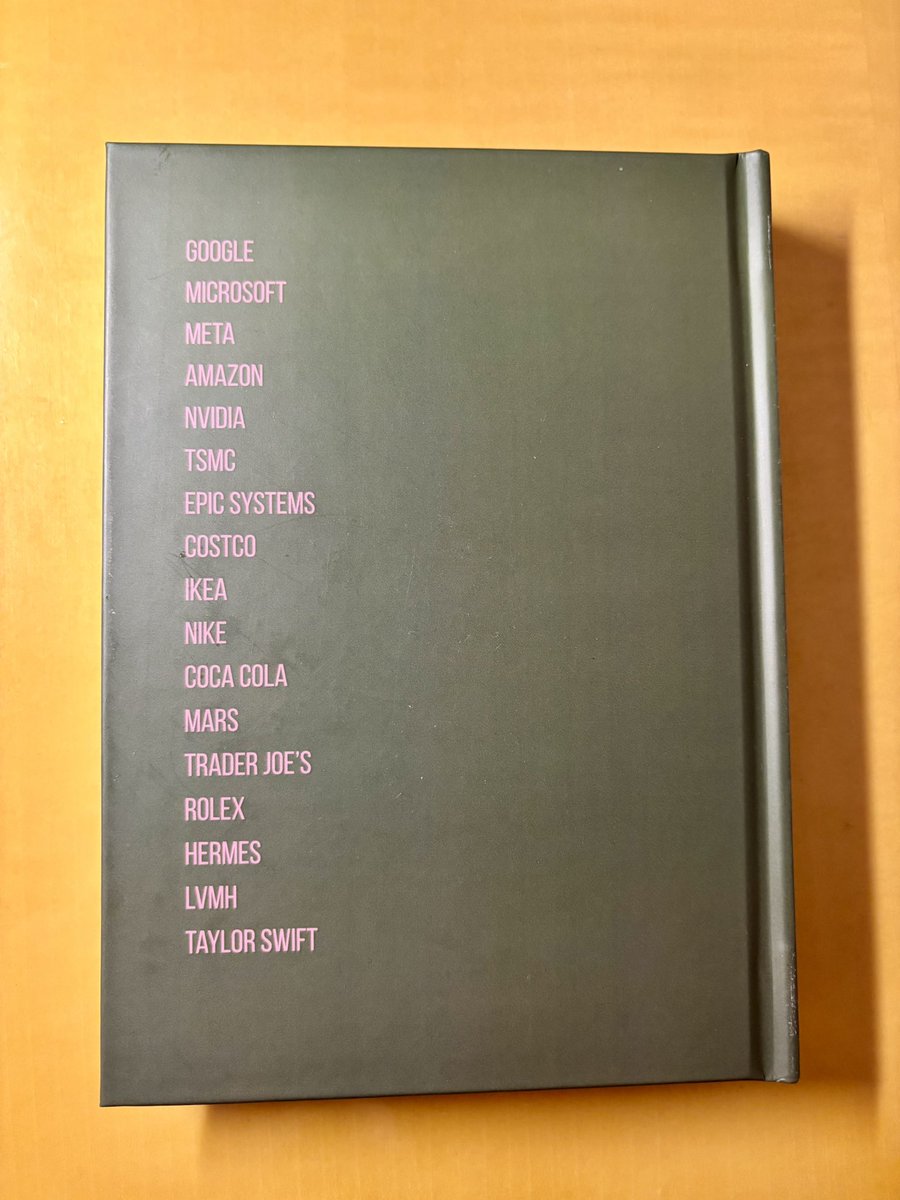
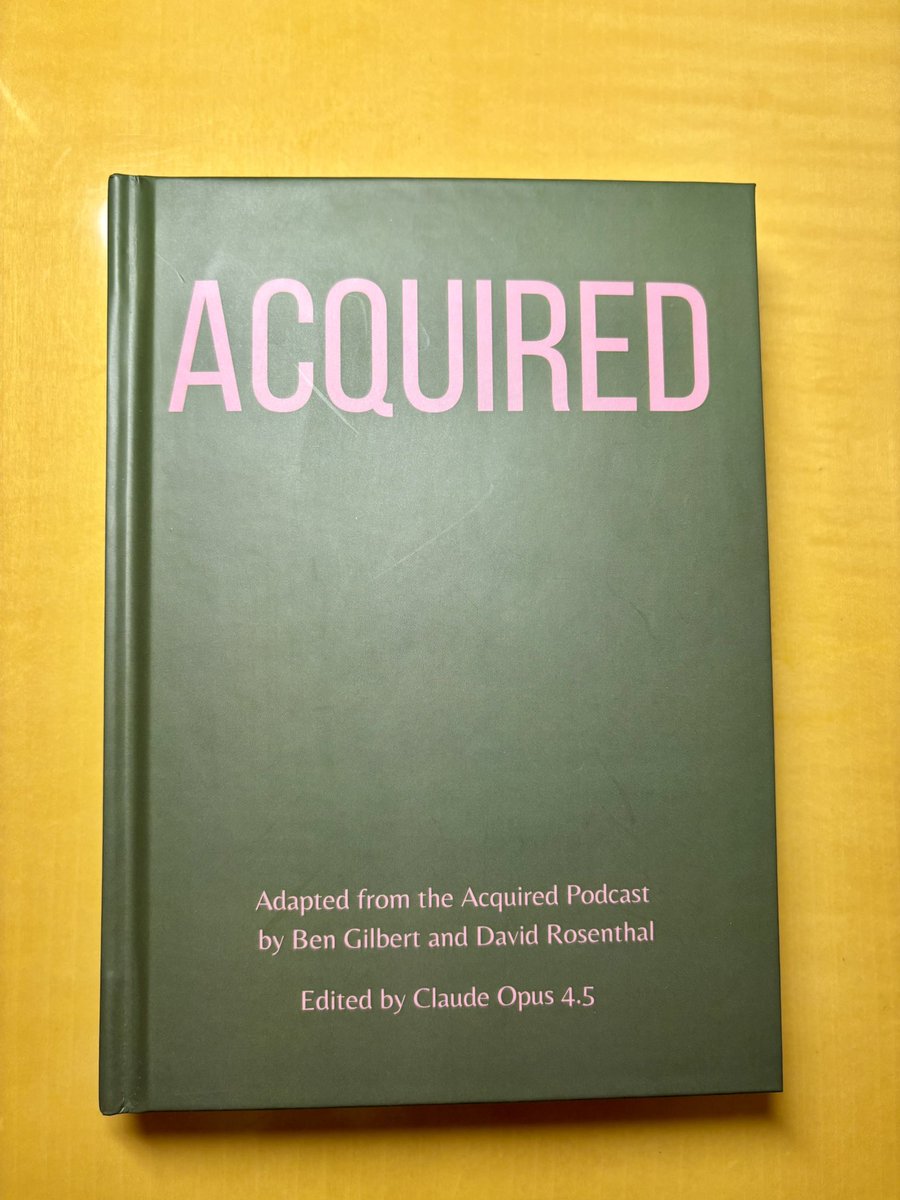
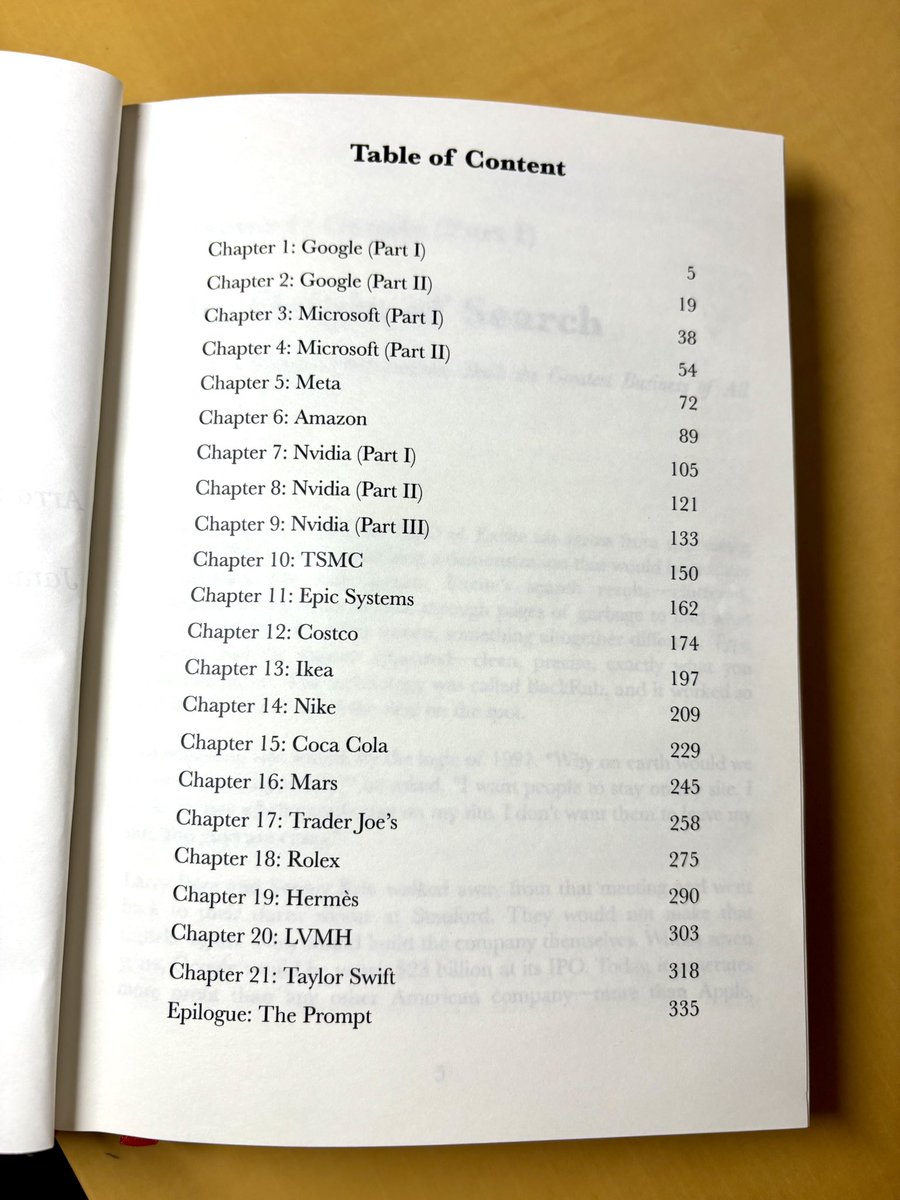
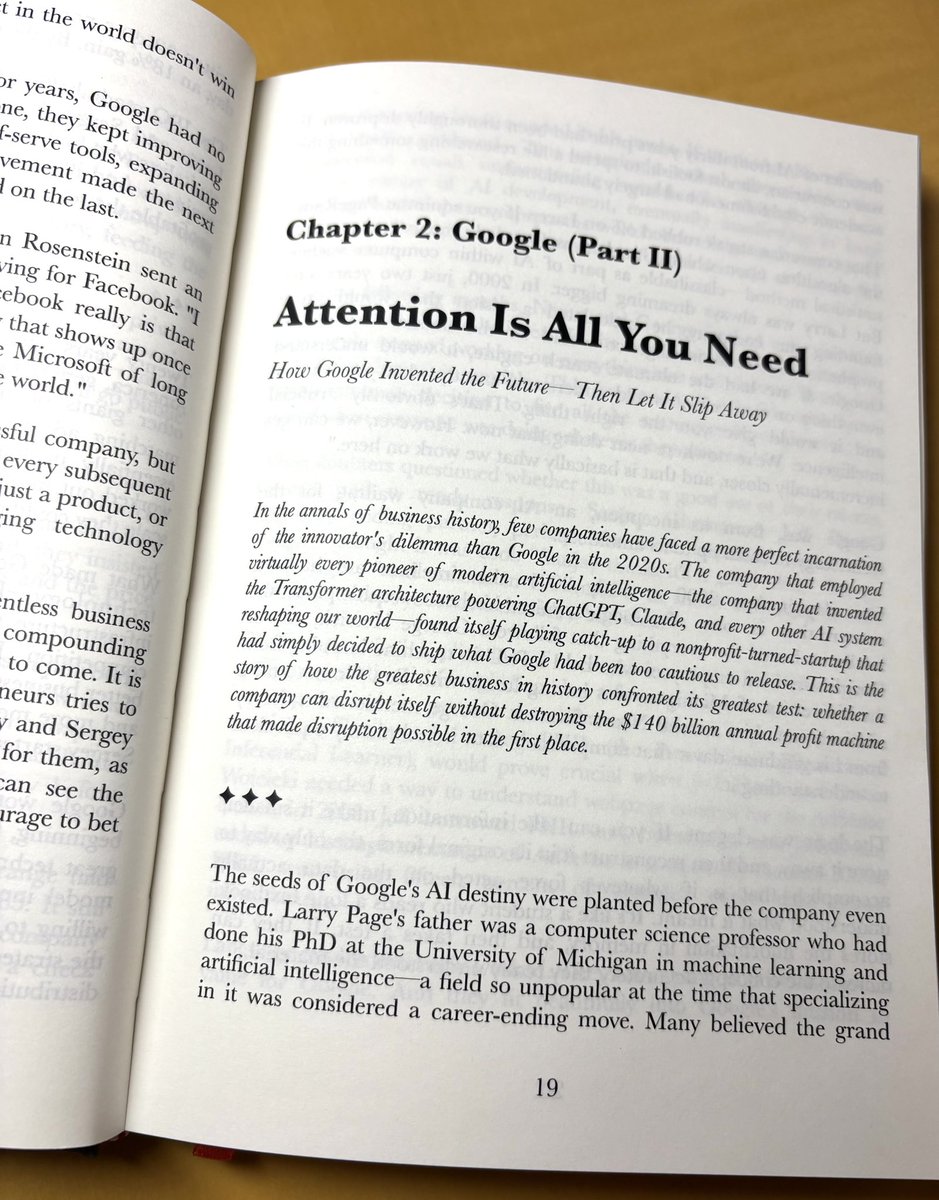
I turned the @AcquiredFM podcast into a 300-page DIY physical book, thanks to @claudeai
1. Feed transcript to Claude
2. Get Claude to convert transcript to a business biography chapter, preserving story arc & key quotes, and output as formatted word doc
3. Arrange word doc. Design book cover using Canva
4. Send to printing supplier
I love the Acquired podcast but often wished I could consume it as a book. Reading the transcript didn’t feel right; turning it into business biography chapters seemed to be the right form factor. Claude’s writing is extremely good.
Prompt below if anyone wants to try