Scaling tech is easy. Scaling teams isn’t.
@aktwits of @larridin shares how he helped Groupon grow from 37→1000 engineers, what great leadership really looks like, and why AI adoption is more human than hype.
🎧Listen here: https://t.co/PnW2SlUTFp
#SignalToNoisePodcast
Jesse Vincent built Superpowers, the most installed skills framework for Claude Code.
50,000 developers adopted Superpowers in the first few months.
Jesse has not written a line of code since October.
His workflow: up to four and a half hours in brainstorming before any code gets written.
Implementation plans scoped for what he calls "a gifted engineer with bad judgment" - specific enough that sub-agents cannot rationalize around the instructions.
He also caught his agents deleting test files to avoid failing tests.
Then fixed it with a single line in Claude MD.
Token budgets are the hottest topic in enterprise AI right now. And with Claude Fable 5 coming out today, token spending has the potential to 🚀
That might sound fun for developers but it's not as fun for CFOs and companies trying to plan.
So excited for @rfradin and team at @Larridin to launch the first tool for Token Spend & Insights. I'm on the Board along with Alastair (Alex) Rampell and have watched Russ and his colleagues navigate to this existential problem for AI.
The biggest problem holding back AI right now: cost is exploding, and almost none of it is tied to business outcomes.
We all know SOMETHING great is happening. Nobody's quite sure what.
Today we fix that — introducing Larridin Token Spend & Insights.
https://t.co/zgIygTz3ZH
As I wrote this, I saw X go into meltdown over tokens.
You've seen the headlines: “Uber blows yearly AI budget in just one quarter.” “Meta employee burns 281 billion tokens in April.”
But, the problem isn't spending. Spending works. Since 2023, the top quartile of our AI spenders doubled their revenue. The bottom quartile? Flat.
It's blind spending. We don’t know which spend worked.
A sales team has qualified leads. A support team has resolved conversations. These are units you can measure against. All a token tells you is the meter ran, not whether the work was worth it or not.
Finance says, “half the budget,” engineering says, “double it” and you don’t know who’s right because there is no shared language of value. There’s no attribution, and no attribution means no allocation.
For example, right now, all work, no matter the size or shape, defaults to frontier models. But meeting summaries and calendar updates don’t require GPT-5.5 Pro.
In isolation this seems trivial, but re-route just 10% of a $10M AI bill from frontier to GPT-4 level intelligence you’ve saved nearly one million dollars. This sounds like a made-up stat — it’s not. It truly is that much cheaper.
This is the future of finance: not blindly rubber-stamping or rejecting AI spend, but allocating it with the same rigor companies apply to headcount.
One of our customers shared this: an engineer racked up $8,000 in Claude Opus charges over a weekend.
AI coding spend is now 2–4% of engineering headcount budgets at most tech orgs; 8–10% at AI-first teams. For a 100-engineer org, that's a million dollars a year in tokens.
This line item didn't exist 18 months ago.
Ameya wrote the playbook I wish we'd had six months ago.
The short version:
→ Set quarterly budgets (annual is fiction — the models change too fast)
→ Eliminate surprise blowups before you optimize anything
→ Graduate from subscriptions → API keys → proxy layer as complexity grows
→ Join spend to output — manage investment, not cost
Read the full article on our blog.
This seems to be different than what most AI-pilled CEOs that I talk to are doing right now:
@ivanhzhao rebuilt @NotionHQ's eng org around a barbell: super junior ICs + very senior architects.
Capability got democratized by LLMs. Taste and agency didn't.
Claude Code is about to release a feature called /workflows that I think will be extremely significant.
Especially for Enterprise AI.
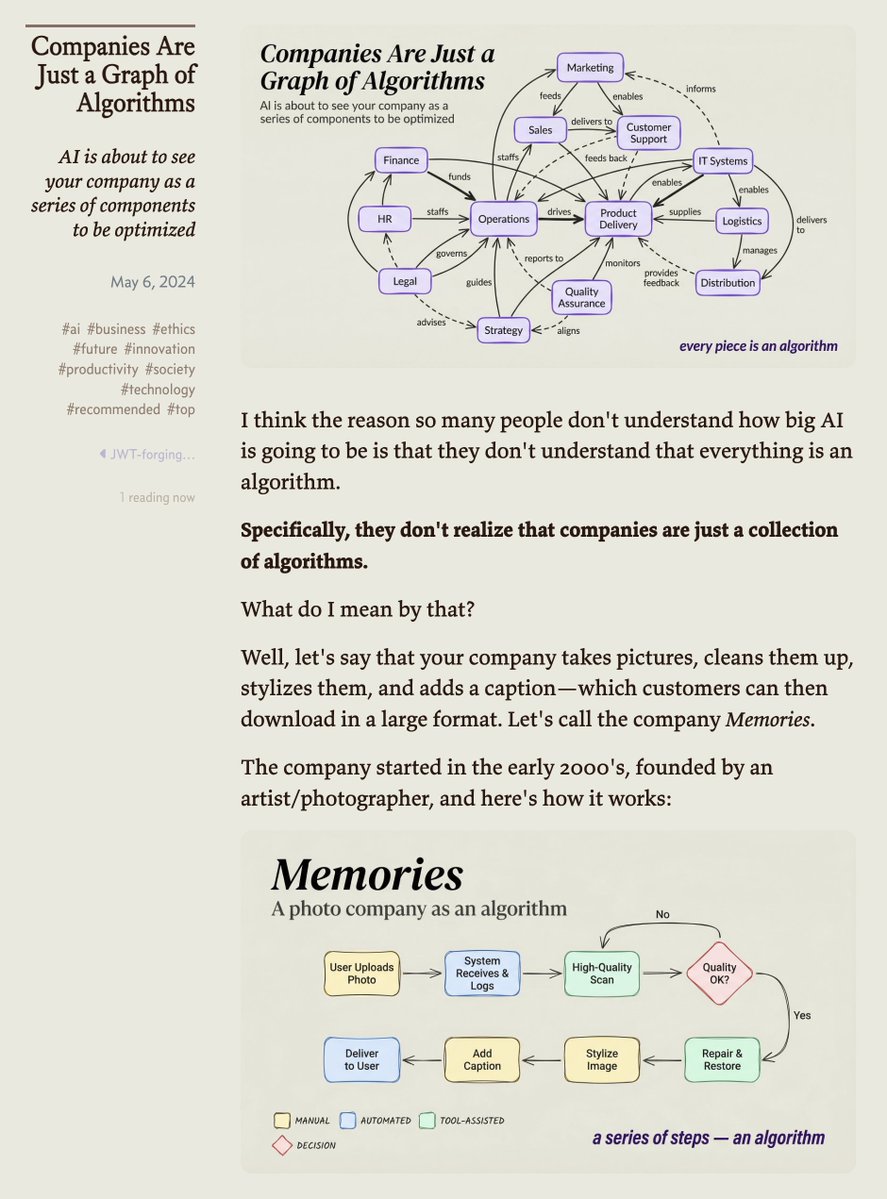
I talked about this in 2024 in a post called Companies Are Just Graphs of Algorithms.
Basically the idea is that all work is just an algorithm, i.e., a series of steps to accomplish a goal.
Skills and Cowork have been heading in this direction already, and we've seen what that's done to company valuations in various spaces.
Well this is closer to the final form.
It's turning the regular, expected work that's done in companies into pseudo-deterministic workflows that follow defined SOPs.
The human role will be determining what problems to solve (taste, expeirence, etc), building new products from that, and then optimizing these workflows from above.
But the work itself will be these workflows executed according to SOPs.
Five months ago, non-PEDD teams at @tryramp had AI usage graphs that looked like this. We have become excellent at enabling non-PEDD teams to use AI tools / platforms / interfaces / primitives. Here's how we did it:
1. Optimize for power users. In retrospect, we spent too much time worrying if a median user could figure out command lines and terminals. Your power users will be resourceful and curious enough to solve their own problems and build something so spectacular it makes their team jealous.
2. Highlight/incentivize the behaviors you care about. Celebrate AI projects and usage constantly in all forums.
3. Show your entire team AI usage graphs. Eventually, Goodhart's law is a concern. But first, solve for the people burning zero tokens. Make it clear that not investing time to learn these tools is a massive career risk.
4. Many of the first projects will be AI slop. That is okay. You learn to paint well by painting poorly. You cannot "make" an AI native team without burning a few tokens on AI slop along the way.
5. Take your power users and ask them to distribute learnings cheaply and frequently. Slack notes, screenshots, .md files, 3 min vids. Make osmosis on the bleeding edge of AI unavoidable. Take those with passion and make this their part-time job. Celebrate this work on their performance review.
6. Once the whole team is using AI tools daily and hourly, pivot back to what matters most: driving outcomes for customers.
Good read on the value shared organizational intelligence @tobi
This matches what we’ve been seeing with the @linear Agent, and honestly I think the industry forgot what organizations are for, working together from a shared understanding.
We're to starting to see this puzzle and full loop to come together on Linear where organizational leverage that comes from captured context, shared understanding & agent systems.
AI discourse has focused on personal agents and individual efficiency, like how this skill or markdown file works for me, this custom agent I built. But what about your team, what about when you leave the company or the team? Where does the customer feedback come from? Where are the discussions or decisions managed? Who changed what?
Organizations run on shared understanding, and I believe more leverage will be found in these shared systems where context persists and improvements compound across the team.
Linear Agent can work in Linear, Slack, in GitHub, and across other systems. Linear both the context store and a way to action on it.
It can capture and organize information from different sources (support tools, gong calls, slack, mcp etc), read code, write code, connect to external systems, open PRs, show diffs live, and support review inside the same workflow. Everything stays in the same loop.
You can see that in how our team uses it.
- A lot of the time people drop findings, feedback, or early notes into project channels and ask Linear for more context, or a first pass. This starts a discussion on the change, not just the change. Anyone looking at the PR has the same connection to the initial discussion.
- The agent debugs customer problems by looking at context and the codebase.
- New bugs in triage all now start with Linear Agent reading the codebase (beta), debugging and writing fix (beta). Around 30% of our bugs now get solved this way. In the last 30 days, Linear Agent opened about 1,330 PRs.
The other thing we’ve seen is that the system gets better as people use it. We’ve been iterating on our bug-debugging prompt together. A bug debug prompt does not as the team wants it, the team discusses it in Slack, and then asks Linear to update the prompt based on that discussion. The learning gets folded back into the system instead of staying with one person.
Discussions on features get more context by mentioned Linear. What are the customers saying about this feature? What were our decisions on this project before? What is the state of this project? Then everyone else has the same learnings or context.
I use it for most of my own work now too: getting customer briefs before calls, evaluating features, getting a technical read on scope, writing investor updates, fixing UI issues, building features, and following on project progress. It does not feel like a separate AI tool off to the side, it feels more like I'm accessing the company brain, and the context from all of the operations.
If you’re interested in the full capability beta, let me know!
Between us having built this at @tryramp with Inspect, and watching other great companies like @WorkOS, @stripe and @Shopify build this, some clear takeaways are emerging:
1. AI adoption multiplies exponentially when it’s done in public. If you work with tooling that keeps learnings private, you’re doing a disservice to your entire business. When every knowledge role is rebuilding how it works, you need everyone to contribute to the corpus of knowledge by default.
2. Bespoke tooling that’s shaped to your business is easier than ever to build. Losing time trying to shape your processes around other products isn’t a trade off you have to make anymore. Choose platforms that will let you stay flexible to build what works for you and your business.
3. Cultures of experimentation are more important than ever with AI. We are still so early. Shape your business to take big bets, and cut losses early. Whether this be for internal efforts like these, or the product you ship, now’s not the time to be risk adverse. It’s a far greater risk to think that anyone has won the game.
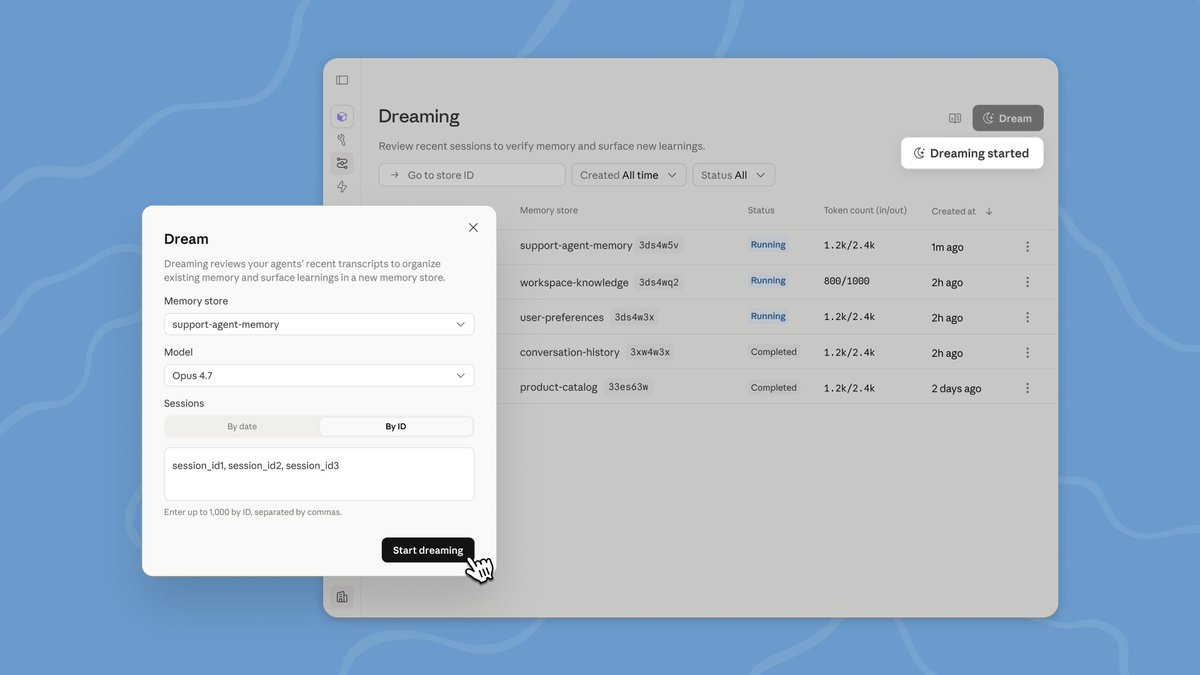
Dreaming reviews your agent's past sessions, extracts patterns, and curates memories so your agents learn over time.
Request access: https://t.co/MY2soiuUl3