Very happy that our paper titled “EEG evidence that morally relevant autobiographical memories can be suppressed” is now published online... with @RHellerstedt@Memory_Control and @zara_bergstrom. See 🧵for a short summary of results
https://t.co/WyOJjy4inG
Before explaining why, I must say what we are NOT advocating. We are NOT advocating the denial of problems or fears; Nor we we advocating avoidance or forgetting of fears; Quite the opposite, in fact.
Does suppressing negative thoughts harm us? According to our paper in @ScienceAdvances with Zulkayda Mamat , suppressing fearful thoughts can improve mental health, done correctly, with bigger benefits seen in those with worse intrusive thought symptoms https://t.co/EvjqK5P3Rt
Is it bad for your mental health to suppress negative thoughts? 🤔
New research from @mrccbu@Memory_Control has shown that it may be possible — and could even be potentially beneficial — to actively suppress our fearful thoughts.
https://t.co/ZfL7TO6XUG
Keep calm & carry on? Perhaps there is something to it.
Zulykayda Mamat and @memory_Control show how suppressing distressing thoughts improves mental health.
DOI: 10.1126/sciadv.adh529
https://t.co/ZDGqabNEmF
#ptsd#anxiety#memory#depression
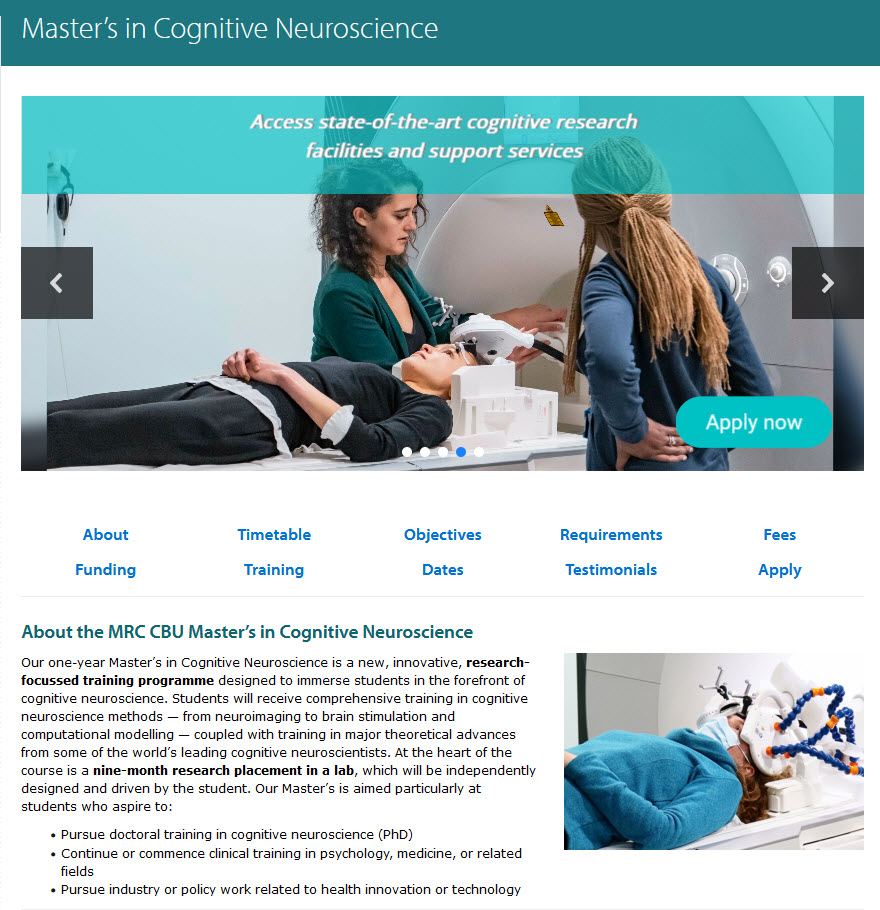
Applications now open to our Master’s in Cognitive Neuroscience, an innovative course combining cutting-edge teaching & deep research experience in a cognitive neuroscience lab https://t.co/USgnXYOmPy
Sign up to a webinar on 20th Sept to find out more – https://t.co/Y0WbmEBdos
How do we balance paying attention to the external world vs our internal thoughts?
The basal forebrain & dorsal attention network dynamically interact with the hippocampus to balance external and internal attention.
Super proud of @CraigPoskanzer! 😊
https://t.co/RRMUA5SwtH
Excited to share my new collaboration with Lukas Kunz (@lks_kunz ) in which we show that neurons in the human brain encode 2D positions in space....
an emotion space, that is, defined by valence and arousal!
And, they do it, dare I say, in a grid-like pattern?
Changes in theta, gamma, and beta synch during working memory. More evidence for beta as a top-down control signal. Groovy.
Task-specific oscillatory synchronization of prefrontal cortex, nucleus reuniens and hippocampus during working memory
https://t.co/Txahe9NsLD
Bats have beautiful rhythms! In a new preprint, @nschawor, @Talking_Bat and myself characterize and compare the waveform shape of delta and gamma oscillations in the bat auditory and frontal cortex. We found some cool things! 🧵 https://t.co/4VBmaBkHuw
Joel T. Martin et al develop 𝙋𝙮����𝙞𝙡𝙎𝙪𝙗 (https://t.co/m2T7hXsHi7) -- an open-source Python toolbox for silent substitution in photoreception research. https://t.co/8etTSKoHy7
A very important pre-print on the memory suppression technique, Think/No-Think, by Prof Anderson @Memory_Control and my mentor, Davide Nardo.
Everything You Ever Wanted to Know About the Think/No-Think task, But Forgot to Ask https://t.co/zHrudzdF8y via @OSFramework
Hi all!
🎓 I'm currently pursuing my MSc in Neural and Cognitive Sciences at the University of Hyderabad! As I continue my academic journey, I'm actively looking for guidance and support in preparing for PhD applications. #GradStudent#Neuroscience#PhDApplications
1/n
One more week to apply for the postdoc position @CambPsych and join my lab on a joint project with Emily Holmes and @rikhens - togetehr we will drill down and discover some secrets of emotional memory https://t.co/x65ZHxCzUV
How do you image the large and the small at the same time? We developed new 🔬 technology to image centimeter-scale specimens - including whole mouse brains 🧠 - with diffraction-limited resolution and without sectioning. #mesoscale#imaging
https://t.co/Kl7ZURNpdM
🧵 (1/n)
In our new paper at Cerebral Cortex, we find that the brain may connect related experiences by reactivating semantic knowledge in medial prefrontal cortex and integrating knowledge about both experiences in hippocampus. 🧵 https://t.co/W1Ceesfc6S @NealWMorton