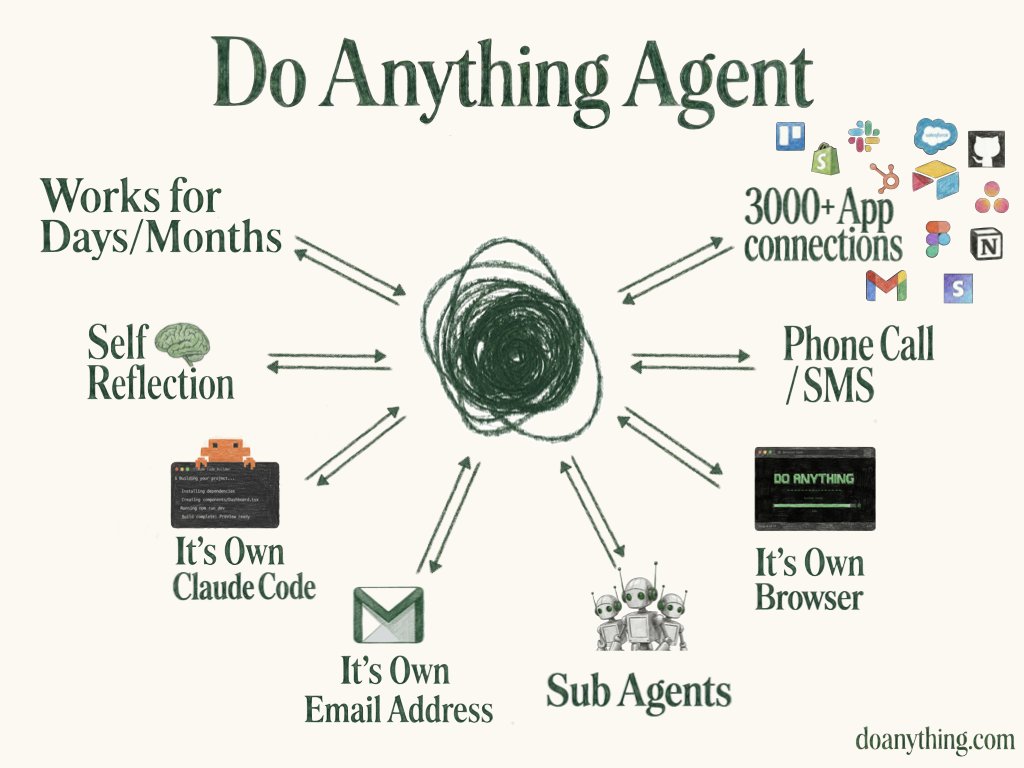
INTRODUCING: @doanythingapp
Do Anything Agents are a totally new kind of agent
They:
- work independently for weeks/months+
- have their own email
- self manage entire projects
- can use almost any tool on the web
Today the alpha opens to the public. Here's how they work:
There are always two ways to do something
1) quickly with no understanding (probably using AI tools now)
2) slowly but with deep understanding.
If you choose 1 more often than 2 over a long period of time, you will find yourself in a very miserable state at the end.
I wrote a 20,000 word Notion guide on what I would do differently as a founder if I were to start from scratch
Covers equity, fundraising, raising money, taxes, hiring & paying my team, running finance, selling secondaries & exiting
Comment or RT & I'll DM you a copy
A friend just raised money for a new company. At lunch, an older man told him: “The business is simple, and it’s simple enough that your biggest risk is getting caught up in all the nonsense you think you need to be doing to please your investors, but don’t actually matter.”
Things like this convince us that 100% of everything we believe about our environment/reality is a temporary lie. Sight, sound, object, matters, etc. have all been contextualized to us as babies by others. Actual reality is probably schizophrenic chaos.
NEW WHOOP RESEARCH: EARLIER BEDTIME, MORE EXERCISE
New Whoop research published in PNAS - the journal of the National Academy of Sciences - shows a clear, measurable link between sleep timing and next-day physical activity: going to bed earlier significantly increases your likelihood of exercising the following day.
This insight emerges from one of the largest behavioral datasets ever studied: nearly 6 million nights of sleep data from 20,000 WHOOP members, analyzed in collaboration with Monash University and Harvard University.
Key findings:
-Individuals with a typical 9 p.m. bedtime logged 30 more minutes of moderate-to-vigorous activity per day than those who habitually went to bed at 1 a.m.
-Even relative to average sleepers (11 p.m. bedtime), early sleepers exercised 15 minutes more each day.
-Crucially, simply going to bed earlier for a single night - without increasing total sleep - predicted greater physical activity the next day.
-Even with *less* total sleep, going to bed earlier still resulted in more likelihood to exercise.
These effects held independent of sleep duration. In other words: *when* you sleep might matter as much as *how much* you sleep. And even modest shifts in sleep timing can translate into meaningful behavioral change.
This research challenges the view that sleep and exercise are independent lifestyle variables. They are tightly coupled - and the directionality is clear: sleep timing can drive next-day movement. It’s a powerful lever for behavior change.
We’re incredibly proud that WHOOP data continues to advance the scientific understanding of human performance - and grateful to collaborate with leading researchers in the world. Congratulations to our SVP of Research, Algorithms, and Data, Emily Capodilupo, Monash University’s Josh Leota, PhD, and all of the other collaborators.
Now that the budget bill has passed Congress, we can see what the projections look like for deficits, government debt, and debt service expenses. In brief, the bill is expected to lead to spending of about $7 trillion a year with inflows of about $5 trillion a year, so the debt, which is now about 6x of the money taken in, 100 percent of GDP, and about $230,000 per American family, will rise over ten years to about 7.5x the money taken in, 130 percent of GDP, and $425,000 per family. That will increase interest and principal payments on the debt from about $10 trillion ($1 trillion in interest, $9 trillion in principal) to about $18 trillion (of which $2 trillion is interest payments), which will lead to either a big squeezing out (and cutting off) of spending and/or unimaginable tax increases, or a lot of printing and devaluing of money and pushing interest rates to unattractively low levels. This printing and devaluing is not good for those holding bonds as a storehold of wealth, and what’s bad for bonds and US credit markets is bad for everyone because the US Treasury market is the backbone of all capital markets, which are the backbones of our economic and social conditions. Unless this path is soon rectified to bring the budget deficit from roughly 7% of GDP to about 3% by making adjustments to spending, taxes, and interest rates, big, painful disruptions will likely occur.
on future of AI interfaces:
future interfaces flow like water — meeting people how they actually think, not how we assume they should
some of us think in bullet points, some in conversations, others need to see everything mapped out visually. the magic happens when the interface adapts to match your specific cognitive style instead of forcing everyone through the same chat box
imagine AI that knows you process complex info better as a timeline, or that you prefer quick back-and-forth over long explanations. it shifts between chat, canvas, tables, whatever actually works for how you think, but acting on the same ground truth
we're moving from “here's one single-purposefully built interface, deal with it” to interfaces that genuinely fit how minds and teams operate. not just understanding what you want, but how you want to receive and work with it
the breakthrough isn't more features — it's interfaces that feel invisible because they match your natural thought patterns perfectly — the ideal form of “it just works.” it grows from something simple and universal, into forms that capture the beautiful complexities of individual minds
rigid UIs assume everyone thinks the same way. adaptive interfaces recognize that great tools should bend to the user, not the other way around