The vast, featureless wastes of the Sahara Desert have shrunk by about 8% since the 1980s.
This astonishing recovery is due to rising CO₂ levels, fueling a remarkable global green renaissance. Data from NASA’s AVHRR and MODIS instruments show 25% to 50% of Earth's vegetated lands have become significantly greener—an area equivalent to twice the continental United States that has also spurred a global windfall for agricultural production.
CO₂ fertilisation has driven around 70% of this boom, making green plants far more efficient with water. By reducing the time stomata (leaf pores) stay open, it directly cuts water loss and boosts drought resistance.
This unplanned green miracle has allowed vegetation to reclaim zones of great emptiness in inhospitable places like the Sahel (the Sahara's southern fringe), the Middle East and Australia's sunburned outback desert. It has reclaimed over 700,000 km2 of barren sand waste in the Sahara alone, pushing back the desert in formerly barren terrain.
Atmospheric CO₂ now hovers around 426 ppm, enabling plants to thrive where once they couldn't. This protracted greening shows the clear, measurable benefit from higher levels of CO₂.
🧵New Orleans just proved failing schools can be fixed at scale.
It became America’s first all-charter school district.
The results are staggering:
• 99th percentile nationally in reading growth
• 98th percentile in math growth
• The only state in America beating pre-pandemic levels in both subjects
This is what real reform looks like. THREAD 🧵
Milton Friedman: “Keep your eye on one thing and one thing only: how much government is spending, because that’s the true tax.”
“If you’re not paying for it in the form of explicit taxes, you’re paying for it indirectly in the form of inflation or borrowing.”
Jordan Peterson went straight to the point:
“I’m not a fan of collectivists. I don’t care if they’re on the left or the right. The right level of analysis is the individual, and that’s what the West got right.”
He called out Marxists, group-first identity politics, and professors turning impressionable 18-year-olds into activists before they’re properly educated.
Building a society that truly respects the individual is one of the hardest things humans have ever tried. It requires constant vigilance. Collectivism always comes back wearing new clothes, as justice, community, equity, or compassion.
“The smallest minority on earth is the individual. Those who deny individual rights cannot claim to be defenders of minorities.” - Ayn Rand
The 19th century was history's greatest experiment in minimal government and maximal human flourishing. You had a federal budget that consumed roughly 3% of GDP, zero income tax until 1913, and a monetary system anchored to gold. The results speak louder than any economic theory: America transformed from an agricultural backwater into the world's industrial powerhouse in less than a century.
Consider the numbers. Real wages doubled between 1860 and 1890. Railroad mileage exploded from 30,000 miles in 1860 to 164,000 miles by 1890. Steel production jumped from 77,000 tons in 1870 to over 4 million tons by 1890. No central planning committee orchestrated this transformation. No industrial policy czar allocated resources. Entrepreneurs risked their own capital, succeeded or failed on their own merits, and consumers voted with their wallets.
The government's role was enforcing contracts and protecting property rights. No antitrust lawsuits against successful companies. No bailouts for failed ventures. No regulatory agencies strangling innovation in its cradle. When Jay Gould built his railroad empire, he answered to bondholders and customers, not bureaucrats. When Andrew Carnegie revolutionized steel production, the market rewarded efficiency and punished waste.
Critics love to mention the "robber barons" while ignoring that these men drove down prices and improved quality through relentless competition. Standard Oil reduced kerosene prices by 90% between 1870 and 1897. Carnegie slashed steel prices so dramatically that skyscrapers became economically viable. They got rich by making everyone else better off.
Today's economists worship GDP growth rates of 3% as miraculous achievements. Nineteenth-century America routinely posted growth rates above 4% with no stimulus packages, quantitative easing, or industrial policy. They had economic freedom and sound money.
Climate has been weaponized to drive a global agenda—orchestrated by the United Nations and backed by a projected $147 trillion in forced structural reinvestment (McKinsey Global, 2022).
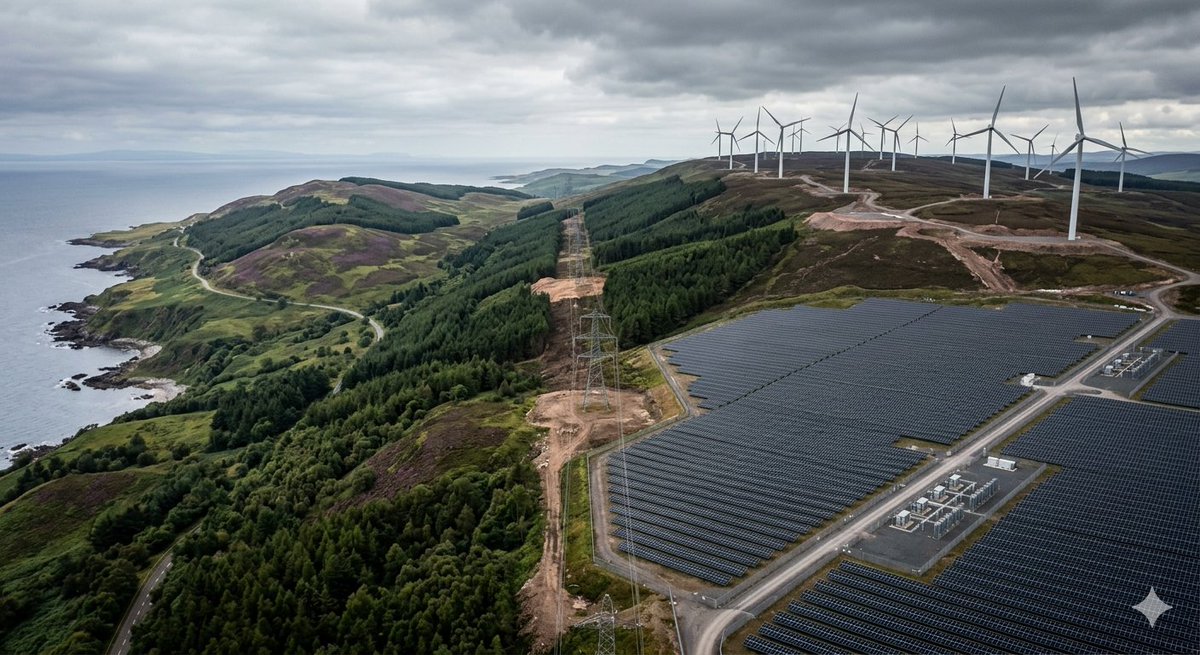
The physical reality of this shift involves up to 1.3 million wind turbines and eight billion solar panels (so far). They are darkening our most iconic land and seascapes, blighting rural farmlands, and cutting massive corridors through pristine native forests.
By definition, climate is simply the study of regional weather patterns over a standard 30-year period. Over time, however, it has transformed into a convenient metaphor for a broader ideological struggle. The underlying reality is that no one can accurately predict a climate crisis decades into the future, when meteorologists struggle with a three-day forecast. Yet, a computer-model 'scenario' has been elevated into the defining crisis of our time.
The evidence for this doomsday narrative is threadbare. While global temperatures have risen by roughly 1.4 degrees since the dawn of the Industrial Revolution in 1769 - when the world’s population was just one billion - that modest warming has already occurred, and humanity has thrived alongside it.
Even the IPCC has quietly backed away from its extreme five-degree doomsday scenarios. To claim a degree or two represents an existential threat ignores human history; we are an adaptable species that thrives from the equator to the Arctic. Yet this erratic metric now underpins a multi-decade campaign that is actively dismantling Western economies.
The consequences are no longer theoretical. The real-world cost is arriving daily—leaving Western society to face its highest electricity prices in history.
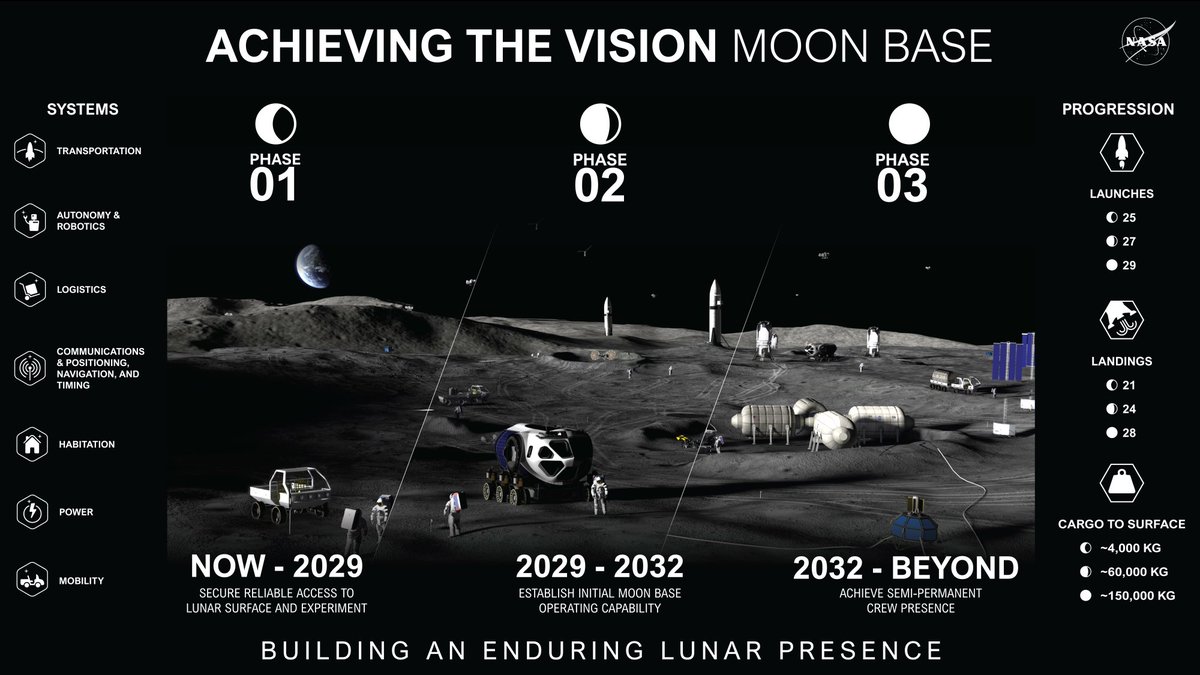
NASA just officially unveiled their master plan for a permanent Moon Base at the lunar South Pole
This is not just about flags and footprints. NASA is moving to establish an enduring, sustained human presence, and they are heavily relying on commercial innovators to build it
The roadmap is highly aggressive:
• Phase 1: Heavy robotic missions and commercial payload deliveries
• Phase 2: Semi-permanent infrastructure, including fission surface power and lunar drones
• Phase 3: A sustained, permanent human outpost
The most important takeaway is NASA explicitly stated this base is the ultimate proving ground to prepare humanity for missions to Mars
While legacy aerospace companies are still struggling to reliably get a small capsule to the ISS, NASA is setting the stage for massive lunar infrastructure....which is exactly the kind of heavy-lift planetary deployment SpaceX’s Starship was designed for
The multi-planetary economy is officially kicking off
Another liftoff angle for 'Viva La StriX' and @synspective on Electron launch #88.
That's 9 launches with 100% mission success completed for Synspective and another 18 more to go before 2030.
Nine years ago today, we launched Electron for the first time.
Later this year, Electron is expected to reach 100 launches, likely making it the fastest privately developed orbital rocket to hit that milestone.
From “It’s a test” to one of the world’s highest cadence launch vehicles in under a decade.
Here's a little walk down memory lane from that first historic launch.
Roadways cut into the pristine Amazon rainforest are leading to a slaughterhouse of animal life every year on an unimaginable scale.
A total of 475 million animals die on the roads each year in Brazil alone. Brazilian territory contains roughly 60% of the entire iconic rainforest, with the remainder shared among eight other nations, led by Peru (13%) and Colombia (10%). The scale of these deaths across South American transit routes is staggering.
The figure for Brazil breaks down to roughly 15 wild animals killed every second - about 1.3 million every day across a 1.7 million kilometre road network. This isn't a blind guess; the Brazilian Center for Studies in Road Ecology calculated it by analysing over a dozen regional field studies, adjusting for road types, local biodiversity, and traffic density. It remains the definitive peer-reviewed benchmark for transport ecology in the region.
The Amazon is the most iconic, threatened natural environment on Earth, rivaling coral reefs as a biological wonderland. Yet, it is steadily being fragmented by expanding human activity.
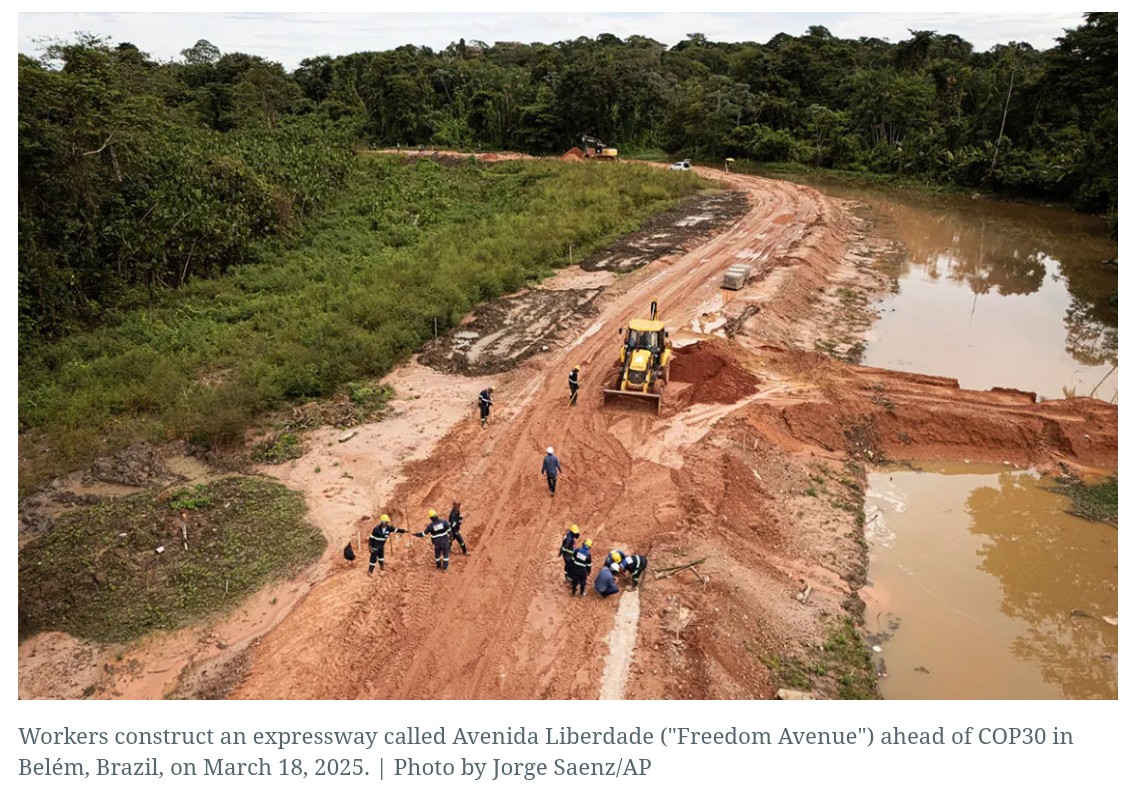
This clash between environmentalism and reality came to a head in the lead-up to the UN's COP30 climate summit in Belém. To facilitate road access to the event, a 13.4-kilometer highway project - originally shelved due to environmental concerns - was fast-tracked. Named the Avenue of Liberty, it gouged a deep scar directly through the protected Belém Environmental Protection Area.
Around 50,000 delegates descended on Belém for the summit, an influx into a vulnerable rainforest borderland. Under the banner of summit preparation, images showed mud-caked excavators demolishing native canopy. Rather than a grand highway, the Avenue of Liberty became a raw causeway of lifeless red dirt bulldozed through the dense green jungle, opening fresh pathways for illegal loggers, cattle ranchers and drug cartels.
The biological toll of these corridors is devastating. Small vertebrates - amphibians, reptiles, and rodents - make up 90% (430 million) of the annual casualties, flattened or scavenged before casual drivers notice them. Medium-sized animals like opossums, monkeys, and hawks account for 9% (40 million).
The final 1% represents a severe conservation crisis: 5 million large vertebrates, including threatened icons like the giant anteater, the maned wolf, and the lowland tapir (which can weigh up to 250 kg, causing fatal collisions for drivers as well).
Worse still, biologists consider 475 million a conservative estimate. It counts only the carcasses left visible on paved surfaces. It entirely misses the animals that crawl into the brush to die, the tiny creatures pulverized instantly under heavy truck tires, and the thousands of miles of informal logging tracks cutting deep into the interior where data collection simply does not exist.