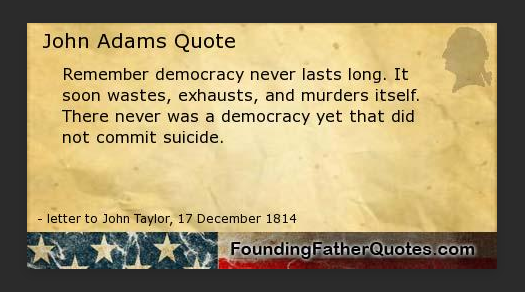
Once you turn a (limited constitutional) republic into a de facto democracy (of unlimited majority rule), which was long ago accomplished by terrible SCOTUS decisions, it's only a matter of time before democratic disaster occurs.
America can either roll back those decisions and return to a strictly limited federal government, or it will inevitably collapse into ruin.
America's founders deliberately did not create a democracy - because they despised democracies.
You seem like a fairly bright fellow, but you keep insisting, by implication, that the phrase "in name only" doesn't mean what it means. Perhaps I can help you with that.
Allowing property to be owned "in name only" means it's not really private property.
You're welcome.
Also, I refer you to my last reply; you apparently failed to understand it the first time.
Is fascism a kind of socialism? I think it is.
Fascism is a nationalistic form of socialism (i.e., anti-capitalism) in which the means of production (e.g., land, banks, mines, factories) are controlled via totalizing state regulation rather than by outright confiscation, as is the case in Marxist socialism, also known as communism.
German fascism (i.e., National Socialism) had a vicious racial component that was missing from (the socialist) Mussolini's Italian fascism - the original fascism - but other than that it was economically the same: authoritarian control over the means of production aiming to curb the unlimited use of profits for the enrichment of capitalists at the expense of the workers. (National Socialist German Workers Party was the official name of the Nazi Party.)
In short, fascism and communism are differing forms of anti-capitalism (i.e., anti-liberty, anti-rights, anti-individualism) the central theme of Marxism/Communism (i.e., Collectivism).
At the time, white male landholders are the people most likely to be educated, preventing rule by the dull and illiterate. Like Aristotle said, the difference between the educated and the uneducated is like the difference between the living and the dead.
And yes, it is of vital importance which rights are recognized by a government and to whom they apply and in what contexts, but that doesn't mean rights or their application are arbitrary, i.e., non-objective, it means men are fallible.
@brainprojector@Salem_GeorgeJ I can simplify for you.
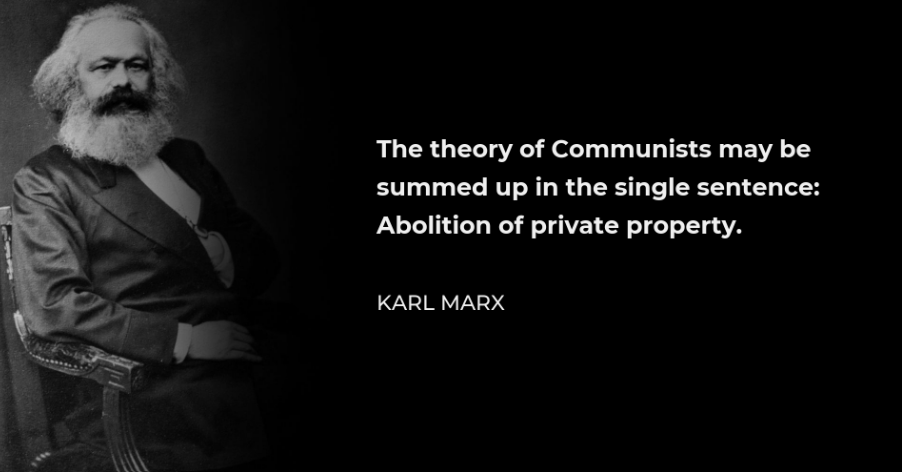
The single most important defining feature of socialism is the denial of private property rights.
Fascism does that de facto. Communism/socialism does that de jure.
One of the biggest "big lies" of all time is that fascism is pro-capitalism.
It. Is. Not.
Fascism is a form of anti-capitalism in which the State, as the overseer of the nation, totally controls the means of production for the benefit, supposedly, of the workers that were formerly exploited by capitalists.
When you hear, "Strength through unity," you're probably near a fascist at heart.
Left-right political spectrums that place tyrannies at each end are logical silliness, and I'm all but convinced that they survived only because left-collectivists want people to think that their only political alternatives are one or another form of tyranny OR a blend of tyranny that falls somewhere between the extremes.
Yes, I do endeavor to independently apply a set of objectively derived, hierarchical principles that I hold to be true to my evaluations of the facts of reality thus my answers tend to be highly compatible with them, hence the consistency you detect in my replies. Thanks for noticing. 😉
Correct definitions are conducive to cognitive efficacy and detrimental to it when erroneous, whether someone "gives a flying fuck about non-essentials" or not. Just sayin'.
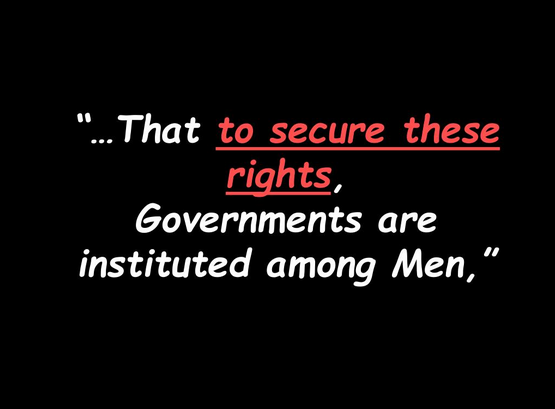
Government has all the power necessary to protect rights. Rights are universal, that is, they apply to everyone equally. The power statists want is to bestow special rights on members of certain groups by denying rights to members of other groups. For example, the Civil Rights Act violates the right of freedom of association, which entails the right to not associate with others for whatever reason, good or bad.
Desegregation was a necessary correction of the error made by government in allowing segregation in state-sponsored education, and would have been unconstitutional if imposed on private-sector educators. Government is rightly prohibited from discriminating based on race because rights are the possession of individuals, not groups. By contrast, private citizens have the right to discriminate (i.e., the right to associate or not associate), be they right or wrong in their judgments; the Constitution is a limitation on government, not on private citizens, especially on their own property.
Racism is an abominable practice, but refusing to associate with other people does not violate their rights. Clearly, no one has a right to force other people to associate with them, and a law requiring them to do so is clearly a violation of rights. The ends do not justify the coercive, compulsive, individual rights-violating means, and all arguments to the contrary must clear that moral/ethical hurdle out of the gate.
What makes a political system "socialist" is it places the society (the group, community, collective, nation, etc.) above the individual in moral concern and importance. The individual serves the group and the Collective may dispose of individual members as it sees fit - for the greater good of the Collective. The rights of the Collective supersede the rights of the individual - the smallest minority of all.
What makes a political system "free" is it places the rights of the individual above the rights of the group, collective, or democratic majority. The rights of the individual supersede the rights of the Collective.
The "dominant motive or goal" of capitalists is to profit by producing and trading goods or services that people desire and can afford. If they don't, they don't survive; most startup businesses fail rather quickly, by the way.
Like all people, including you, capitalists don't want to pay more for goods and services than they have to, properly so. Since labor is a service, capitalists naturally (again, like everybody else) and properly want to pay as little as possible for labor services; this keeps the prices of goods affordable and profits achieveable.
The price of labor services is set by the market for labor, not by the capitalist employer, much like the price people pay for an auto mechanic's labor is set by the market, not by the mechanic. There is no exploitation occurring and no one is being immoral for wanting to pay as little as possible for things generally, including for labor services by employers. All arguments to the contrary are motivated by envy and greed, not by reason or justice. And they are fueled by economic ignorance.
Capitalism is the socioeconomic corollary of classical individual rights-based liberalism, in which government has a monopoly not on "violence" but on the retaliatory use of force (violent force only if necessary to combat its initiation) against rights violators, also known as criminals. Said monopoly is necessary for an objective enforcement of law and administration of justice. Inalienable rights serve (in theory) as a barrier which simple democratic majorities or pluralities may not cross.
Socialism's outright rejection of private property and individual rights (thus private fortunes) is merely a sophist's ploy to make outright criminality seem like (social) justice and government appear as the private police service of the capitalist class. It's complete horse hockey; a castle in the clouds of arid minds.
@pauliebeats183@Salem_GeorgeJ The Trading with the Enemy Act was a WW1-era law that went into effect when war was declared against Germany in 1941. What is your point?
@pauliebeats183@Salem_GeorgeJ Norway is what happens when your country is small, per-capita rich in oil (which will soon enough become obsolete), culturally homogeneous, and subscribes to the moral code of altruism. Suicide and alcoholism are also big problems there, I'm told.
@pauliebeats183@Salem_GeorgeJ I'm an Objectivist, not a libertarian.
The mind is the most vital factor of production. Machines are the frozen form of living intelligences.
All production is applied intelligence - not applied muscle - and the mind is the root of all material progress.