🚨 A junior at Jane Street reportedly landed a $220K–$600K role because he used AI to analyze trillions of data points faster than most teams ever could.
In this 1-hour lecture, he breaks down the exact system behind it:
• how he researches massive datasets
• how AI finds patterns humans miss
• how his machine turns raw data into decisions
• how you can apply the same thinking yourself
Skip Netflix tonight.
Watch this instead.
One hour could completely change how you think about research, AI, and opportunity.
It was around 6pm, 13h from the ddl of submission. I tried to construct a brand new idea by message back and forth with AI.
I have to say AI isn't so bad as I thought. They can't think at all but they can help organize my thought, and finish the "dirty thinking process".
I had to do smth. I couldn't miss it.
I started to promote myself stupidly in the build game tg group chat. It wasn't smart cuz I'm actually picky when it comes to product ideas. And I don't like to rely on others but rather start my own project instead. So I start to think.
Throwback to 16th
It was so exciting to meet the founders @DogecoinZack@DavidThaDegen of our UW Blockchain Society on a casual event on the 0th🤪 day with @Mark_Nakatani
It was also amazing that they @GenzioCo is carrying the marketting of @EthereumDenver! Let's go dawgs!
How I think about "security":
The goal is to minimize the divergence between the user's intent, and the actual behavior of the system.
"User experience" can also be defined in this way. Thus, "user experience" and "security" are thus not separate fields. However, "security" focuses on tail risk situations (where downside of divergence is large), and specifically tail risk situations that come about as a result of adversarial behavior.
One thing that becomes immediately obvious from the above definition, is that "perfect security" is impossible. Not because machines are "flawed", or even because humans designing the machines are "flawed", but because "the user's intent" is fundamentally an extremely complex object that the user themselves does not have easy access to.
Suppose the user's intent is "I want to send 1 ETH to Bob". But "Bob" is itself a complicated meatspace entity that cannot be easily mathematically defined. You could "represent" Bob with some public key or hash, but then the possibility that the public key or hash is not actually Bob becomes part of the threat model. The possibility that there is a contentious hard fork, and so the question of which chain represents "ETH" is subjective. In reality, the user has a well-formed picture about these topics, which gets summarized by the umbrella term "common sense", but these things are not easily mathematically defined.
Once you get into more complicated user goals - take, for example, the goal of "preserving the user's privacy" - it becomes even more complicated. Many people intuitively think that encrypting messages is enough, but the reality is that the metadata pattern of who talks to whom, and the timing pattern between messages, etc, can leak a huge amount of information. What is a "trivial" privacy loss, versus a "catastrophic" loss?
If you're familiar with early Yudkowskian thinking about AI safety, and how simply specifying goals robustly is one of the hardest parts of the problem, you will recognize that this is the same problem.
Now, what do "good security solutions" look like?
This applies for:
* Ethereum wallets
* Operating systems
* Formal verification of smart contracts or clients or any computer programs
* Hardware
* ...
The fundamental constraint is: anything that the user can input into the system is fundamentally far too low-complexity to fully encode their intent. I would argue that the common trait of a good solution is: the user is specifying their intention in multiple, overlapping ways, and the system only acts when these specifications are aligned with each other.
Examples:
* Type systems in programming: the programmer first specifies *what the program does* (the code itself), but then also specifies *what "shape" each data structure has at every step of the computation*. If the two diverge, the program fails to compile.
* Formal verification: the programmer specifies what the program does (the code itself), and then also specifies mathematical properties that the program satisfies
* Transaction simulations: the user specifies first what action they want to take, and then clicks "OK" or "Cancel" after seeing a simulation of the onchain consequences of that action
* Post-assertions in transactions: the transaction specifies both the action and its expected effects, and both have to match for the transaction to take effect
* Multisig / social recovery: the user specifies multiple keys that represent their authority
* Spending limits, new-address confirmations, etc: the user specifies first what action they want to take, and then, if that action is "unusual" or "high-risk" in some sense, the user has to re-specify "yes, I know I am doing something unusual / high-risk"
In all cases, the pattern is the same: there is no perfection, there is only risk reduction through redundancy. And you want the different redundant specifications to "approach the user's intent" from different "angles": eg. action, and expected consequences, expected level of significance, economic bound on downside, etc
This way of thinking also hints at the right way to use LLMs. LLMs done right are themselves a simulation of intent. A generic LLM is (among other things) like a "shadow" of the concept of human common sense. A user-fine-tuned LLM is like a "shadow" of that user themselves, and can identify in a more fine-grained way what is normal vs unusual.
LLMs should under no circumstances be relied on as a sole determiner of intent. But they are one "angle" from which a user's intent can be approximated. It's an angle very different from traditional, explicit, ways of encoding intent, and that difference itself maximizes the likelihood that the redundancy will prove useful.
One other corollary is that "security" does NOT mean "make the user do more clicks for everything". Rather, security should mean: it should be easy (if not automated) to do low-risk things, and hard to do dangerous things. Getting this balance right is the challenge.
What a session! 👏
We loved having @wangandy and the @worldnetwork team join us for a deep dive yesterday. It was inspiring to hear how they are approaching utility and building for the future.
Thanks to everyone who came out! 🌐
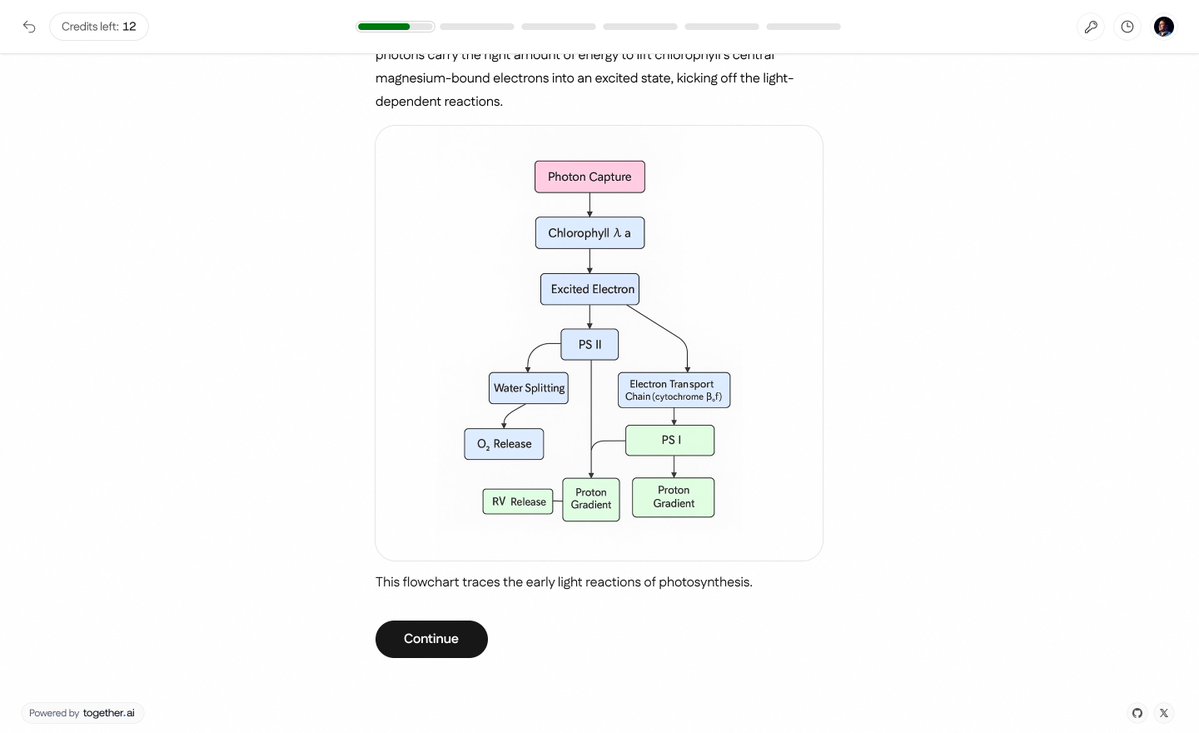
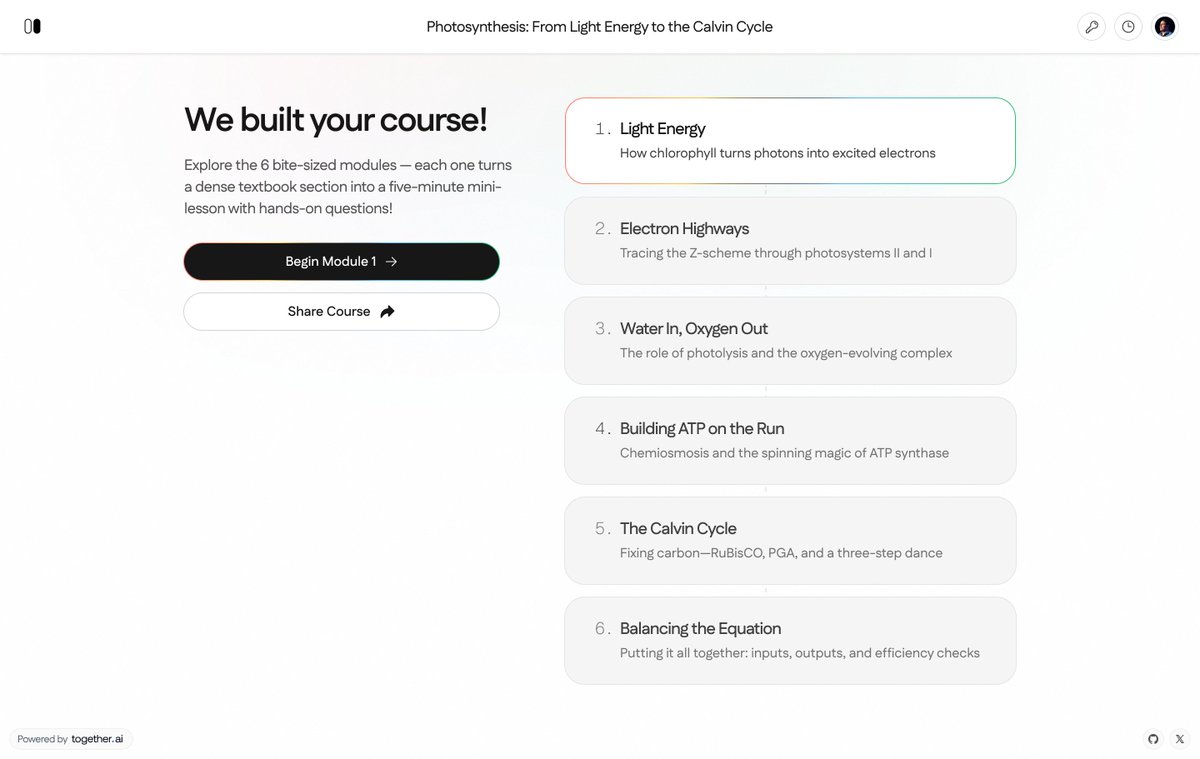
Building an agent that can generate an entire interactive course from a PDF/textbook 🤯
The way it works: I have pre-built components (Q&A, drag & match, flowchart, info bubble, ect...) that can be invoked through tool calls.
Here's the full workflow:
1. The agent will first parse the material passed in (can either remain in context if small or be embedded if big)
2. Agent will then decide on a good structure for the lesson (will be given a few good examples for reference)
3. Through tool calling, it will be able to select the right components now that it has a lesson structure. It will also pass in the relevant params to the components (like generated questions or content for a flowchart).
4. The finished lesson gets handed off to a Lesson Reviewer agent for a final check against source material
5. Lesson gets created & is able to be sent to others
This app will be built with open source LLMs from @togethercompute and will be free & open source!
I think this will turn out to be one of my most interesting apps. Let me know if y'all want to see a guide on how I built it as well!
What the fuck just happened 🤯
Stanford just made fine-tuning irrelevant with a single paper.
It’s called Agentic Context Engineering (ACE) and it proves you can make models smarter without touching a single weight.
Instead of retraining, ACE evolves the context itself.
The model writes, reflects, and rewrites its own prompt over and over until it becomes a self-improving system.
Think of it like the model keeping a living notebook.
Every failure becomes a lesson. Every success becomes a rule.
And the results are absurd:
+10.6% better than GPT-4–powered agents on AppWorld
+8.6% on financial reasoning
86.9% lower cost and latency
No labels. Just feedback.
Everyone’s obsessed with “short, clean” prompts.
ACE flips that. It builds dense, evolving playbooks that compound over time and never forget.
Because LLMs don’t crave simplicity.
They crave context density.
If this scales, the next generation of AI won’t be fine-tuned.
It’ll be self-tuned.
We’re entering the era of living prompts.