The "Europoor" meme is what happens when you let GDP/capita do the thinking for you.
Europeans aren't poor. They're just not interested in the trade.
I cover the companies the world's wealthy actually buy from.
They're nearly all European.
Draw your own conclusions.
I just asked Gemini 3.0 to analyze the $GOOG vs $NVDA dynamic. Read this. I could be generational wealth changing.
Everyone is comparing Gemini 3.0 vs GPT-5.1 on benchmarks. You're watching the wrong scoreboard.
The real war isn't about who is smarter. It's about who creates the "Prisoner's Dilemma" that kills Nvidia's 75% margins.
I spent the morning mapping this out like a Cold War game theory scenario. Here is the board. 👇
1/ Right now, Nvidia is the "Arms Merchant." They sell the H100s. Everyone pays the tax.
Their entire stock price assumes they keep ~75% margins forever.
But Google just made a move that changes the physics of the board. They aren't trying to sell chips. They're trying to make chips irrelevant.
2/ The setup is simple:
Nvidia makes money by keeping hardware expensive (High Margin). Google makes money on ads/services, so they want compute to be free (High Volume).
These goals are incompatible. In Game Theory, this is a "Structural Conflict."
3/ For years, Nvidia had a "Hold-Up" on the industry.
You want to do AI? You pay the Nvidia tax because CUDA is the only software that works.
It was a monopoly based on fear: "Switching to another chip is too risky. What if the code breaks?"
4/ Enter Gemini 3.0.
Google trained it on TPUs. They run it on TPUs. They don't pay the Nvidia tax.
This means their internal cost-per-token is structurally ~50% lower than OpenAI's (who has to pay Microsoft, who has to pay Nvidia).
5/ (This is the part that clicked for me)
Google creates a "Price Ceiling."
If Google sells intelligence for $1, OpenAI can’t sell it for $2 just because they use expensive Nvidia chips.
OpenAI must match the price to survive. But they can't. Not while paying Nvidia's margin.
6/ This traps Nvidia’s best customers in a corner.
To match Google’s prices, Microsoft and OpenAI are forced to build their own chips (Maia) to stop paying Nvidia.
Nvidia’s own pricing power is exactly what is incentivizing its customers to destroy it.
7/ So where does the equilibrium settle? I ran the scenarios. It leads to a split.
Zone A: Discovery (Nvidia Wins)Researchers still use Nvidia because speed matters more than cost.
Zone B: Utility (Google Wins)Once a model works, you run it on cheap custom chips.
8/ You can see the strategies shifting in real-time right now:
Google: Aggressive subsidies ($350k credits) to get startups to rewrite their code off CUDA.
Nvidia: Bundling software (NIMs) to make leaving impossible.
It's classic "Free Drugs" vs "Golden Handcuffs."
9/ If you are building in AI, here is the "Tripwire" to watch.
Ignore the benchmarks. Watch the Token Price.
If GPT-5 class pricing drops below $2.00/1M tokens, the "Nvidia Tax" is mathematically dead. The market is fleeing to custom silicon.
10/ The one question to ask your CTO tomorrow:
"If we had to switch from Nvidia GPUs to Google TPUs or AWS chips tomorrow, would it take us 1 week or 6 months?"
If the answer is 6 months, you are the "sucker" at the table paying the tax.
11/ The takeaway:
In a gold rush, it's usually good to sell shovels.
Unless your biggest customer decides to invent a steam shovel just to stop paying you.
Game on.
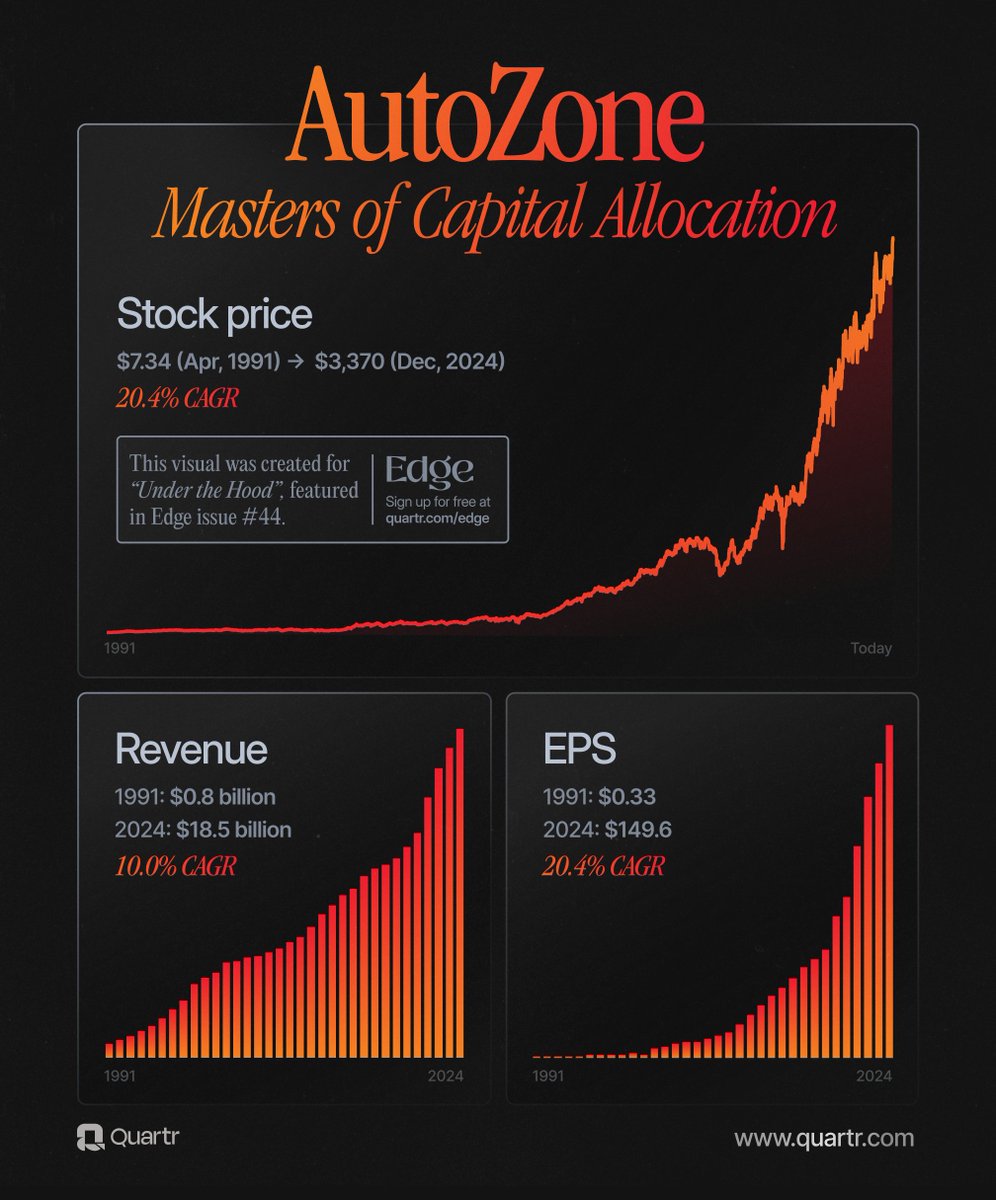
AutoZone exemplifies retail excellence and masterful capital allocation.
Since its IPO in 1991, $AZO has achieved a remarkable financial development:
→ 10% Revenue CAGR
→ 20% EPS CAGR
→ 20% Stock Price CAGR