We built Hermit 🐚 to make RSI and CL more comparable, verifiable, and shareable.
For researchers: Most RSI and CL work follows the same loop: the agent acts, gets feedback, and updates itself. But each research ships its own benchmark setup and its own evolver, which makes results hard to compare. Hermit puts them behind one interface, so you can swap the evolver while keeping the tasks, judge, and evaluation fixed.
For users: Pick a state-of-the-art evolver, point it at your task, and let it improve your agent from feedback automatically.
Github:https://t.co/3BcLSUdqXX
More in our blog post 👇
#HarnessEvolution #ContinualLearning #RSI #Agent
AI is hitting two walls at once: power and memory.
Voters just pushed back on new data centers over power bills, and HBM and DRAM are in short supply.
Our question: can coding agents make the models themselves smaller?
Introducing CompressionBench 🧵
https://t.co/SHN8KOTP5d
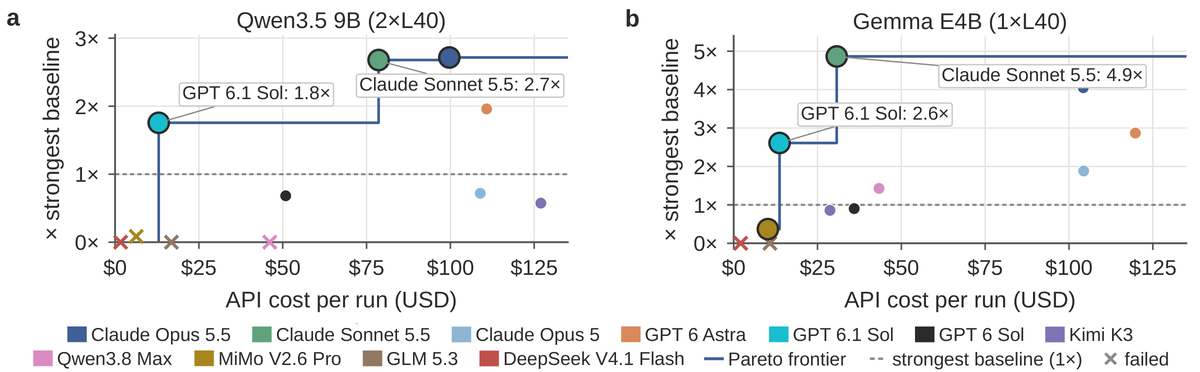
New AI data centers are now a fight over power and memory. The cheapest capacity: more from the GPUs we have.
We asked coding agents to build LLM servers from scratch. The best served up to 4.9× the value per GPU dollar of vLLM/SGLang.
ServerBench 🧵
https://t.co/WPPw3uExz1
Congrats on the release of Hermit v0.2.0! Happy to see more amazing open-source projects advancing harness evolution, and excited to see our Harness² included! @InfiniAILab
We developed Harness² to explore how agents can improve their own harnesses, then use that experience to become better at making future improvements.
You can now run Harness² through Hermit! Thanks to the team for making our work more accessible and bringing different harness evolution methods together for the community to explore. 💐
📄: https://t.co/B7pq2jAtzh
💻: https://t.co/zjNg7gSReD
Huge congrats on the Hermit release by @haizhong_zheng, @BeidiChen@InfiniAILab! 🐚 Building a unified, plug-and-play adapter framework for harness evolution is exactly what the agent RSI community needs right now.
😄 Super excited to see our RRSI during my internship at
@Google integrated right out of the box! You can now run RRSI in Hermit to evolve transferable adapters across tasks like OfficeQA and CL-Bench, and seamlessly deploy them to Claude Code / Codex without changing a single line of the base harness.
Most RSI methods drop off hard when shifting to OOD settings, so seeing RRSI generalize and perform so strongly across different frameworks and harnesses is awesome. 👇
📄 Paper: https://t.co/BDZkHOMPTC
💻 Code: https://t.co/Vc5xbckY79
🌐 Project: https://t.co/KTSsGF3jHJ
Check out the new version of Hermit (v0.2.0)! Now we support 12 harness evolution algorithms, and you can evolve your harness directly with your coding plan.
Super excited that our EvoSafeHarness (https://t.co/YgggNWoiqb) is now integrated into Hermit v0.2.0! 🐚🦀
EvoSafeHarness automatically evolves model- and domain-specific safety harnesses (natural-language policy + executable enforcement logic) around a frozen LLM agent, delivering a much stronger safety-utility trade-off than fixed expert defenses.
The real power of this integration:
Hermit’s harness-adapter design lets EvoSafeHarness plug into the complex, production-grade harnesses people actually use every day (Codex, Claude Code, and similar agent runtimes) without touching the original harness or model. Safety evolution can now run on top of real-world agent stacks instead of being limited to research prototypes.
Let’s keep making agent safety evolvable 🚀
What We Hope Hermit Brings to RSI🐚
1. Think of adapters as plugins. 🔌
2. RSI should be for everyone to use and share. 🧬
We wish everyone to benefit from RSI and participate in the process, so we build trainable, adaptive, and transferable adapters to help harnesses such as Codex, Claude Code, DSH, and Pi evolve. Train an adapter, then share it with a friend! 🤝
3. Training with RSI should be easy. 🛠️
Hermit lets you train a lightweight adapter without modifying the underlying harness, and you can use your coding plan to train it on your own tasks and harness.
4. We believe the gap between evolving a harness and evolving an adapter will eventually disappear. 🔄
For methods like Meta-Harness, RRSI, and AHE, which originally required modifying the underlying harness, we’ve developed adapter-based versions that bring their evolution capabilities to Codex and Claude Code (with comparable performance on the benchmarks we’ve tested so far)
5. More algorithms, more benchmarks, more progress. 🔬
We’ll be quickly adding more harness-level RSI algorithms and benchmarks to help you improve your agents and work more efficiently. Stay Tuned!!
Finally, we hope you enjoy Hermit! Let us know what you need and what we can improve. 🐚💬
What if foundation model systems could continuously learn and improve on their own, without relying on human experts or stronger models?
Recursa is a step toward building self-improving foundation model systems. It builds and continuously evolves a knowledge repository by acquiring knowledge from domain-specific data corpora and learning from its own experience during task execution.
On held-out test tasks from @harvey Harvey LAB’s Firm Knowledge benchmark, Recursa improves the all-pass rate from 30% to 55% with DeepSeek-V4.1-Flash and from 35% to 46% with Qwen3.8-Flash.
We see this as just the beginning. Looking ahead, we’re interested in closing the self-improvement loop through training and extending this approach to a broader range of challenging domains, including science. Our long-term vision is to build foundation model systems that continuously learn and improve on their own.
Paper: https://t.co/7FpwtF24yo
It's time to DIY your own harness, and plugins are the perfect way!
Excited to see DeepSeek just released Creator Mode, and plugin creation is now built into DSH.
However, an open question remains: 𝐜𝐚𝐧 𝐚𝐠𝐞𝐧𝐭𝐬 𝐚𝐮𝐭𝐨𝐦𝐚𝐭𝐢𝐜𝐚𝐥𝐥𝐲 𝐝𝐢𝐬𝐜𝐨𝐯𝐞𝐫 𝐰𝐡𝐚𝐭 𝐩𝐥𝐮𝐠𝐢𝐧𝐬 𝐭𝐨 𝐛𝐮𝐢𝐥𝐝 𝐨𝐫 𝐢𝐦𝐩𝐫𝐨𝐯𝐞 𝐟𝐫𝐨𝐦 𝐫𝐞𝐚𝐥-𝐰𝐨𝐫𝐥𝐝 𝐬𝐞𝐫𝐯𝐢𝐧𝐠 𝐝𝐚𝐭𝐚 𝐚𝐧𝐝 𝐟𝐞𝐞𝐝𝐛𝐚𝐜𝐤?
That's why we built Hermit: a unified framework for harness evolution algorithms on trainable plugins (harness adapters).
Check more here: https://t.co/4wM93EnnsN
“Won’t OAI/Anthropic do that next year?”
I hear this a lot when discussing research. Apparently, the literature review now includes next year’s release notes 😅
That’s why the recent neolab releases have been such a morale boost. It’s exciting to see focused teams and fresh ideas go far with *comparatively* small resources.
Academic labs can be smart about where we contribute, too: challenge an assumption, find an overlooked bottleneck, make an expensive approach practical. Choosing the right question is itself part of the innovation.
Rooting for all my neolab friends. The world would be far too boring if we already knew where every breakthrough would come from. 🚀
To move toward RSI, they built a trainable adapter for agents. Instead of changing the model or rewriting the whole system, you just plug this adapter into an existing agent. It learns skills, tool use, and memory from real tasks, so the agent keeps improving while the original model stays fixed.
Great work!
One thing I love the most in Hermit is the abstraction of the harness adapter. Here we freeze the underlying model + agent harness and make an external adapter the learnable object (like learning the residual/delta) .
This clean separation makes harness evolution much easier to implement and deploy. The learned delta can be versioned, evaluated, and transferred independently, while different evolution algorithms can operate through the same adapter interface without modifying the original agent stack.
Excited to integrate Hermit into Reef’s training backend for harness evolution!
Hermit is a very clean, all-in-one adapter for harness evolution. We’re also working on integrating it as an option for reef’s harness evolution. Stay tuned!