1)
While broader crypto is in shambles, Maker continues to grow its position as the biggest in DeFi
Everyone else shitcoin'd and ponzi'd. Maker built stuff that works & in the last month Dai grew by 400m
Next up is SubDAOs and they will be a gamechanger for growth in crypto
Bailout is obviously good for everyone affected and more broadly for DeFi.
But all the same problems remain. Aave v3 is still a complete mess of a lending protocol and needs major surgery.
It was ludicrous it was marketed as a risk free rate.
Isolated markets for the win.
What's possibly a little worrisome is that redemption gates are being hit across the board for private credit funds, while these same private credit funds are becoming the darling of DeFi's RWA narrative.
Blackrock's HLEND
➢ 5% met, 9% requested
Cliffwater's CCLFX
➢ 7% met, 14% requested
Apollo's ADS
➢ 5% met, 11% requested
Morgan Stanly's NHPIF
➢ 7% met, 14% requested
Ares' ASIF
➢ 5% met, 11% requested
UBS is halting withdrawals for its Euroinvest real estate funds.
That said, people who are unable to redeem have to sell to exit. This is similar to people selling a vault share when they can't redeem it; I.E., we could see some steep discounts on these fund shares.
Anyone looking to buy these proverbial depegs?
Obsessing over avoiding duration risk often exposes us to much more serious risks that can’t be solved by simply matching asset and liability durations. DeFi needs to dig into this.
I think that by prioritizing “instant liquidity”, we often end up mispricing risk.
When an asset is used as stablecoin collateral, we start treating it as if it could always be sold, at any size, at “the price”.
That makes us focus on liquidation mechanics and ignore more basic questions:
– Who is actually behind this collateral (credit risk)
– Whether the protocol and its assumptions really hold under stress
– If the oracle price is actually tradable in size
– What happens to liquidity and slippage when everyone needs to sell
– And how many other protocols depend on the same assets and liquidity
Maybe we should accept a bit more duration risk and design liabilities that actually match the assets. Not everything needs to be instant liquidity. Assets with pull to par and low credit risk can be great collateral and make the system much more robust.
@marc1_1965@claudiosavoia wtf! que en este siglo alguien no sepa las atrocidades q hace/hizo china toda la vida (date una vuelta x el tibet el genocidio de 2M) q diga q Putin no invade ni somete a nadie....ya es 1 poco demasiado y creo que igual Iran debe ser el peor de los 3.....
Yesterday, mF-ONE posted a down-print of about ~2%, reflecting an update on the basis of official NAV valuations. This is well within the buffer that ensures lenders face no risk of bad debt and is a regular occurence in the asset class.
We hold a $1M position in mF-ONE in order to access investor factsheets and regular communications. This position is up 4% over the last 5 months.
⚡ @albinmrc called out the hard truth: DeFi isn’t creating value if yields come from incentives, opacity or private deals you can’t verify.
Why are we putting the most illiquid TradFi assets onchain instead of transparent, market-priced ones? Listen 👇
https://t.co/7yowQNYsv8
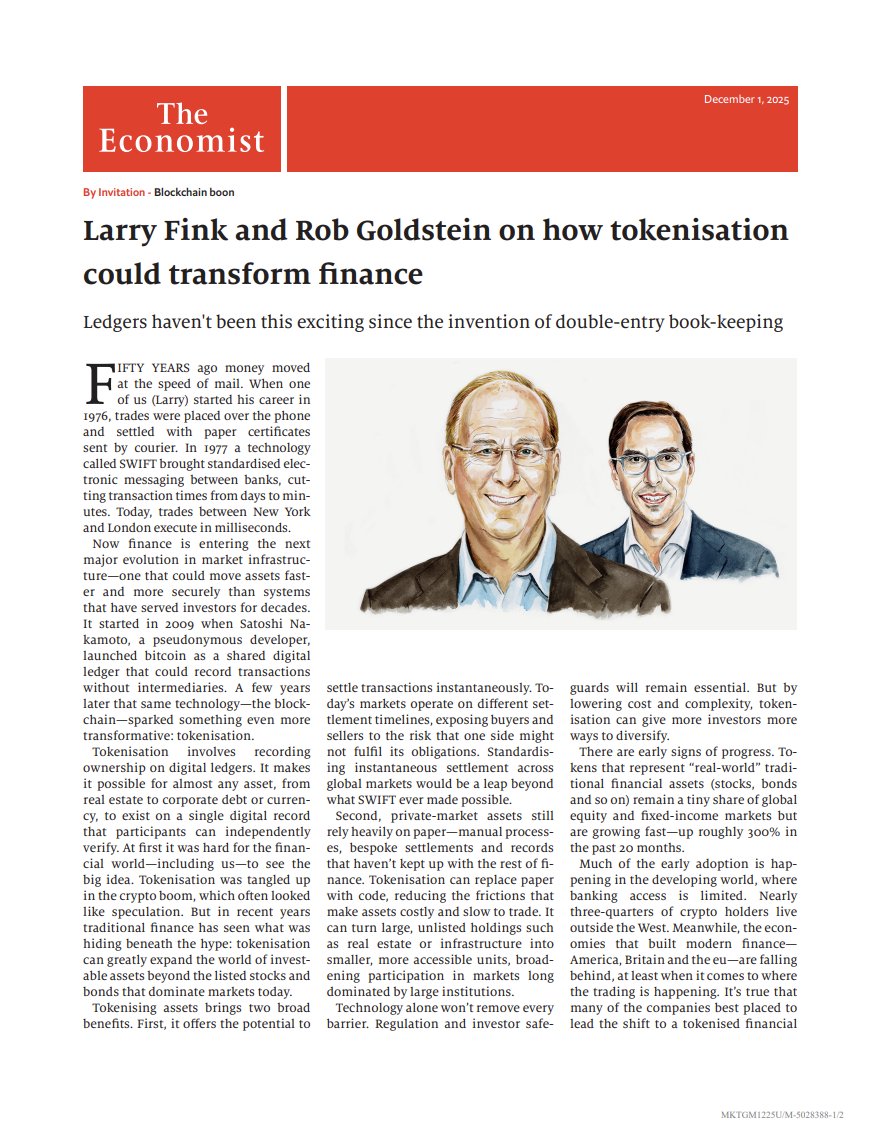
Tokenization is shaping the next evolution of global markets. In @TheEconomist, Larry Fink and Rob Goldstein discuss how tokenization can modernize market infrastructure, enhancing efficiency, transparency, and access by connecting traditional and digital finance. Read more:
Thank you to everyone who joined us for Stable Summit!
In Argentina stablecoins are actually used and not just discussed on panels. Hosting this edition in this amazing country felt just right. The sessions reflected that mix of real-world demand and ongoing innovation across the space.
Appreciation to @StakeCapital for hosting and to @CurveFinance for supporting as our ambassador.
Thank you to all the speakers, builders, researchers, and teams who spent 2 days comparing models, debating integrations, and exploring how stablecoins fit into a more decentralized financial system.
Check out the vibes!
Real World Assets today is all about trying to fit a square peg into a round hole.
In this meeting of two radically different worlds, there’s a huge gap in financial literacy. In DeFi, very few people understand risk analysis, portfolio construction, or financial planning. Everything is “on sight,” overcollateralized, and superficial. Few users know how to read or price risk. For most of them, yield is the only truth, and anything with a low standard deviation feels “safe.” They farm relentlessly, chasing returns without much regard for what lies beneath.
Meanwhile, those from TradFi don’t grasp how DeFi is built, the speed, the lack of loyalty in how capital moves, the fact that past performance rules above everything. They tend to ignore structural risks like smart contract failures, liquidations, or incentive misalignments.
DeFi doesn’t forgive inefficiency. TradFi, on the other hand, is full of it, yet it also relies on regulation, human judgment, and the institutional frameworks meant to protect the broader system
Apart form the always mentioned liquidity and market trading hours that complicate price feeds, in TradFi when things spiral, there are rules that stop the storm, circuit breakers, trading halts, pauses so everyone can think.
The industry values that markets close, people rest, statements are made, and order is restored. DeFi, instead, celebrates 24/7 trading, pure freedom. Having lived through Lehman’s collapse, I support freedom deeply, (and I know we’re probably moving toward it ) but I also wonder how an open, infinite market would absorb that level of disruption.
What I hope is not to see one side misleading the other. Both have so much to offer.
Now institutions are entering the ecosystem at scale, it’s a true game-changer. I’m curious to see how it unfolds, whether it will bring balance between the rigor and discipline of TradFi, and the innovation and openness that make DeFi so powerful.
So far I see the asymmetry of information as a red flag. I am afraid we might be building systemic risk by bringing too many illiquid and non transparent assets onchain, in the search for absolute yield.