Treasury bills are the bedrock of finance. Tokenizing them could unlock more than just yield.
Tony Pecore, Head of Investment Management, Franklin Crypto, explains how this is a huge leap for finance on @CRYPTO101Pod.
via the FT Media Garden at Out East Summit @TheTieIO
JUST IN: OpenAI launches global cybersecurity initiative called “Patch the Planet” after AI helped uncover critical flaws in PHP, a programming language powering millions of websites.
The NCSC has issued an update to the PHP alert reflecting the release of mitigations.
We encourage UK organisations to take immediate action.
For more information on the issue as well as our guidance, head to⬇️
https://t.co/l6TDtVurJN
🚨 NEW: Ripple urges the SEC to finalize its proposed Regulation Crypto Assets framework, arguing that cryptocurrencies should not remain classified as securities indefinitely.
🇪🇺 MAJOR: The European Central Bank today outlined its vision for the future of European capital markets, built around tokenized assets, interoperable distributed ledgers and settlement in central bank money.
The ECB envisions an integrated financial system connecting banks, exchanges, custodians, clearinghouses and securities depositories through shared and interoperable networks.
The transition would enable 24/7 transactions, atomic settlement, programmable securities, automated corporate actions and near-real-time collateral mobility.
The foundations are already emerging. Pontes now enables DLT transactions to settle in euro central bank money, while eligible tokenized securities can be used as collateral in Eurosystem credit operations.
Through Appia, the ECB plans to develop a blueprint for Europe's future tokenized financial infrastructure by 2028, working alongside banks and other market participants.
The ECB describes tokenization as moving from experimentation to early adoption.
This is a fundamental rethinking of how European capital markets will operate, from securities issuance and trading to settlement, custody and collateral management.
Finance teams will let AI tell them what to do with cash. Very few let it act on its own. Generative AI use for cash flow management jumped from 16% to 80% in a year, while agentic AI slipped from 6% to 5%.
PYMNTS Intelligence’s Time to Cash report, produced in collaboration with @jpmorgan, shows where CFOs are drawing the line on automation. https://t.co/ryPVu8YHDn
🚨 Your Money Is Going Digital: Cyberattacks Are a Wake-Up Call for the Planned New Financial System
3 massive cyberattacks in just 72 hours.
Finland, Netherlands, France and Japan are shutting down websites as we speak.
Your passwords, private data, and even the websites you trust could be at risk. Millions may be exposed, and most people have NO idea.
And the scariest part is that it all happened at the exact same day.
A NEW MONETARY RESET IS BEING PLANNED TO MOVE THE FINANCIAL SYSTEM ON-CHAIN‼️
This week G7 nations announced planned cyberattacks to test the banking system.
Scott Bessent openly talked about a “grand economic reorder” on the scale of Bretton Woods and how stablecoins will be used to grow out of the $40 Trillion debt.
BlackRock says all stocks, bonds, identities will be moving on-chain in the next two years. The same company that managed the planned bail-out of banks during repo crisis in 2019, which was followed by COVID and $6 Trillion in money printing.
The new financial system is becoming easier to surveil, and without privacy, financial freedom is just an illusion.
What if the biggest financial revolution is happening right under our noses?
Private digital identities. Zero-knowledge proofs. A system where you can prove who you are without revealing who you are.
Private digital identities. Zero-knowledge proofs. A financial system where you can prove who you are without exposing who you are.
A future of complete on-chain financial privacy and almost nobody is paying attention.
This is why @DNAOnChain is about to be the biggest company in the new on-chain financial system.
The SEC also held a roundtable on zk-proofs.
Be prepared for the new financial system. It’s always followed by an engineered crisis.
Some Government of Canada websites have been temporarily taken offline as a precaution to protect government systems and Canadians' information, following guidance from the Canadian Centre for Cyber Security.
This is in response to a vulnerability identified in PHP, software used by websites around the world. This is a global issue, and other governments and organizations are also taking protective measures.
If your organization uses PHP, apply the latest security updates as soon as possible and follow @cybercentre_ca for updates.
We take this situation extremely seriously. Thank you to the cyber security teams working to protect the services Canadians rely on. Affected websites will be restored once patches are applied.
BREAKING: Two critical security flaws in PHP, the programming language behind much of the internet, are forcing governments to take websites offline, per the BBC.
The flaws were found by AI. Security firm Wiz called them the “most severe vulnerabilities ever discovered” by the technology.
Effective Immediately, all organizations using PHP for their systems are advised to be prepared for an update addressing two critical vulnerabilities. PHP is widely used for web applications. These vulnerabilities often provide a direct path to the server's file system or database. If an immediate update is not feasible, it is recommend that organizations take the system offline until it can be fully mitigated. NSA will follow up shortly with more specific guidance.
.@USComptroller Jonathan V. Gould: Today’s final rule advances @POTUS Trump’s and @SecScottBessent’s vision for American leadership in digital assets. We are providing a clear, practical framework for payment stablecoin innovation, with strong standards for reserve backing, redemption, and risk management. The OCC is drawing on its longstanding supervisory expertise to support responsible growth and innovation for this new industry. https://t.co/IWuIHnQQ0f
🇺🇸 BREAKING: The United States just finalized regulations implementing the GENIUS Act. Federal standards are now established for stablecoin issuance, banking participation and digital asset payments.
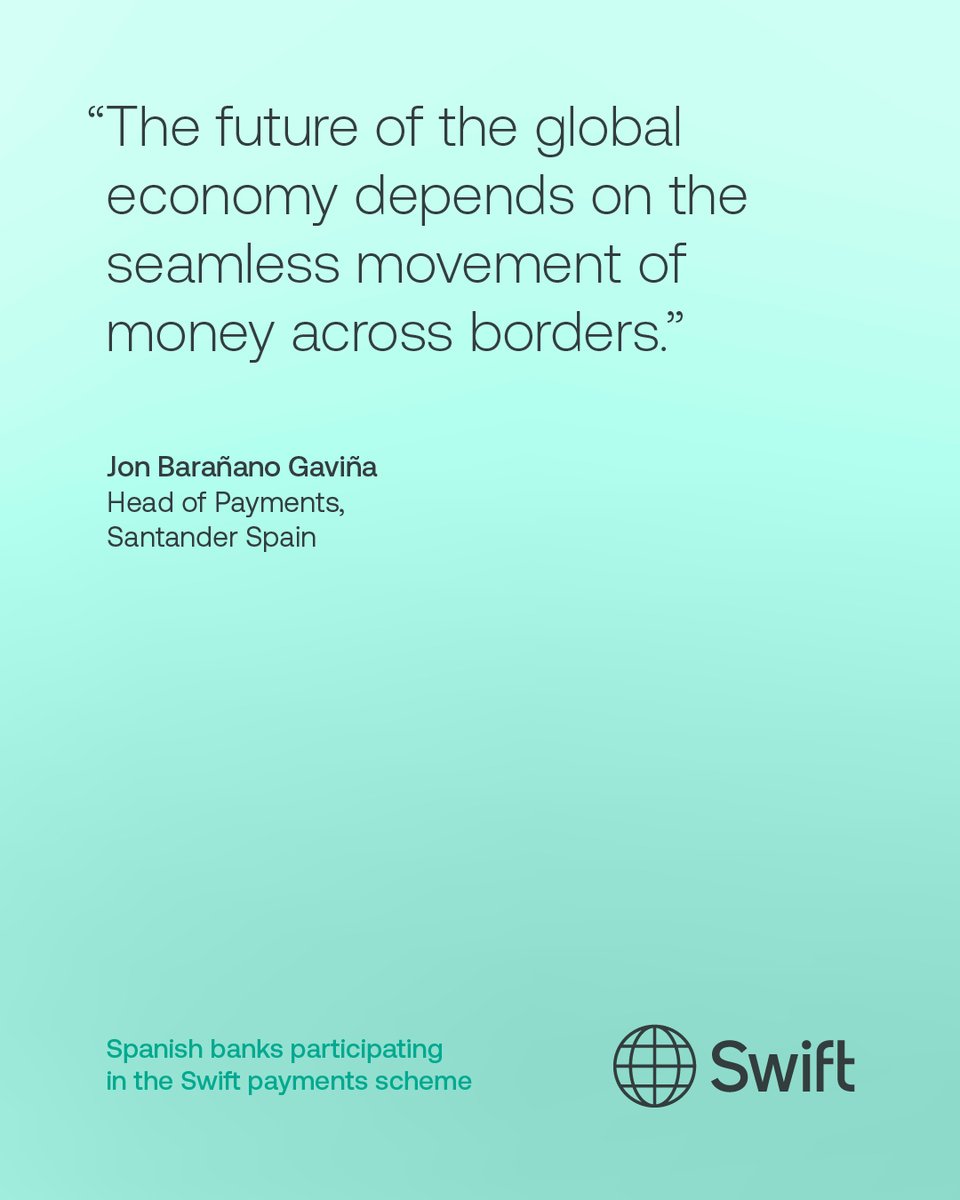
Spain is raising the bar for cross-border payments.
Over the past decade, Spain has become a leader in instant payments. Today, the Spanish banking community is building on that success by connecting domestic payment capabilities with international payment networks.
The result? A faster, more transparent and more predictable experience for businesses and consumers alike.
Read more: https://t.co/N0VzvhpEnM
#CrossBorderPayments #SwiftScheme
🏦 Finastra launched StandbyX Monday, a cloud solution that lets regional and mid-sized US banks digitize standby letter of credit processing without standing up a full trade finance platform.
Full story on PYMNTS. https://t.co/Bx6SaNF1fa