We're live on Product Hunt today. 🚀
The next wave of buyers won't be people. They'll be AI agents, and most companies are invisible to them.
Nearly a billion people a week now ask agents what to buy. Increasingly, the agent buys it for them.
OpenAI, Google, Stripe, Mastercard and Coinbase are all building the rails for agent led checkout right now. But rails alone don't make a business ready. Someone has to give companies the toolbox to become discoverable and payable an all rails. A blue ocean of new opportunities. That's @bluerailsdotcom.
The new top of funnel isn't ads. It's being discoverable and transactable by AI agents.
I spent my career watching the internet decide who wins. At @GetYourGuide I lived inside a Web2 marketplace. At @passionfrootme I learned the market rewards demand, not just storefronts. Now the ground has shifted again, and discovery is moving into the AI layer.
One integration, and your business is ready for both the customer and the agent buying on their behalf, in dollars or stablecoins. No intermediaries, no commission.
Two things you can do today:
👉 Support us on Product Hunt (link in comments). Any support and feedback helps.
👉 Run your own site through Bluerails Discovery for free and see exactly how discoverable and payable you are to AI agents.
We'd love your feedback, especially from businesses figuring out how to get ready for agentic payments.
Thanks to @benln for hunting us! <3
@noahkagan Had 2 such moments with Claude in high effort yesterday. Do not use it for tax summaries or even less to help you out with what to do if your laptop was stolen. Terrible outcomes, wrong all over the place
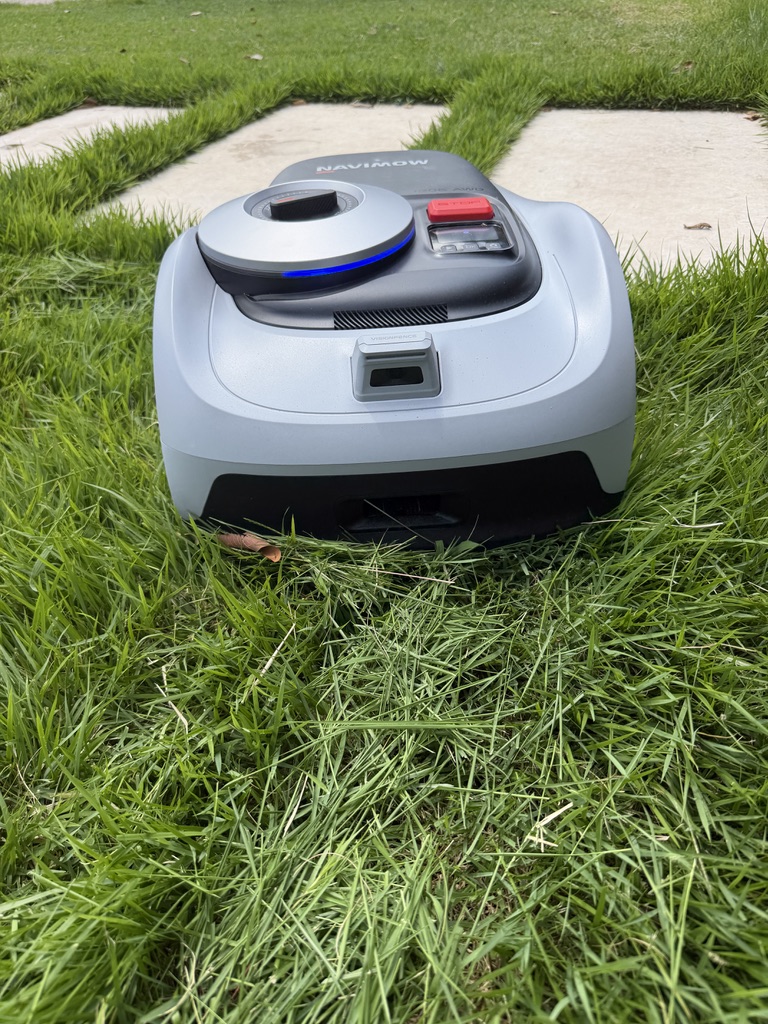
My $900 AI lawnmower lost to a guy named Alon.
I was paying about $100 a month for lawn care. Then I found an AI-enabled, self-driving lawnmower on sale for $900. The thing paid for itself. Hit a button, cut my grass, perfect lawn forever. A little money upfront for a problem I'd never think about again.
Hello Vibe Cutting!
I'm telling you this because it's what I'm seeing happen everywhere right now, including inside AppSumo.
AI shows up with a promise you can genuinely believe. Then the real cost, the implementation, the maintenance, and what it actually delivers turn out to be somewhat else entirely.
So it arrived and I told it to go cut. I figured. See you later, humans. No more need for you. 👋
Figured it would just look at my yard with its cameras and figure out the grass. Nope. First you have to map the lawn, supposedly can do it "automatically." The air quotes are for dramatic effect.
The mower drove all over the place. Then it ran out of battery and crawled back to charge. I tried to map more and it mapped the wrong part of the yard. I tried again, finally got it to map the right thing.
It cut. Sort of. There were patches it missed entirely. It left the clippings exactly where they fell instead of bagging them. It didn't touch the edges.
It did, however, find time to mow down a row of my wife's plants. She was not pleased. That was day one. Day two I learned it also has to sit in a specific spot to get GPS. Every problem I solved revealed the next one underneath it.
Here is the part that stuck with me. As amazing as the idea is, it's still only $100 to have a person do it, and do it better. Could the machine eventually beat that? Sure. Maybe.
My vibe cutting is the exact same gap I feel with vibe coding and AI right now. The promise is a button. Describe what you want, hit go, get a finished product. What you actually get is a thing that drives all over the place, runs out of battery halfway through and pisses off your wife.
The demo is magic. The implementation, the cost, and what it actually delivers are still a long way from the pitch.
Will it get there? Maybe. Will it stay too expensive to be worth it? Also maybe. I don't know yet, and anyone who tells you they do is selling something.
What I do know is that Alon comes by twice a month, cuts the grass, blows the leaves, does a better job than my robot, and I like seeing him. For now the button I keep hitting is the one that calls Alon.
I returned the mower, I'll see Alon on Friday!👯♂️
@gomining The course about "How to Avoid Scams and Protect Yourself Against Risks". Very succint and to the point, packed with great security insights! Well done GoMining team!
@gomining#GoMiningAcademy
Why I Think Michael Burry Is Shutting Down Scion Now
Let’s put a few things together…Burry’s liquidation letter, his depreciation thread on the hyperscalers, and his “me then, me now” Big Short meme and he’s basically spelling out one story.
He thinks we’re in an earnings inflated, AI driven bubble that a value investor can’t sit inside without eventually getting crushed.
In the letter he says it plainly “My estimation of value in securities is not now, and has not been for some time, in sync with the markets.” That’s not a I’m tired of running money line. That’s a man saying, I can’t reconcile what I see in the numbers with the prices the market is willing to pay. When someone like Burry reaches that point, the logical move isn’t to keep collecting fees and hope it mean reverts. It’s to get out of the structure that forces you to play the game at all.
Then you look at his post on depreciation. He’s saying the biggest beneficiaries of the AI boom that includes META, GOOG, ORCL, MSFT, AMZN of juicing earnings by quietly stretching the useful life of servers and GPU rigs that are really on a 2–3 year technology cycle. Extend the life in the accounting model, and you cut today’s depreciation expense. Cut depreciation, and EPS looks 20–30% higher than it would under a stricter assumption. He’s saying that the market is paying premium multiples on numbers that are, in his view, structurally overstated.
Put that together with the “me then, me now… it worked out, it will work out” post, and he’s clearly casting himself as the same guy who sat in front of a wall of subprime prospectuses in 2005. Back then, he saw engineered AAA paper built on bad collateral. Now he sees trillion dollar market caps built on AI capex and accounting choices he thinks will blow up 2026–2028 as the depreciation math reverses.
SO WHY SHUT DOWN SCION NOW? MY HIGHEST PROBABILITY READ IS THIS
He expects a major repricing in the very stocks that dominate the indices and he doesn’t want to live through the last, craziest stretch of the bubble with other people’s money tied to his name.
If he’s right about the under depreciation, then over the next few years earnings growth for the hyperscalers should slow sharply or even go negative just as the AI narrative cools and the cycle matures. When that happens, multiples compress, passive flows that are overweight those names work in reverse, and the broad market takes a hit because the “Magnificent Few” are the market. From his perspective, that looks less like a normal correction and more like the equity version of the housing unwind: a long stretch of fake comfort, then a sharp break when the math can’t be hidden anymore.
Closing the fund accomplishes a few things at once. It lets him step aside before that break, so he’s not fighting client redemptions or daily benchmarking while he’s trying to hold deeply contrarian positions. It frees him to short or sit in cash on his own terms, without regulators and LPs looking over his shoulder. And it sends a signal: if valuations are this disconnected from what he thinks the true earnings power is, the most honest thing he can do as a fiduciary is hand back the money and say, I don’t want you in this.
So, in my view, he’s not walking away because he’s done with markets. He’s stepping off the stage because he thinks the show has turned into something he’s seen before: a late cycle mania, powered by flattering models and aggressive accounting, that ends with a long, grinding reset in stock prices especially at the top of the index. @michaeljburry
Los boomers creen que los “lujos” son caros porque en su juventud lo eran. Hoy ocurre lo contrario: la tecnología y los caprichos cuestan cada vez menos, mientras que lo básico —vivienda, educación, salud, cuidados— se dispara.
El problema no son los gadgets, es que la vida esencial se ha vuelto prohibitiva.
El mundo está cambiando pero mucha gente no se da cuenta, y por eso no entienden que las políticas que se aplicaban antes ya no solucionan los problemas de la actualidad.
Si no se actúa, al final ocurre lo que está pasando: el descontento cada vez es mayor y se polariza la opinión pública.
He estado reflexionando sobre el ruido que ha generado la propuesta de las hipotecas a 50 años de Trump.
Y una vez más, la mayoría está opinando desde la ignorancia, la ideología o el ego financiero mal digerido.
Mi visión👇
Win 1 BTC as we race to 5M X followers! 🚀
🚀 From 4.6M–5M followers, every +0.1M = 200 winners split 0.2 BTC
👥 Invite friends to get double chance
1⃣ Follow @bitgetglobal
2⃣ RT & tag 3 friends w/ #FollowToWin1BTC
1,000 winners in total
Join now 👉 https://t.co/2ifx2uJk36
Win 1 BTC as we race to 5M X followers! 🚀
🚀 From 4.6M–5M followers, every +0.1M = 200 winners split 0.2 BTC
👥 Invite friends to get double chance
1⃣ Follow @bitgetglobal
2⃣ RT & tag 3 friends w/ #FollowToWin1BTC
1,000 winners in total
Join now 👉 https://t.co/2ifx2uJk36
El mercado de las Stablecoins, “E-Money Tokens” en Europa tras MICA, ha nacido apaleado.
No se ha entendido, o quizá sí demasiado bien, la importancia que tienen USDT de Theter y sus variantes.
Quieren mantenernos atados al FIAT, y además, a su versión más obsoleta.
Los europeos lo pagaremos caro.
Opt out.
#bitcoin
Sorto de entradas para la #EBC202@EBlockchainCon te espera!
Si sos parte de la comunidad de #CryptoConnect by @cultura_c3 comentá en este post: “Quiero participar” y ya estás dentro 🙌
También te ofrecemos descuentos 😉😉
En 1945, EEUU poseía el 80% del dinero mundial. El oro era dinero en aquel entonces. Controlaba la mitad del PIB mundial. Así estableció el orden mundial.
Un argumento potente de Dalio para entender la carrera actual de los Bancos centrales por el oro.
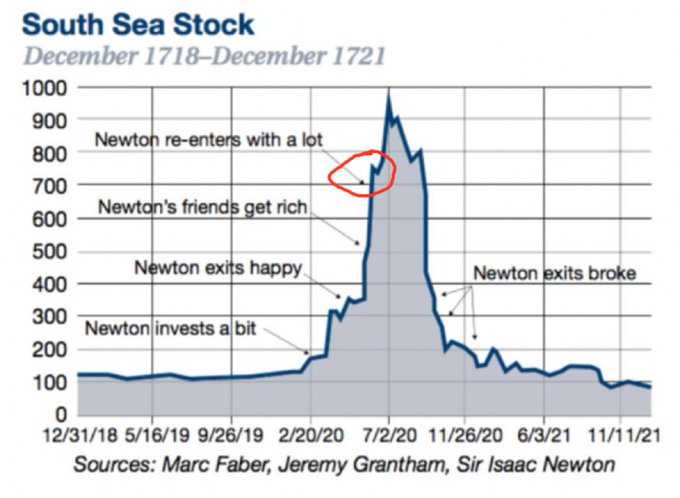
Isaac Newton, uno de los mayores genios de la historia, fue víctima de la burbuja de los Mares del Sur (South Sea Bubble) en 1720. La South Sea Company prometía grandes beneficios gracias al comercio con América del Sur, pero en realidad era más un esquema especulativo que un negocio sólido.
Newton primero invirtió temprano, ganó dinero y salió con beneficios. Sin embargo, al ver cómo sus amigos se enriquecían aún más, volvió a entrar con una suma mucho mayor justo antes de que la burbuja estallara. Terminó perdiendo la mayor parte de su fortuna.
Se cuenta que Newton comentó:
"Puedo calcular el movimiento de los cuerpos celestes, pero no la locura de la gente."
El gráfico es una recreación moderna (no un gráfico histórico original de cotización), difundido por analistas como Marc Faber o Jeremy Grantham para ilustrar la historia.
Incluso genios como Newton fueron atrapados por el efecto FOMO del momento.