MSc Economics (BSE) 📖 //OtraPágina podcast 🎙️, reflexiones sobre clásicos de la literatura. //Substack 📝: Sculpting the Abstract (Philosophy & Economics).
A partir de ahora, usaré esta cuenta también para subir citas y/o reflexiones sobre los libros que vaya leyendo para el podcast:
https://t.co/dwdldlfOh3
Yesterday, I lectured on Alexander Hamilton’s economic program for the U.S. I always look forward to this lecture, both for the content and because Hamilton is my favorite founding father. I was never a Jefferson man.
Hamilton understood that “libertarianism in one country” is not feasible. Assume, just for this paragraph, that libertarian economic policy is right: that a minimal state is the best recipe for growth. A country that adopts it will grow much richer than its neighbors. But then its neighbors will want to invade it to seize its wealth or, at least, use the threat of violence to turn it into a tributary state and extract rents. And a libertarian state cannot defend itself (no, Switzerland was never a libertarian state; it always spent heavily on defense, for example in the service it required from its citizens). The more you believe in libertarian economic policy, the more you should fear your country adopting it (unless, by some miracle, the whole world adopts it at once).
Hamilton instead foresaw that the U.S. would live in a world of competing empires, where constant war requires professional armies, not militias. The Revolutionary War was not won by militias, however much the myth of the well-regulated militia survives among some Americans, but by the professional armed forces of the U.S., France, and Spain. No “la Royale” under the Comte de Grasse, no victory at Yorktown.
Hamilton therefore anticipated that the U.S. would need a powerful fiscal-military state and a prosperous economy to ensure the survival of freedom and the republic. Economic and military strength go hand in hand: like the god Janus, they are two faces of the same phenomenon.
For some decades, the U.S. fiscal-military state could stay small: two oceans and luck with neighbors (a quasi-balance with the British Empire to the north after the War of 1812, where neither side had much incentive to deviate, and a quasi-failed state to the south). But by the early twentieth century, reality kicked in: Germany, Japan, the Soviet Union, China. This is an important and often underappreciated mechanism behind the creation of the Federal Reserve System in 1913 and its survival thereafter, as shown by the way it floated the Liberty Loans of 1917 (no, the U.S. could not have fought in France on tax revenue alone; no great power ever has).
This was not the first case. Central banks were not born from monetary theory but from war. The Bank of England was created in 1694 to finance William III’s war against France. Hamilton’s First Bank of the United States was established to consolidate Revolutionary War debt. The logic is simple: the state that borrows cheaply and at scale outlasts its rivals on the battlefield, and a credible central bank is what makes such borrowing possible.
This is why central banks survive even in republics deeply suspicious of concentrated financial power. Presidents could campaign as Jeffersonians as much as they wanted; the first serious war turned them into Hamiltonians. Hamilton understood how the world works; Jefferson did not. And the causality also runs in the other direction: by lowering the cost of mobilizing resources, central banks made war on a modern scale possible.
To paraphrase Charles Tilly: war made the central bank, and the central bank made war.
What do studies say about "freezing the rent"?
Let's have a thread🧵
First thing's first: Most studies agree that rent controlled units have lower rents, but also the supply of rentable units goes down and un-controlled units see their rents increase.
Uh-oh!
Half the land area of Boston, a quarter of NYC, and 15% of San Francisco were raised from the sea before 1970.
Since then, land values have grown by 30x but land reclamation has ground to a halt.
This failure follows the spread environmental law around the world rather than any geographic, technological, or economic constraint.
Thus, our lack of land reclamation and the severe land constraints in our most important cities are self-imposed and avoidable. We should make more land!
https://t.co/J9zghvLkz2
Land reclamation was common practice in American cities in the 19th and 20th centuries. Seattle, Chicago, Boston, Charleston, San Francisco, New York, Philadelphia, Norfolk, DC, Oakland, and LA all had major land reclamation projects that extended residential living space or infrastructure or both.
The Bay Area alone reclaimed an area of land equivalent to ten Manhattans between 1850 and 1957, at an inflation-adjusted cost of $330,000 per acre. Today, an acre of single-family-zoned land in San Francisco County averages $24 million. Even if the cost of land reclamation grew faster than inflation, despite technological leaps in dredging and construction technology, there should be plenty of room for profitable arbitrage.
And yet, land reclamation is extinct in the Bay Area as well as in every other American city. This isn’t because we ran out of good spots to reclaim: Two thirds of the San Francisco Bay is shallower than Boston’s Back Bay was when it was reclaimed in the 1860s. Nor is it because of better transportation: We’ve used up all of the easy suburban expansions enabled by the train and the automobile so prices are rising even in outlying suburbs.
Instead, land reclamation’s death is due to environmental law. Evidence for this claim shows up in the coincident timing of land reclamation’s demise across dozens of cities in the US and in the environmental compliance process of the few reclamation projects still inching along today, but the best evidence is found internationally.
No country has more experience or more reason to reclaim land than the Netherlands. The Dutch built 5% of their country out of the sea over the first half of the 20th century and by 1975 they had another artificial lake in the Zuiderzee ready to drain at the flip of a switch, which would have made tens of thousands of acres of land just east of Amsterdam. But a 1969 environmental review law, similar to NEPA in the US, stopped the project before it was finished and the site is now a protected bird sanctuary. Their one major reclamation since, the Maasvlakte 2 extension of the port of Rotterdam, took 11 years and 6,000 pages of environmental review before construction began.
Inversely, countries without these laws, like China, Singapore, and Japan have continued major land reclamation projects into the 21st century. China has reclaimed over 5,000 square kilometers since 2000, including a city of half a million outside Shanghai and Singapore has grown by a quarter since 1975.
Every major American city has a land shortage. But we have more than enough shallow water, dredging capacity, and market incentive to make more land, just like we did 150 years ago. The only obstacle is our own choice to make making land illegal. The benefits of more land in our most productive cities are large enough to justify the effort of reforming the laws that currently prevent it. Let’s make more land!
Yesterday marked 10 years since the release of Piketty's "Capital In The 21st Century". Hard to think of an economics book in the past 10 years which, for better or worse, has had as much influence on discussion about economics, policy and politics. A Thread🧵
Well, she’s basically right. Capitalism doesn’t spontaneously occur naturally. It is a creation. And since its creation the average human being stopped being poor, ignorant, and short-lived. Poverty is natural. Violence and death by bowel stewing disease is natural. Prosperity is unnatural. And we have capitalism largely to thank for it.
.@TheEconomist covers our "Is Europe Stagnating" debate with Krugman. It reaches three conclusions I am happy to settle for:
"First, Europe is growing slower than America. Second, that is a problem: even if Europe can free-ride on America’s dynamism, as Team Krugman argues, that is no way to run an economy. Third, the AI era may be less forgiving than the last wave of tech-driven growth."
https://t.co/FltbWXSyLs
8) Write for one reader
Zinsser said the writer's job is not to address an audience.
It is to address one person.
The moment you imagine a crowd, you start writing for the average of the crowd. You soften the edges. You add qualifications. You cover every possible interpretation. The writing becomes careful and becomes vague at the same time.
Write for one specific person who is intelligent, curious, and has no reason to keep reading unless you earn it.
That person is a better editor than any crowd you can imagine.
William Zinsser taught writing at Yale, then wrote the book that has fixed more bad writing than every English class combined.
Here are 10 cuts from "On Writing Well" that instantly make your writing twice as strong.
1) Delete every word doing no work
⚠️España se sitúa entre los países de la UE (el quinto peor) donde la intervención del Estado es la que menos ayuda a reducir la pobreza.
Concretamente, las transferencias públicas logran reducir el 23,2% de la pobreza, 10 p.p. menos de lo que se logra en media en la UE.
Piketty, Stiglitz & co are ultimately inverted Rawlsians (minimax, minimize the max wealth) when it comes to their social welfare function. Unlike standard Rawlsians whose social welfare function is maximin, maximize the min wealth. Also wealth for them is a negative externality.
People also forget Dollar and Kraay who show that economic growth for the average income correlates strongly with income growth in bottom decile
See below
Because tax bases and amounts affect political behavior. Politicians can converty revenues into deadweight loss by indulging in rent-seeking, inefficient programs, political businesss cycles, etc.
A wealth tax intensified rent-seeking because it creates strong incentives for wealthy individuals and firms to devote resources to securing exemptions, preferential valuations, special treatments for certain assets, or loopholes. At thesame time, it incentivizes groups with huge concentrated benefits (farmers, industrial firms, public sectors union etc) to ask for their favors since there is a larger pool of revenues they can pick in (fiscal commons) and the group paying is not them. Thus, the supply of rent-seeking increases. The result is competition over political privileges rather than productive activity. Society, including the poor, are poorer.
Its why James Buchanan explained that we can never treat revenues as transfers but as potential deadweight losses. In so doing, we understand that the goal is to constrain power and a wealth tax fails to do this. In fact, it may incentivize other types of rent-seeking. The result is an expansion of what Buchanan called the fiscal commons problem: more resources become available for political appropriation, increasing the scope for Leviathan and the deadweight losses associated with political competition.
The fear that the rich may hold power at their favor as a purchase from their wealth is correct. But the problem is that power is available for them to purchase in the first place. Not the wealth. And taxing the wealth aint gonna remedy the problem.
Again, causality is in reverse. Big -- but more importantly unconstrained -- government incentivizes the use of wealth to acquirer power which begets more wealth.
You can either tax wealth -- which will then incentivize problems of its own notably the effort to resist the taxation of wealth -- or you can constrain government.
This is why I often tell people that I dont disagree on many points with the PSE people when its time to diagnoses. I disagree on remedies which I view as the cure from the hair of the dog.
John similarly has stated that "Greed, monopolies, and supply shocks only move relative prices."
My counterclaim is that, provided the innovations in questions are themselves permanent, they will in fact raise P permanently.
This is coming from a famous economist, so it's probably worth clarifying that there's no economics in this report showing that their degrowth pathway is either an ideal or likely decarbonization path. It's an opinion they work backwards from.
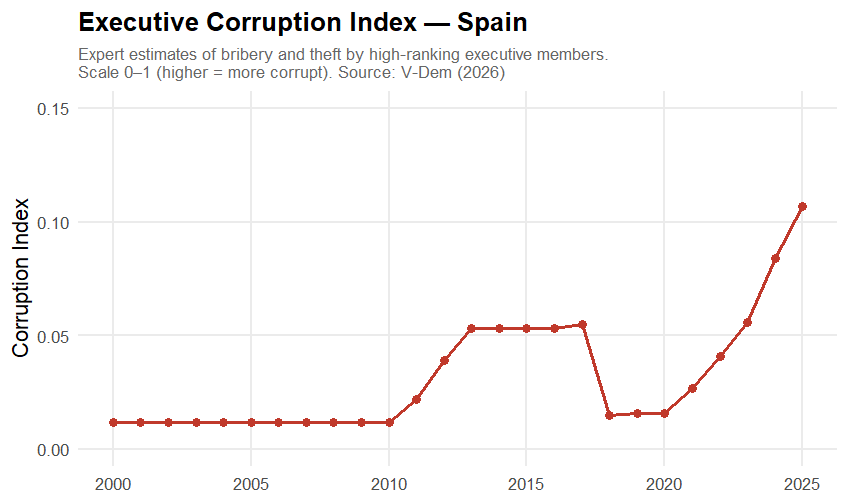
También es muy llamativo que en concreto el sub-índice Corrupción del Ejecutivo se multiplica por 11. Pasa de 0.01 en 2018 a 0.11 en 2025.
Para no pecar de "cherry picking", si comparamos con el máximo del gobierno anterior, el índice se multiplica por 1.83. De 0.06 a 0.11.
Aviso: Es un índice construido en base a opinión de expertos. Aun así, informativo.