From Humanitarian Crisis to Football Delusion
ETHIOPIA ― In a country ranked 100th out of 123 nations on the 2025 Global Hunger Index, where the FAO and WFP have classified entire regions as hunger hotspots, Ethiopia’s leadership appears dangerously detached from reality.
Roughly 13 million Ethiopians, including 4 million internally displaced people, urgently require humanitarian food assistance. Across large parts of the country, communities continue to endure conflict, displacement, drone strikes, kidnappings, and collapsing public services.
Yet Deputy Prime Minister Temesgen Tiruneh travelled to Bahir Dar, the capital of one of the country’s poorest and most unstable regions, not with a plan for reconstruction or recovery, but with a fantasy worthy of a development policy. (find the speech in the comment section)
Standing before thousands, he promised that the ruling "Prosperity Party" would transform Bahir Dar such that one day, it would be capable of hosting clubs like Arsenal F.C., Manchester United F.C., Liverpool F.C. and other elite clubs whenever Europe’s weather becomes cold.
For millions of Ethiopians struggling to survive, the speech landed not as an inspiration but a mockery.
People who cannot safely travel between towns were promised Premier League tourism. Families mourning relatives lost to war were offered fantasies about elite European clubs playing exhibition matches in a conflict zone.
Citizens living without reliable healthcare, electricity, or security were told to dream about English Premier League while their daily reality continues to collapse around them.
The cruelty is not merely in the promise itself. It is in the staggering disconnect between the suffering on the ground and the fantasies being sold from the podium. Absolutely unhinged.
Spare us the late concern! Where was this urgency for 3 years? As the Pretoria Agreement was dismantled by the Feds. drone strikes, siege conditions, blocked services, & unremoved non ENDF forces, over a million IDPs & refugees are suffering while their homes & land are occupied.
ETHIOPIA ― ⚡️PM Abiy Ahmed keeps selling the story that #Ethiopia has cracked wheat self-sufficiency and is even "exporting" surplus. 🫣
Sounds impressive. Unfortunately, the receipts aren’t matching the speech. The Economist and U.S. agencies have already poked holes in the numbers, and once your stats are competing with Russia, you’re not convincing anyone, you’re entertaining them.
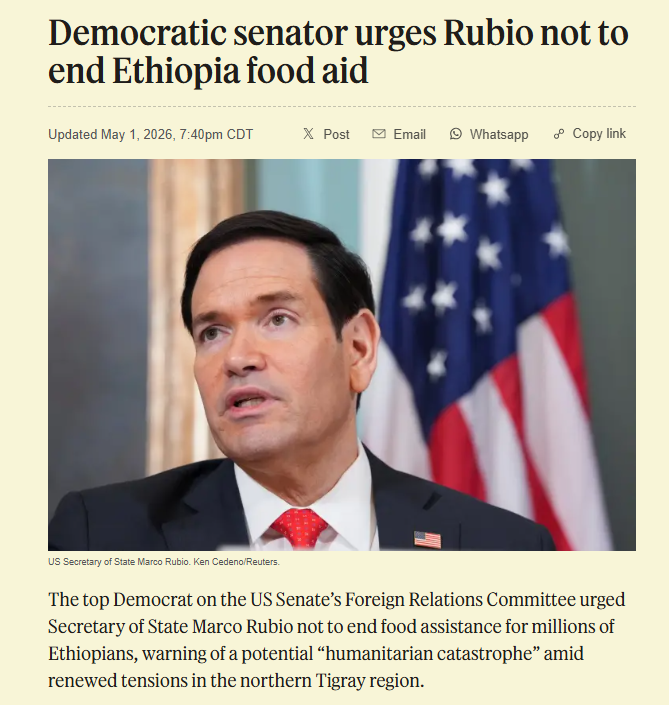
So Marco Rubio, who’s not buying the fairytale, steps in with a pretty reasonable question: if the country is that self-sufficient, why is it still heavily dependent on U.S. food aid?
The answer from the State Department is, therefore, time for a “responsible transition,” pushing both the Abiy Ahmed government and other donors to share more of the burden.
But not everyone agrees on this shift to end Ethiopia food aid. Jeanne Shaheen, top Democrat on the US Senate’s Foreign Relations Committee, has pushed back, warning that cutting aid could trigger a humanitarian disaster.
And the data backs her up, with the Famine Early Warning Systems Network says food aid needs in the country could jump from about 9 million people to 16 million by July. So much for the export boom.
So the real question is, either PM Abiy Ahmed is exporting wheat … or importing reality.
"በአፍ ይጠፉ በለፈለፉ" ... 😂
https://t.co/xItyhz65oa
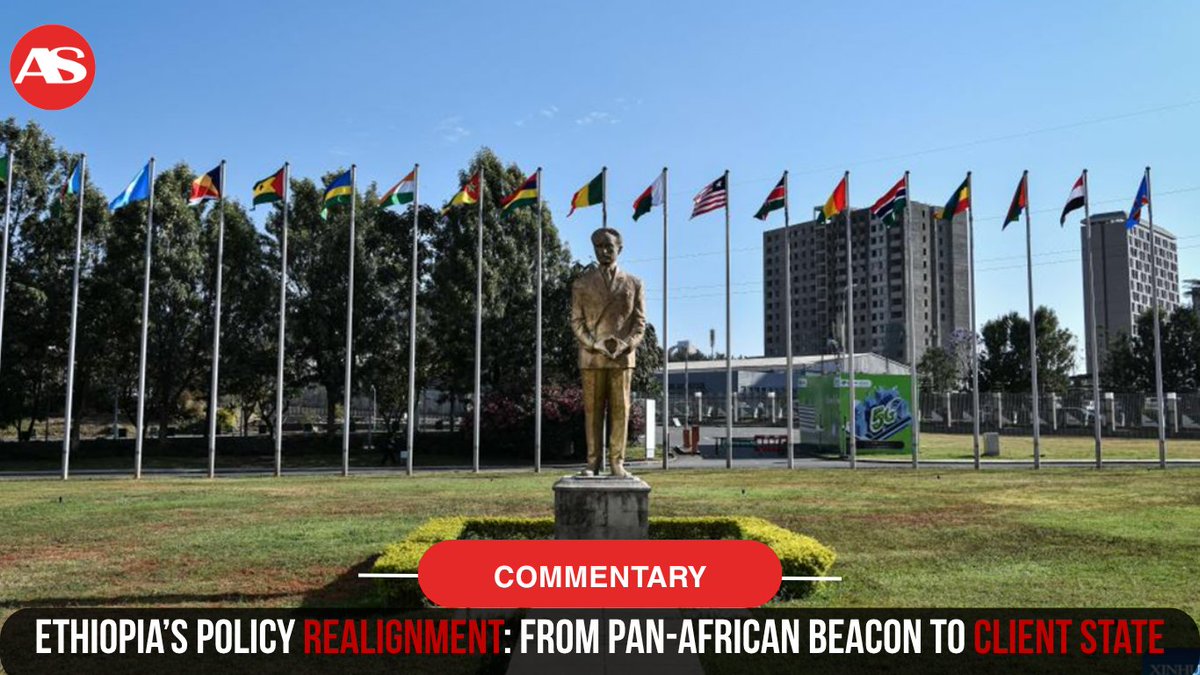
#Commentary: #Ethiopia’s Policy Realignment: From #Pan_African Beacon to Client State
https://t.co/zDg19UYTzA
On 31 March 2026, the UN Human Rights Council adopted a resolution condemning #Israel’s actions in the occupied #Palestinian territories and the Syrian Golan Heights. Thirty-one countries voted in favor, while Ethiopia was among only three that opposed it. The decision, as Sidoc Haytu, the author of this commentary, argues, marks “a profound betrayal of the Pan-Africanist and anti-colonial principles that once defined the Ethiopian state.”
Although government officials justify the vote as pragmatic diplomacy—citing security cooperation, interests in the #Red_Sea, and the necessity of Western alliances—Sidoc contends that it serves elite interests over the public will. He emphasizes that “the calculation was not performed on behalf of the 120 million Ethiopians,” but rather by a narrow ruling class increasingly aligned with foreign capital and regional powers.
The author contrasts this shift with Ethiopia’s historical record, noting its cautious approach to colonial issues as far back as the 1947 #UN partition debate on Palestine. He argues that new geopolitical alignments with Israel and the #UAE have compromised this sovereign legacy. “When Ethiopia votes at the UN… it is voting as a client of… Abu Dhabi and… Tel Aviv,” Sidoc claims, citing this shift as evidence of a steady erosion of national sovereignty.
Ultimately, the author contends that restoring Ethiopia’s international dignity requires an immediate reversal of its diplomatic course. He concludes with a call to honor the nation's history: “Ethiopia remembers what it cost to be colonized. Ethiopia will not stand with colonizers.”
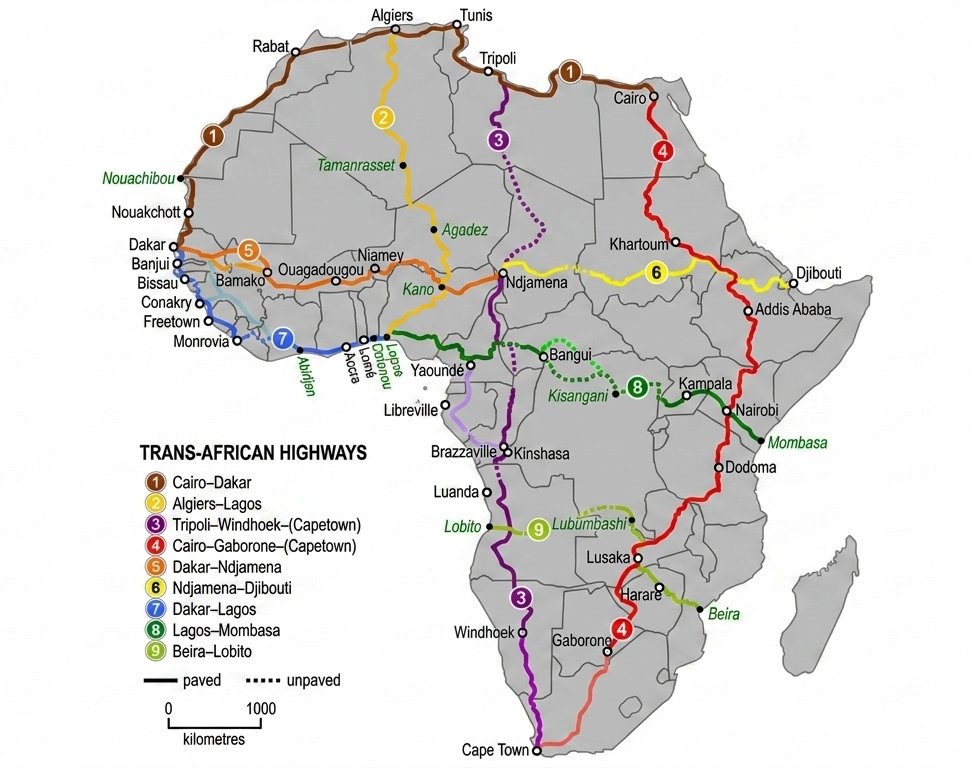
For nearly 80 years African leaders have dreamt, talked, planned, and officials have shown maps and Power Points of these Trans-African Highways. We are still waiting for them to come true. I am told we must continue believing and hoping.
𝑯𝒂𝒑𝒑𝒚 𝑵𝒆𝒘 𝒀𝒆𝒂𝒓 𝟐𝟎𝟐𝟔 𝒕𝒐 𝒂𝒍𝒍 𝒄𝒆𝒍𝒆𝒃𝒓𝒂𝒕𝒊𝒏𝒈– 𝑨 𝒀𝒆𝒂𝒓 𝒐𝒇 𝑹𝒆𝒏𝒆𝒘𝒆𝒅 𝑪𝒐𝒎𝒎𝒊𝒕𝒎𝒆𝒏𝒕!
-----------------------------------------
As we step into the New Year, we celebrate the shared spirit that drives our mission forward. May 2026 bring more peace, solidarity, stability, growth, and meaningful impact for all.
2026 is a year in which we commit to uplifting Tigray and its people from the extraordinary and unparalleled challenges they are facing due to ongoing socio-political turmoil.
Let this year be one of solidarity, as we work hard to secure our territorial integrity; facilitate the safe, dignified, and voluntary return of our IDPs and refugees to their homes and properties; advance collective healing, recovery, and reconstruction; consolidate peace; and create the conditions necessary for Tigray to transition into a functional and democratically elected government through free, fair, and transparent elections.
The Global Society of Tigray Scholars and Professionals (GSTS) remains steadfast in its dedication to supporting the full implementation of the Pretoria Agreement, promoting peace, resilience, unity, and lasting solutions for Tigray, its people, and beyond in the year ahead.
Best Regards,
The Global Society of Tigray Scholars and Professionals (GSTS)
The collective actions triggered by emerging social media leaders to end death by starvation in Tigray are exemplary both in message and method, and deserve support from all of us!
Context in numbers, figures, and maps:
Nearly half of all reported deaths in Tigray are due to starvation, most of them among IDPs.
An academic study covering November 2022–August 2023 found that starvation was the leading cause of death across all age groups, accounting for 49.3% of verified deaths. Children under five and women were among the most vulnerable.
Earlier investigations revealed that over 300 IDPs have died from starvation and lack of medical care at Hitsats IDP Camp in Northwestern Tigray since 2022. These are conservative numbers.
Since July 2025 alone, more than 50 additional deaths have been reported, placing thousands more lives at immediate risk.
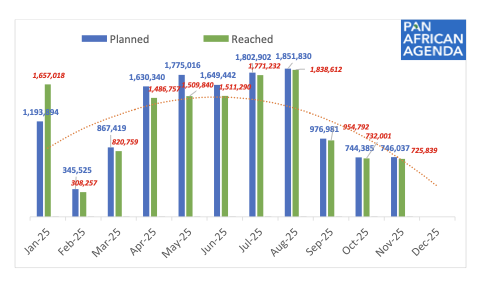
Meanwhile, a dramatic cut in humanitarian aid has deepened the crisis. Food assistance dropped by 56.2%, from 1,657,018 people in January 2025 to just 725,839 in November 2025, mostly IDPs. This means 931,179 fewer people received life-saving support in just eleven months.
History and science are clear: where governance is responsive, famine does not exist. These deaths are not inevitable; they are the result of bad power politics, resource greed, and failed regimes.