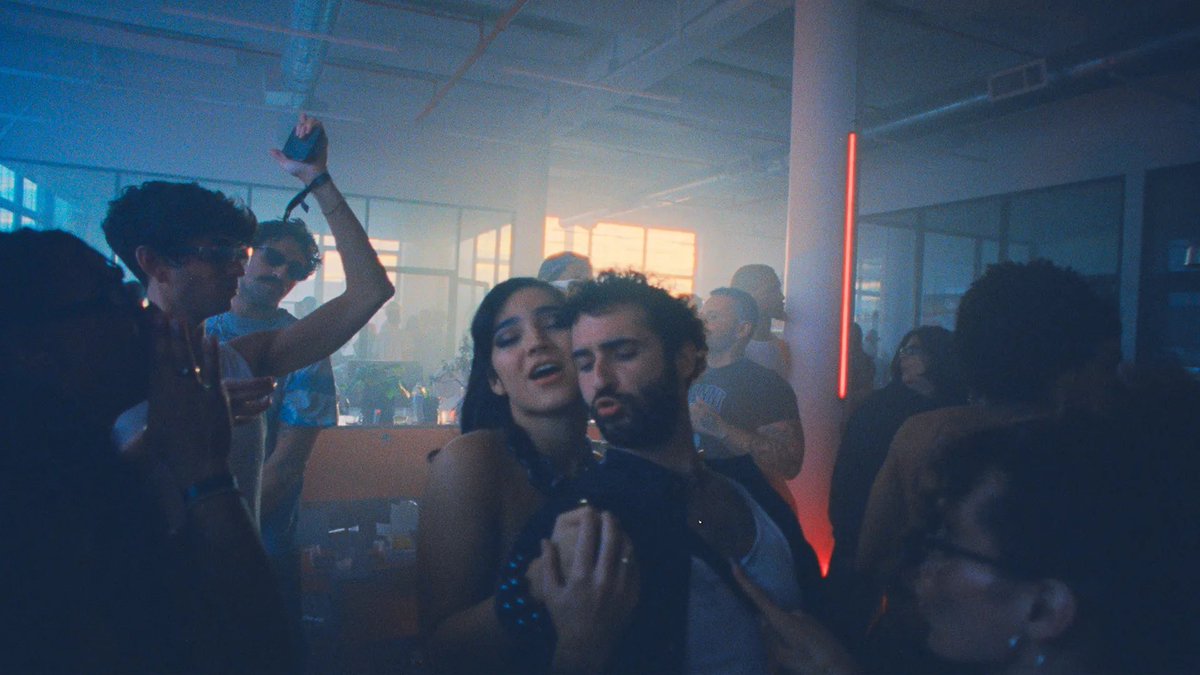
Jordan Firstman’s directorial debut ‘CLUB KID’ has sparked a bidding war with offers already in the eight-figure range.
A24, Mubi, Focus Features, Searchlight Pictures and Netflix are leading contenders to acquire the film.
Each bee has four wings. So this veil took about 5,000 dead bees to make. A single healthy hive holds up to 60,000.
Luci Jockel is a jeweler out of Rhode Island School of Design who only uses bees that died of natural causes. She found beekeepers who’d lost their hives and made a deal: she’d put in physical labor helping them rebuild, and they’d give her the wings from the bees that didn’t survive. A Rhode Island beekeeper named Paul Whewell had lost everything to a harsh winter. She worked his hives, learned to keep bees from him, then started her own colonies with her dad. Other wings came from rooftop hives at the RISD Museum, the Brooklyn Museum, and the MAD Museum in Manhattan.
Each wing is about half the width of a dime. She glued them one at a time with archival glue, the kind museums use to preserve artwork, to create a material she calls “bee wing lace.” The pattern comes from Dutch lace collars she studied in 1600s portraits at the RISD Museum. Nine years of work. The finished piece is a mourning veil, made to grieve the bees it came from.
Jockel started building this in 2017. Back then, US beekeepers were already losing around 40% of their colonies every year. Last year it hit 55.6%, the worst since tracking began in 2010. Commercial operations lost 62%. In raw numbers: 1.6 million colonies gone in twelve months, with damage above $600 million in replacement costs and lost honey production alone.
Bees keep most of your food supply running. About 75% of US crop production depends on them. California’s almond harvest alone needs 1.4 million hives trucked in every spring, roughly 60% of all managed colonies in the country, for a crop worth $6 billion a year. Total annual value to American farming: $34 billion.
She needed 5,000 bees and nine years to build one veil. One in every three bites of food you eat depends on the ones still alive.
For #LongCovid Awareness Day, we’re releasing the 2026 Long Covid Fact Sheet! This is a list of key statistics about LC, using recent data to reflect contemporary risks.
We hope this will be useful for journalists, policymakers, patients, & others!
https://t.co/Grn24AurKe 1/
if you don't enjoy writing something, people aren't going to enjoy reading it, so stop writing those work emails and get back to writing that sopranos omegaverse fanfiction
My favorite tip trick I saw for getting my son to apologize has been the “what do you think we could do to make them feel better?”
At first he would come up with silly things, like he hit my brother once so I asked him what we should do and he said “get him medicine and a bandaid.” Tbh I was happy with that as a start but the next time I I wanted him to apologize to someone, I just kinda added to his silly response like, “we could do that, or say sorry, or give a hug” and now almost every time I ask him what we should do he says “let’s say sorry together?” meaning he wants me to go with him, but he will say it by himself.
Any time I would simply ask him to just say sorry, it wouldn’t go well, and this way I think he links the apology to repairing a little more since he is the one choosing to do it (from a limited set of options ofc)