I can’t believe that just a few years ago the “knowledge that matters” was just being very efficient at hard repetitive tasks.
Now this is definitely over. It shifted to solving the right problems + task specification.
@_albertgu@TheOfficialACM@bold_lab_ai We did not try it specifically on feature decoding but Mamba-3 performs better than Mamba-2 on market simulation in general (based on CE and LOB-Bench scores)
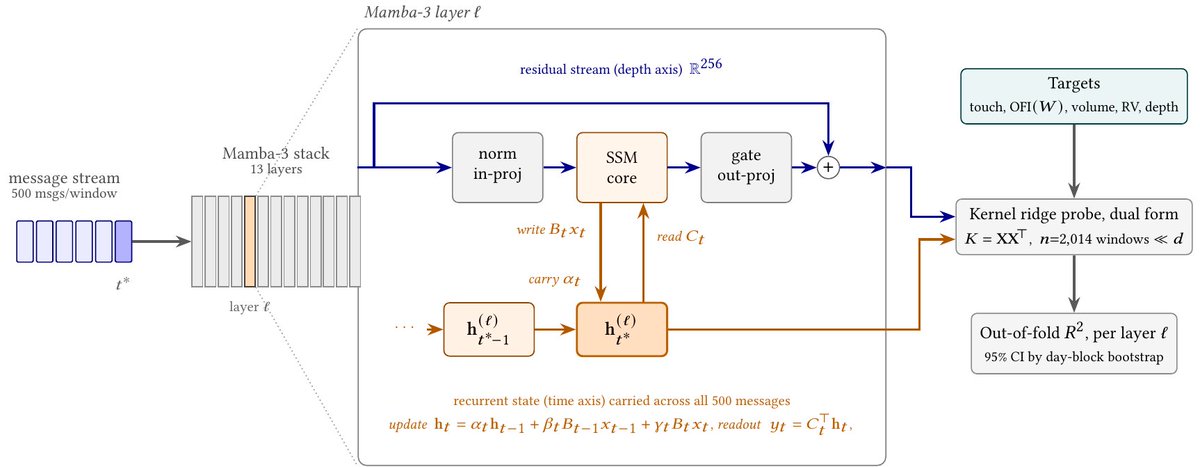
What do market simulators learn about stocks?
Trained autoregressively, Mamba-3 re-derives in its recurrent state market microstructure features such as order-flow imbalance, volume and volatility.
Accepted at @TheOfficialACM's ICAIF '26, Milan. New work from @bold_lab_ai 🧵
Joint work with Valentin Mohl (co-first author), Aramis Marti-Shahandeh, George Nigmatulin (@george_nigm), Kang Li (@Kang__Oxford), Stefan Zohren, @j_foerst, Mihai Cucuringu and Ani Calinescu, at @bold_lab_ai.
Paper: https://t.co/rTH1XvMU0U
It is causally steerable: pushing the state along the OFI direction moves the model's probability that the next message is a buy from 0.51 to 0.57, or to 0.45 the other way. Shuffled-label directions of equal norm leave it at 0.51.
Joint work with Kang Li (@Kang__Oxford, co-first author), Aramis Marti-Shahandeh, Valentin Mohl, @j_foerst and Ani Calinescu at @bold_lab_ai, University of Oxford, from my master's thesis.
Paper: https://t.co/7LLflybMzd
Scaling pre-training won’t stop foundation models from compounding errors in high-frequency market simulation. In our new paper, we show that adversarial post-training can greatly help.
Accepted at @TheOfficialACM's ICAIF '26. @bold_lab_ai 🧵
Results: realism on the LOB-Bench held-out panel improves by 17.6% (WS-21) and 17.0% (Mean-L1) with 3 orders of magnitude less tokens than pre-training. Compounding error over 500-message rollouts drops from 3.1x to 2.3x.
Why don't Graph Transformers attend to the same token?
In LLMs, most sequences attend heavily to the first token, an "attention sink". Do Graph Transformers do it too?
I am happy to publish my new paper, accepted at the GDDL workshop for the @NeurIPSConf 2026 🧵
@bold_lab_ai
Takeaway: attention sinks are a property of dot-product attention, not of Transformers in general. They form when dot-product scoring has a distinguishable node to concentrate on. The graph can prevent them, but on molecules it is the scoring function that decides.