Excited for a new paper at Frontiers in Immunology. We present a first implementation of the sparse identification of non-linear dynamics (SINDy) on biological data of in vitro CAR T-cell killing of cancer cells to discover the underlying dynamics. 1/13
https://t.co/CwAJsugxxd
Dear friends who write NSF GRFP rec letters, this year rec letters are due BEFORE the applications, so about 10 days earlier than normal on Oct. 11. Please don't let NSF's deadline change on rec letters screw over the applicants in your lives.
In April, I visited Frontier, the world's fastest supercomputer, in Tennessee. It's 35 times faster than Tianhe-2A, which was #1 in 2014, and 33,000 times faster than Earth Simulator, #1 in 2004. Here's my story on what they're doing with it. https://t.co/x4VUVWSOwI
This paper has my vote for Most Interesting & Provocative new ideas in "philosophy of modeling" in the last several years:
https://t.co/cim0zqNqkg
My summary: 🧵🧵🧵
More exciting summer research to highlight! Alyssa Craft is working this summer with Dr. Jennifer Fox in the Department of Chemistry & Biochemistry to study mitochondrial proteins important for our health. @CofCChem
@SuzanneSindi Did you see the article interviewing
@AliciaAarnio
where she highlights that their department single-handedly increased the number of physics PhDs awarded to black US students by 20-25%? It's pretty unbelievable that admins can simply erase these numbers instead of embrace them.
@djm_MEEG super cool! will def. read! evolutionary selection on metabolic rates are gaining a lot traction in cancer research as more ecological approaches to therapy are being adopted.
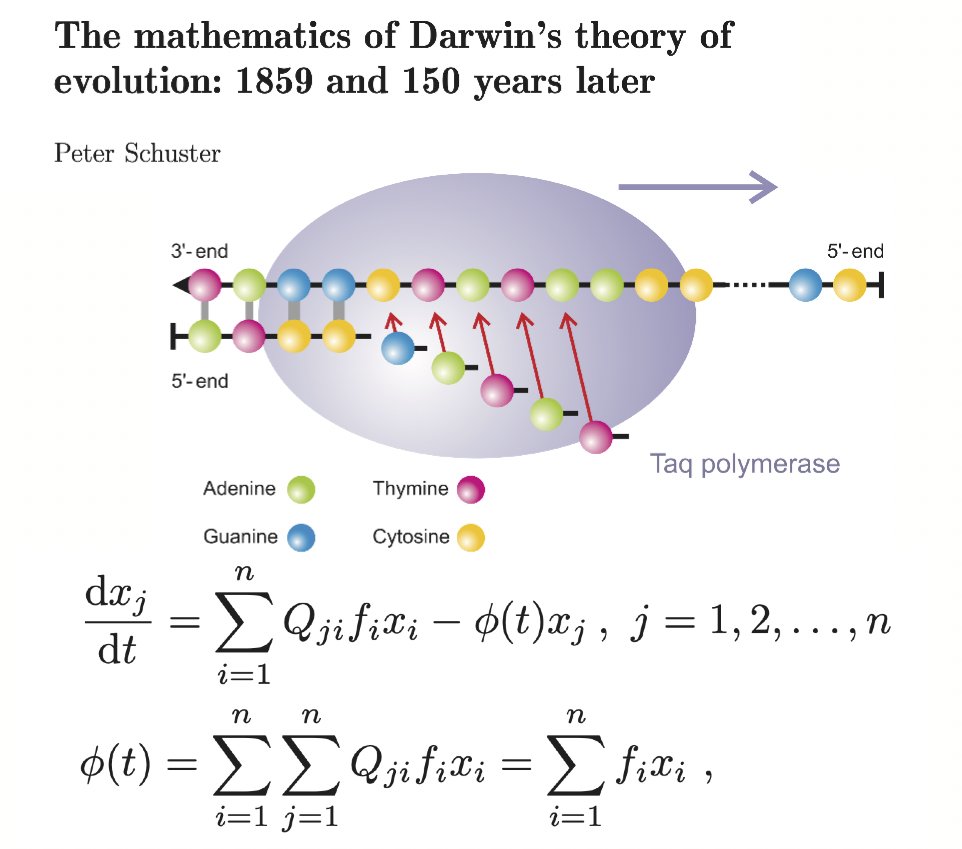
How do we express Darwin's theory of Natural Selection in mathematical terms? One of the best and most elegant papers about this came from @univienna and @sfiscience external professor Peter Schuster https://t.co/dmQhy7pR5N
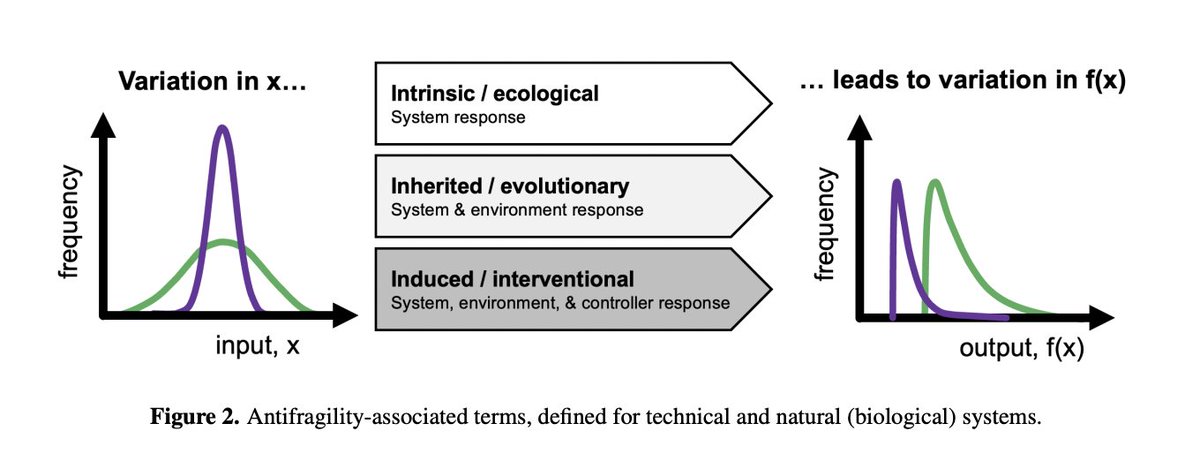
New #antifragility preprint:
"Antifragility as a complex system's response to perturbations, volatility, and time"
wherein we define scales of @nntaleb's antifragility:
https://t.co/mWjYS8o5Yu
@mathoncbro@nntaleb Will read, looks great! Initially, figures and your summary remind me of trait-driver theory from macroecology. In short, structure of moments expansions of (plant) measurables contains information about (plant) responses to environmental forcing.
@FreyaHolmer Love your posts. Glad to see this in your repertoire. I wish everyone learned linear algebra. There are some nice connections between performing matrix inversions and integrating the Frenet-Serret equations.