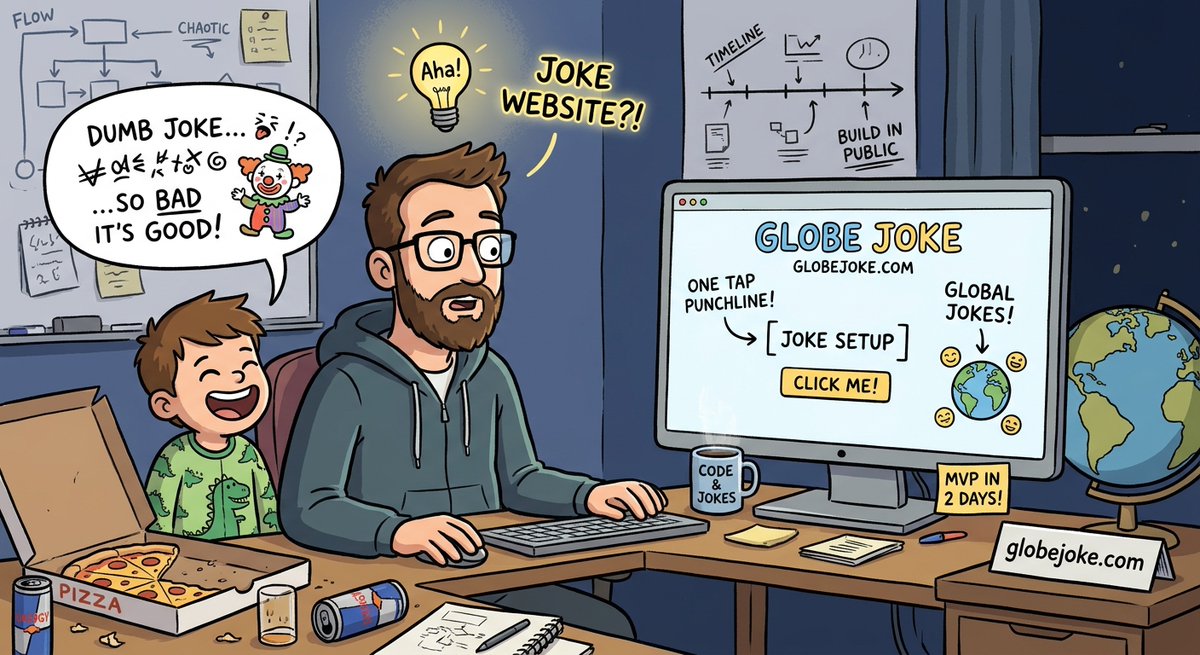
A few nights ago, my kid hits me with a joke.
A dumb one. The kind that's so bad it loops back around and actually gets you. I laugh way harder than I should, and then I can't let it go. Not the joke. The feeling. Twenty seconds of laughing resets my whole evening.
Then the obvious question showed up: why isn't there just... a website for this?
And I don't mean one of those old "jokes dot com" graveyards. Think about how it actually works now. We're all busy. We're all fried. Nobody's opening a tab to go hunting for a joke. Jokes find us. Buried in the feed, squeezed between a political rant and somebody's vacation photos. You scroll and hope one lands, and usually you get twelve ads instead of a punchline.
Everybody's got a firehose of bad news pointed at their face. Nobody built a decent faucet for the other thing.
So I built one.
The MVP took a day, maybe two. Making the thing exist was honestly the easy part. The work was everything after it. The optimizing. The scraping. Digging through mountains of internet junk to find the stuff that actually lands. And a big chunk of it is old material. Folk jokes, classics, stuff that's been passed around for a century. Which means actually tracking down sources, dealing with licensing, and honoring takedowns instead of just grabbing whatever's lying around.
A few things I got stubborn about:
• One tap to the punchline. You get the setup, the punchline stays hidden until you ask for it.
• Every joke lists where it came from. If it's yours and you'd rather it weren't there, tell me and it's gone.
• No account. No paywall. No "sign up to see the punchline."
• A joke of the day and a random button, for when you need one right now.
It's free. Nothing to buy, nothing to subscribe to, no growth plan. It's not a startup, it's a website.
My kid told me one joke, and now there's a place full of them, from all over the world.
We're all a little tired out here. That's the whole pitch.
Go laugh at something stupid: https://t.co/kpoiJrq9MZ
Metí 200$ en Rakazo, ajusté los parámetros y me fui a la cama.
Abrí la app al despertar y la cuenta marcaba 2.811,31$.
El bot operó solo toda la noche: un 14,06x de rentabilidad sin que yo tocara nada.
Cada operación siguió al pie de la letra las reglas que dejé configuradas.
6 mesas de agentes trabajando mientras dormía:
→ Recorrieron las sesiones de Asia, Europa y el pre-market de EE. UU., analizando 11.400 valores en NYSE, NASDAQ, LSE y la Bolsa de Tokio
→ Descartaron lo que no encajaba, revisaron volumen, liquidez y resultados recientes, y se quedaron con 94 candidatos
→ 41 operaciones abiertas: 29 en verde y 12 en rojo
→ Stop-loss automático en -8% y toma de beneficios en +15%
Quien movió todo fue mi Rakazo.
La mejor operación de la noche dejó 760$ en PLTR, y la peor apenas restó 3,50$.
200$ dentro, una noche de sueño y la cuenta en 2.811,31$.
Enlace abajo👇
No dashboard, no alert: if ChatGPT sent you a hundred visitors last month, you'd never know. The 3-layer setup instead — one GA4 channel, dark-traffic triangulation, a monthly prompt panel. Afternoon to build, 15 minutes a month. https://t.co/9wDWbUkJOX
That chill physics vibe is super tempting. I’m actually leaning toward a 3D browser game where you fly through the inside of a neural network—navigating latent spaces, dodging transformer attention heads, and solving physics puzzles using vector embeddings. Three.js makes the browser load blazing fast anyway.
Decided to dive into 3D web game dev using AI to handle code & assets.
Thinking about these 3 directions:
1-Low-poly sci-fi space runner
2-Voxel-style mini dungeon crawler
3-Chill 3D physics puzzle
Which one should I build first?
@CarolRehor Precisely. Treating AI search like traditional Google Search Console is a dead end. Synthetic prompt monitoring is the ground truth layer until LLM providers normalize referral standards.
@M__Houser This is wild! Mind sharing a bit on the backend/DevOps side if you don't mind? Curious how you handled server hosting, state management, and infra scaling for a game this scale without a coding background.
@QiuBNB Weibo and Xiaohongshu are great for local trends, but X has that unique global chaos and niche interest groups that make the extra friction worth it
@DesignArena@AnthropicAI@OpenAI Claude Fable 5.2 taking #1 on 3D Design is well deserved. Spatial understanding is becoming a core benchmark for frontier models.
@jason_zig Yup,user-reported attribution is a signal of mindshare, not immediate conversion. Combining qualitative survey optics with hard analytics leads to cleaner insights.
Great research. The biggest takeaway for me is that AI citations and AI recommendations are two very different things.
We're building https://t.co/hQl9dB4SNC around that distinction.
The opportunity isn't another GEO score or SEO checklist. It's helping brands understand:
Why AI recommends their competitors instead of them.
How their visibility changes across AI engines over time.
What evidence supports those recommendations and what they can actually improve.
Technical SEO is the foundation. Measurable AI brand visibility is the product.
I'd also add one thing to your playbook: a single AI audit is a snapshot, not a reliable measurement. Repeated tests and transparent methodology are essential.
Really useful breakdown. Thanks for sharing!
@perplexity_ai Significant unit economics improvement for enterprise LLM workloads. High performance at 40% of the market cost changes the deployment calculus.