for anyone who builds with a coding agent
one prompt is too vague, so the agent guesses
say or type your idea. https://t.co/cIamxbZp0E does the groundwork: competitor research, a PRD, a tech design, a brand kit and a story-by-story roadmap
download it, then build. first idea free.
a data scientist's coworkers are worried because he hands every analysis to ai now.
where's your line? what's the one thing you still refuse to hand to an agent?
claude code can now write one small script that calls a bunch of tools at once, instead of 15 back-and-forth calls. anthropic says up to 85% fewer tokens on agent tool use.
honest question: is cost what stops you from letting agents run longer, or is it trust?
@TheEaglegon agreed, as you mentioned proper handoffs and checkpoints are required for one to trust the long chain entirely. plus have some restricted actions that agent asks approval/permission for
cursor, then claude code, then codex, then back to claude code.
switching coding agents costs about nothing now. the only thing that moves with you is your repo and your rules file.
which one would you never drop?
i think you all know about my choice xD
@jombotey did you migrate existing users over or only use supabase for new projects? that's the part of dropping custom auth that always looks scary to me
@mayank_twts does the wake event carry the actual payload, like which check failed or the review comment, or just "something changed"? that decides whether the agent needs a fetch step after waking.
@pradyum1916 which part do you expect to hurt most on a rewrite, auth or the data model? that's where i'd guess the real lock-in is, curious if anyone's actually felt it
@AIGryffindor what are you shipping, a fresh build or changes in an existing codebase? that decides it more than the tool does. and how much of your week is review vs writing?
@aiwaremax curious how the redesign guard works in practice. does it block claude from touching layouts that already shipped, or just flag the drift after the fact?
building ui at various companies taught me one thing: the screen is never the slow part. the animation timing is.
what's the ui detail users always notice but never mention?
if tokens cost 4x tomorrow, i wouldn't quit. i'd just stop letting the agent "explore".
what's the first thing you'd stop doing with your agent if tokens got 4x pricier?
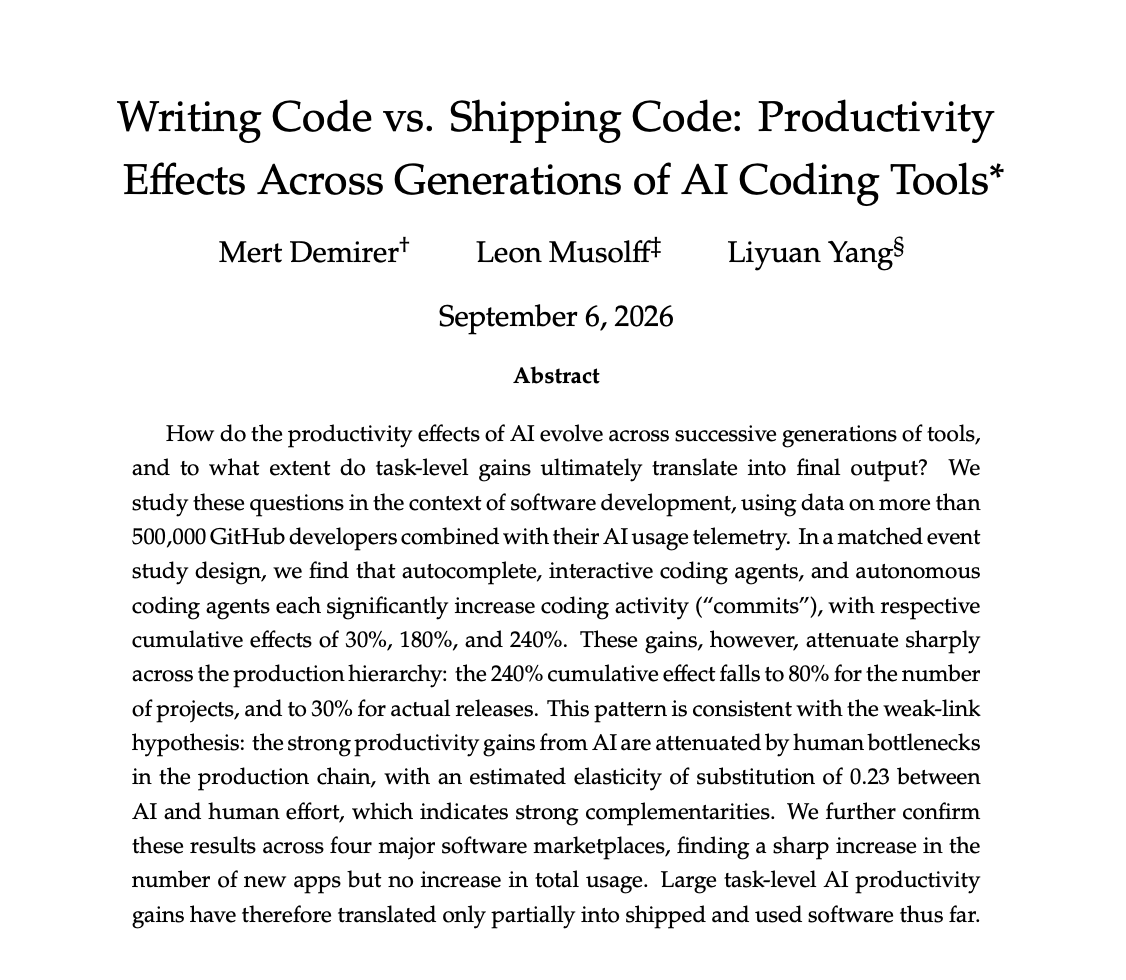
500k github devs tracked. commits up 240% with coding agents. actual releases up 30%.
we didn't get faster at shipping. we got faster at starting.
how many unfinished repos are sitting on your machine right now?
MIT published the most uncomfortable paper on vibe coding.
They tracked every new app that dropped on the app store, play store and chrome web store after coding agents showed up.
And the findings are brutal.
devs who started using autonomous agents wrote 25.5x more code. commits up 240%. repos touched up 80%. actual releases? +30%.
So like... where's the other 95% going?
In the trash.
After adopting tools claude code, devs wrote 7x more lines and deleted 12.2x more. repos abandoned within 30 days went from 60% to 69%.
and the storefront side is where it gets kinda bleak. new apps launching across the app store, play, chrome web store, sourceforge - roughly doubled since early 2025.
user engagement? didn’t move.
that's the part that messed with me honestly. twice as many apps shipping into the void. nobody downloading more, nobody using more. just... more noise on the shelf.
I’ve been thinking about this bc i felt it myself. i shipped three "projects" last month with claude code and im pretty sure zero humans used any of them.. its so easy to start something now that finishing stopped meaning anything.
writing code was never the real bottleneck. shipping something coherent, reviewing it properly, building a thing anyone wanted - that was.
everyone's writing off software engineering this week.
agents write the code now. someone still has to know what's worth building and notice when it's broken.
what part of your job got more valuable since agents showed up?
In the last few days, I’ve seen a lot of people writing off software engineering and saying there’s no value left in software.
To me, that’s preposterous.
If anyone has watched Hidden Figures, they would have seen how NASA’s transition to IBM mainframes changed the role of its human “computers,” who previously performed calculations by hand.
Instead of becoming obsolete, people like Dorothy Vaughan learned to program these machines, using their deep understanding of mathematics and impeccable logical thinking.
NASA went on to accomplish bigger and better things.
This era is no different. We tend to overestimate technology and underestimate the value of human intellect.
Humans adapt. Humans think. Humans build.
Software engineering is not about coding and writing together perfect alphanumeric strings. It’s about problem solving. It’s about building things to solve problems with the tools available.
If the tool is assembly, so be it. If it’s a high-level language like Java or C++, so be it.
And if it’s an LLM, then again, so be it.
The principles of engineering and problem solving never change.
If it really is different this time, why don’t the people saying software engineering is dead trust their company’s security to infrastructure generated entirely by Claude Code?
Feel free to build your own load balancers, network proxies, firewalls with AI.
I would love to see anyone who says software engineering is dead put their money where their mouth is.
It’s quite ironic to write off software engineering when organizations like FBI are being subject to cyber attacks.
It will be software engineers who will rescue us from this unsafe world and rebuild our systems for an ai first world.
Software engineers will use LLMs to build incredible new products. But there will be a massive difference between a well-engineered product and something vibe coded by people who don’t understand the systems they’re building.
Generating code is not the same as engineering software.