@Kimi_Moonshot built a 2.8 trillion parameter model that would need more than 5TB in BF16.
The harder problem was not training it. It was making it practical to serve.
Kimi K3 activates only 104 billion parameters per token, but sparsity alone does not solve the memory and bandwidth bottlenecks.
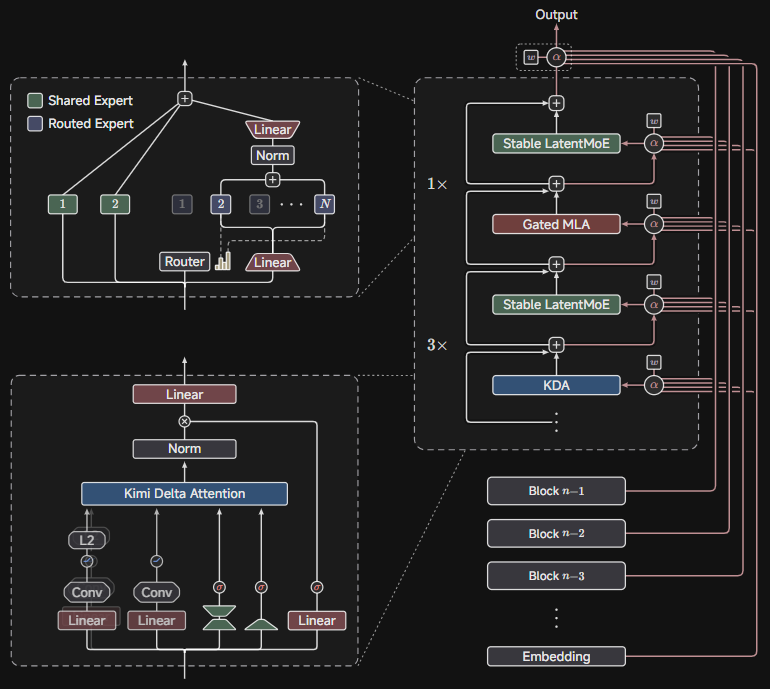
Moonshot redesigned the model across four layers:
> LatentMoE compresses tokens before expert routing
> KDA keeps a fixed-size attention state
> MLA compresses the KV cache for exact retrieval
> Native FP4 training cuts the weight footprint
Kimi K3 combines three KDA layers with one Gated MLA layer. This gives it constant-memory attention for most layers while retaining full context retrieval where it matters.
That hybrid design makes its 1 million token context practical without a KV cache that grows across every token and layer.
Quantization-aware training handles the remaining weight problem. Moonshot trains the post-training pipeline in low precision instead of compressing the model after training.
Kimi K3 has more than twice the parameters of Kimi K2, but its deployed memory footprint grows by a much smaller ratio.
45 min into a call with my expensive ass attorney, my son thought it would be hilarious to punch me in the nuts.
1. F him. 2. I agree, it was hilarious
We ran Thinking Machines Inkling through our private coding-agent bench.
Same harness as the rest of the field. Signaldesk v1: 13 planted bugs in a ~7k-line full-stack app, network-off Docker sandboxes, hidden tests at score time.
Across 8 models and 553 attempts, Inkling landed 6th.
> 89% resolve (58/65)
> $0.104 per successful fix
> 61s average attempt
> $6.01 total spend
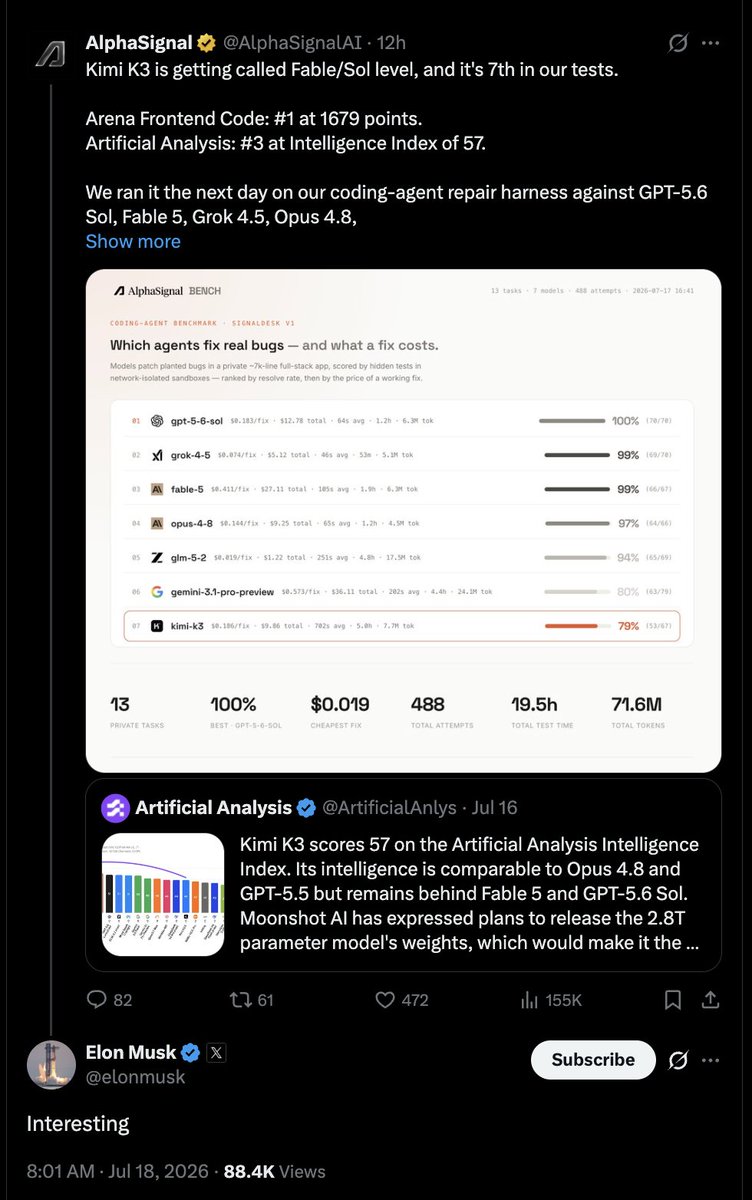
That puts it under gpt-5.6-sol (100%, $0.183/fix), grok-4.5 (99%, $0.074), fable-5 (99%, $0.411), opus-4.8 (97%, $0.144), and glm-5.2 (94%, $0.019). Above gemini-3.1-pro-preview (80%) and kimi-k3 (79%).
Localized bugs and security tasks were clean. All three injection/auth tasks went 5/5. Easy and moderate tiers both hit 100%.
The gap is deep investigation. Expert-tier resolve dropped to 20%. On sd-013 ranking-tiebreak it scored 1/5. On sd-003 empty-digest it scored 2/5. Peers cleared sd-013 at 5/5 (kimi 4/5).
Behavior matches the miss pattern. Highest turn count in the run at 20.2 average turns, 2.4× gpt-5.6-sol’s 8.3, with the lowest average output tokens in the field. Fast wall clock (2nd after grok at 46s). Sparse thinking, lots of tool loops.
Route high-stakes multi-file bugs elsewhere. Keep Inkling for fast, mid-depth agent fixes where open weights and $1/$4.05 pricing matter.
Full Inkling deep dive plus how we read sparse routing and self-host cost is in the article. Bench tables in the first reply.
the "slower and more expensive" part comes down to retrieval quality. a search API hands you ranked web results, but your agent needs a retrieval index, so it pulls 10 pages, reads all of them, and throws most away. you're paying tokens to filter noise the index should've caught first.
curious what Antonio's self test measures. recall, or cost per correct answer?
AlphaSignal Workshop - 5.5M wasted queries a year. Is your agent one of them?
If your agent’s web search is just an LLM + search API, it’s probably slower, more expensive, and less accurate than it should be.
July 28th @ 10a PT, @seltz_ai founder Antonio Mallia (built web search for Alexa) runs a live side-by-side naive setup vs. real index, same queries, plus a self-test you can run on your own stack same day.
Reserve your seat for this virtual workshop today: https://t.co/6vsD0pwJax
AlphaSignal Workshop - 5.5M wasted queries a year. Is your agent one of them?
If your agent’s web search is just an LLM + search API, it’s probably slower, more expensive, and less accurate than it should be.
July 28th @ 10a PT, @seltz_ai founder Antonio Mallia (built web search for Alexa) runs a live side-by-side naive setup vs. real index, same queries, plus a self-test you can run on your own stack same day.
Reserve your seat for this virtual workshop today: https://t.co/6vsD0pwJax