Good conversation with the team at Yahoo Finance this morning on the bond sell-off and what, if anything, to do about it.
Higher rates have spooked some of the same people who complained eight years ago that fixed income offered no return. The 10-year auction drew tremendous demand, but the government borrowed at the highest rate it has paid since 2000. A mixed bag, though there is finally a real return in rates. You can't time it and it will be bumpy, but if you believe it works, this is where the return is.
With the sell-off rippling out globally, the hardest conversation with any allocator is still international diversification. Recent experience says it will sting, and AI spending is a growth story that favors America. We still think you stay diversified, because mathematically it wins out in the long run.
The bigger threat to the Fed is political. There's no great economic reason to cut today, much the opposite, yet the President is unusually invested in the 10-year and has floated trade policy in lieu of monetary policy to get lower rates. Either rates get pushed down artificially, through something like yield curve control, or they come down because something else has gone wrong.
Inside the Fed, a 12-0 vote hides two completely different camps on how inflation works. Our Warsh GPT keeps saying hold and make no promises, and the jobs report gives the committee room to pass in October.
I think they do exactly that.
Watch Here - https://t.co/1qq0nY2ODr
#FixedIncome #FmInvestments #FederalReserve #TreasuryMarkets #AssetAllocation
Wednesday morning brought a rare bit of upbeat inflation news for consumers and Fed voters alike. The Fed’s preferred inflation measure, PCE or Personal Consumption Expenditures, actually came in a little lighter than feared, releasing a little of the pressure for higher short-term interest rates, and potentially delaying (but not eliminating) a second 2026 Fed rate hike.
Headline PCE matched consensus at +0.3% on a month-over-month basis, but was below consensus on a core basis, +0.2%, vs +0.3% expected. On an annual basis, PCE was up 3.4%, or 3.0% for core, a smidge better than feared, though still well above the Fed’s 2% target. Still “work to do,” as Warsh said.
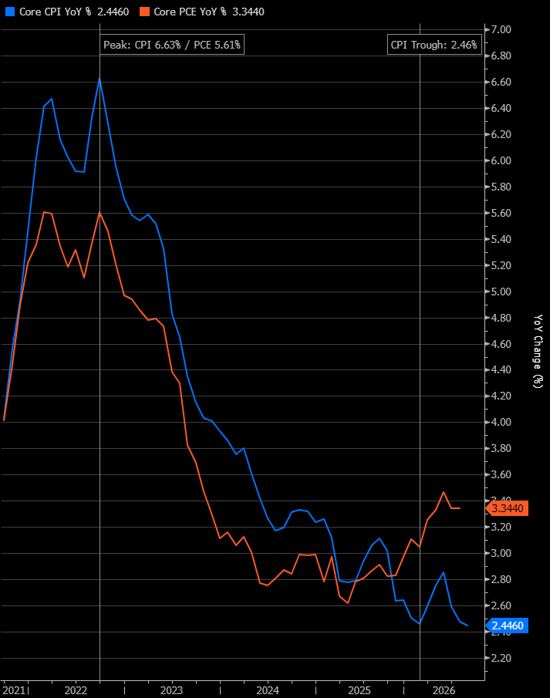
For many years, faster-reacting PCE lagged behind the more widely followed Consumer Price Index (which prices TIPS), but of late PCE has pushed above CPI, a reflection of some differences in the measures, in particular how they account for healthcare. CPI in August rose 0.4% on a seasonally adjusted basis, up 3.4% from a year earlier. The Fed has become increasingly frustrated with the stubborn persistence of inflation above target – it has been running above the 2% level for more than five years. That helps explain the FOMC’s recent quarter-point hike in the Fed Funds target range to between 3.75% and 4% - and the market’s conviction that more rate hikes await. Just a few days ago, there was consensus that the next hike will arrive at the FOMC meeting in late October, less than a week ahead of the midterms – but the PCE report has spurred a consensus reversal. The conventional wisdom is that the Fed will stay put in October, and hike in December.
In a speech Monday, Fed Governor Lisa Cook made it clear that no quick fix for inflation is likely. “[I]n coming months I expect to see continued pressure on inflation from the AI buildout,” she said, “and from the pass-through of higher oil prices and supply chain disruptions associated with the conflict in the Middle East.”
Meanwhile, one potential outcome of upticking yields - the long-bond sits at 5.63%, the highest since June 2002 - could be a shift in the Treasury’s issuance strategy to simply suspend selling 20- and 30-year bonds. Uncle Sam could focus at the other end of the curve and save some money for taxpayers over time.
That sounds radical, but the government has often changed issuance strategy. In 1986, the Reagan Administration stopped issuing 20-year bonds. Bill Clinton’s Treasury eliminated seven-year notes and reduced 30-year auctions. When George W. Bush was president, the Treasury suspended 30-year bond auctions for more than four years, from October 31, 2001, until Feb. 9, 2006. The question is not whether Treasury can remove these maturities—it has, it can—but whether the savings justify the resulting financing and interest-rate risks. If PCE comes in hot, expect another uptick in rates - and heated whispering about what the Fed - and the Treasury - might do in response.
A Modest Proposal
For Preventing the American Dream from Interfering with the Proper Functioning of the Economy, and for Making the Disappointments of Aspiring Homeowners a Cause for Public Rejoicing.
The Wall Street Journal columnist Allysia Finley recently wrote a piece headlined “Hurray for Higher Mortgage Rates,” which details the advantages of soaring costs for home loans.
Sound economics underpins her argument. Higher rates reduce demand. Fewer marginal buyers bid on houses. Investors retreat. Prices adjust. Capital gets re-allocated. Finley notes approvingly that foreclosures have risen, returning more houses to the market. And that is where Finley-nomics starts to sound downright Swiftian.
It’s the “hurray” I struggle with in particular.
She seems to have absorbed the form but not the true message of Jonathan Swift’s A Modest Proposal. In case you never read it, Swift’s legendary 1729 essay suggested that impoverished Irish parents sell their young children as food to wealthy English landlords. “[A] young healthy child well nursed, is, at a year old, a most delicious nourishing and wholesome food, whether stewed, roasted, baked, or boiled; and I make no doubt that it will equally serve in a fricassee, or a ragout,” he writes.
Swift's narrator cloaks the appalling proposal in the language of economic benefits. But beware the elegant calculation that requires overlooking the people being counted.
Perhaps a few other modest proposals:
We could ease wage pressure by encouraging layoffs. We could improve pension finances by moving retirement to age 100. Making groceries outrageously expensive - we’re already experimenting with that one - ought to cure excess consumption, while addressing obesity to boot. To discourage spendthrifts, repeal usury laws.
Former Fed Chair Jerome Powell, while running one of the most aggressive tightening cycles in decades, regularly ended his remarks with some version of: “We understand that our actions affect communities, families, and businesses across the country.”
Powell understood the tradeoffs. Many economists miss the forest for the trees. The yield curve is fascinating. Financial conditions are measurable. “Demand destruction” fits nicely into a research note. A basis point can be ignored until you multiply it by a mortgage.
Consider the first house someone can’t buy. Or the move nearer family you cannot make. Or the business that never opens, and the employee who isn’t hired.
Of course, sometimes the economy needs to slow. Sometimes, credit should be tighter. Sometimes, the Fed’s job is to make financial conditions uncomfortable.
But don’t cheer human discomfort. Markets turn lives into numbers so we can understand them. Good policy remembers to turn the numbers back into people. Let’s save “hurray” for a soft landing.
Where’s gravity when you need it?
Over the last month, we’ve had a quarter-point Fed Funds hike, a weaker-than-expected jobs report, a softer-than-expected reading on PCE (the Fed’s favorite inflation gauge), a long-bond buyback program by the Treasury, and ongoing serious debates about the risks of AI (or SI, for the White House appeasers in the group) Armageddon.
And where has that all left us?
Just like Elphaba. Defying gravity. (Theatre kids will get that one.)
The 30-year sits at 5.7%, a 24-year high, while the 10-year at 5.3% likewise has its highest yield since 2002. Meanwhile, 30-year mortgage rates have reached 7.5%; Brent crude is above $100 a barrel; and diesel remains north of $6 a gallon. Oh, and in case you missed it, Russia reportedly had a lab leak involving Yersinia pestis, a bacterium that causes bubonic plague. We’ve had a measles outbreak, so why not a little dose of the Black Death?
Anyway, as I discussed in an appearance on CNBC Europe early this morning, the big question for the markets now is what (if anything) is going to stop the spike in yields. And the short answer is, there’s nothing especially obvious.
A slowdown in economic growth would do the trick, but the ongoing tech spend-a-thon for AI data centers shows no signs of slowing and instead continues to be a major driver of economic growth. A reversal in the employment market would turn the tide, but the soft August report was more suggestive of an economy at full employment than one with true weakness. An end to hostilities in the Middle East would help, but there seems little near-term prospects for that to happen: the White House just pledged to send a third aircraft carrier strike group and an additional 10,000 troops to the Mideast, up from the roughly 50,000 GIs now in the region.
What would really cheer the market and push yields down would be any signs of budgetary restraint in Washington, but neither meaningful spending cuts nor substantial tax increases seem very likely, so the federal debt will surely grow beyond the current $40.2 trillion (and counting).
While the burden for steering the economy falls most heavily on Fed Chair Kevin Warsh, who seems single-mindedly focused on bringing down inflation, don’t ignore the role of Treasury Secretary Scott Bessent, who appears to have a difference of opinion with the Fed on where rates should go from here.
Bessent (a hedge fund manager) last week made an eye-opening hire, bringing on the former Jefferies chief market strategist David Zervos (a macro whisperer) as a “counselor,” effective immediately. Zervos (a/k/a Kellyanne Conway’s boyfriend) is on the record supporting Bessent’s move to accelerate Treasury’s repurchases of long-dated debt and has pushed for cutting interest rates. Zervos had been considered a candidate for Fed Chair, with President Trump ultimately choosing Warsh instead. What’s he doing hanging around with Bessent? Well, I don’t know. But something big seems to be brewing.
Clearly, the market’s crystal ball has gone on the fritz.
And for that you can thank the wizard in chief.
The seer in question, of course, is Federal Reserve Chair Kevin Warsh, who has made it his policy not to give any hints at all about his thinking on the future course of interest rates, the economy, the major league baseball playoffs, the potential for an AI-driven human extinction event, or much of anything else. (But if you like that kind of thing, maybe head over to Kalshi, where it shows a 67% chance President Trump will be impeached for a third time before 2028.)
But nature and the financial markets abhor a vacuum - the concept started with Aristotle, who coined the fantastic phrase horror vacui - and so have come to rely more on the pearls from the rest of the interest rate commentariat. Jackson Hole leads me to believe Kevin learned he needed to say more than he hoped, which will take time to calibrate.
One week ago, the much-watched but often widely off target CME FedWatch indicator showed a 64% chance that the Fed will once again hike interest rates when it meets in October. This morning, after a flurry of dovish comments from various non-Warsh members of the Fed, and a softer-than-forecast Friday-morning jobs report for October from the Labor Department, the same indicator shows just an 18% chance of a hike at the October meeting, which as I’ve noted before is less than a week before the midterms.
What kind of an indicator swings nearly 50 percentage points in a week?
One that blows around in the wind, that’s for sure.
We need better prognosticators, clearly. Where’s Gandalf? Where’s Dumbledore? Merlin? Yoda? Nostradamus? Bill Gross? Bueller? Bueller? Bueller? Anyone?
Meanwhile, there is little reason to think the Fed will go one-and-done on rate hikes, softer jobs reading notwithstanding.
Let’s not forget that PCE and CPI are both running above 3%, well ahead of the well-entrenched 2% inflation target. And while the recent sharp jump in interest rates has at least briefly paused, thanks to the meh jobs numbers, the fact remains that long rates are sitting at multi-year highs, with the 30-year still flirting with a 5.6% yield, the highest in nearly a quarter century.
And 30-year mortgage rates are now north of 7.5%, the highest level since 2024.
Granted, rate policy is dispassionate, but we all need some compassion for home buyers here. Soaring mortgage rates are bad news for both home buyers and sellers, adding to the pressure consumers are feeling from both higher oil prices and soaring food costs. Diesel prices remain near record levels. Brent crude still hovers at close to $100 a barrel. In San Francisco last week, you could find gas as high as $7.29 a gallon.
Will all of it matter to voters? We’ll find out in 32 days. No guessing required.
Today, bad news is good news.
The American economy added just 29,000 jobs in September, well short of the roughly 90,000 jobs economists had expected, and down from a revised increase of 133,000 in August. The unemployment rate ticked up to 4.2%, above the 4.1% level that had been expected, and up a tenth from August. Meanwhile, average hourly earnings for private nonfarm payrolls was up a paltry 5 cents, or 0.1%, to $37.81. Over the past 12 months, average hourly wages rose3 %, continuing to lag inflation.
Also, the Labor Department revised down their figures for both July and August by a combined 60,000 jobs: July was revised down by 31,000 to a loss of 10,000 jobs, rather than an increase of 21,000. August was revised down by 29,000 jobs.
With immigration throttled, the number of jobs needed each month to hold unemployment flat has collapsed. This month’s number is probably about breakeven. A year ago, unemployment was 4.4%. It's lower now.
The takeaway here is crystal clear. The bond market has concluded that the softer jobs report drastically reduces the potential that the FOMC will hike short-term interest rates for a second meeting in a row when it convenes later this month, just ahead of the midterm elections. The CME FedWatch tool now shows an 18% probability of an October rate hike, down from 64% just a week ago. But remember that the odds of another increase had already begun to decrease sharply, following dovish commentary this week from two key Fed members.
“There is no need for urgency,” Federal Reserve Bank of New York President John Williams said in a speech on Tuesday in Buffalo. Fed Vice Chair Philip Jefferson on Thursday delivered a similar message (maybe a little more obtusely). “My colleagues and I will need to come to our own judgment, which may take more time,” he said.
Ergo, on Friday morning, Treasuries initially rallied sharply - and yields fell - across the curve – but within an hour, prices were little changed from a day earlier. Stocks rose about 1%.
The economy and the job market continue to move along at a steady pace, some months better than others, with the same industries generally showing the strongest hiring month after month. Health-care employment was up 17,000, a slower pace than the average 33,000 increase over the last 12 months. Construction jobs were up 11,000, about in line with recent trends. Manufacturing jobs grew 9,000. There was little change in most other major industries.
As the last reading before the midterms, this particular jobs report carries extra weight - the next one comes Nov. 6, three days after voting ends. There is fodder here for both sides of the aisle. Republicans will likely be relieved that the Fed is not likely to raise rates at the October FOMC meeting. But Democrats will point to the softer job growth - and the failure of wage growth to keep up with inflation. Expect to hear a lot of discussion about that in the next five weeks.
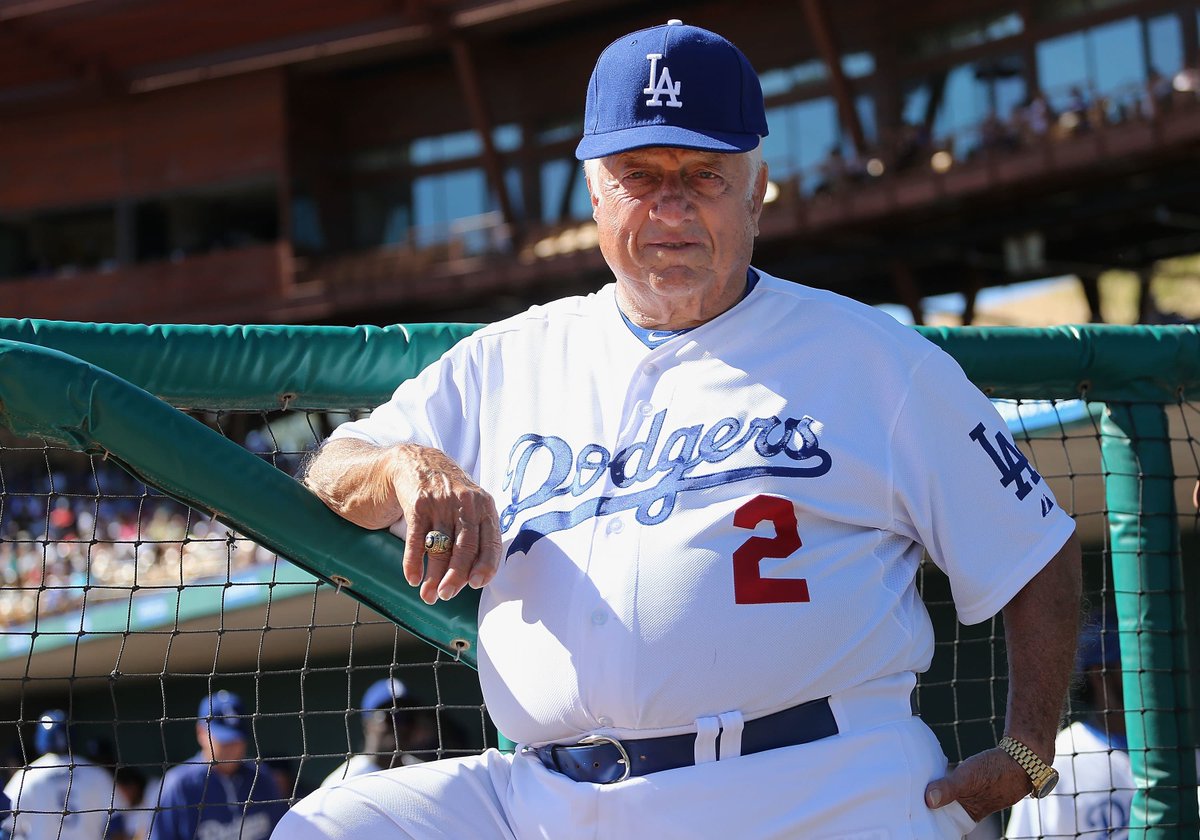
The great Los Angeles Dodgers manager Tommy Lasorda once made a smart observation about the slim margin that separates great baseball teams from bad ones.
“No matter how good you are, you're going to lose one-third of your games,” Lasorda said. “No matter how bad you are, you're going to win one-third of your games. It's the other third that makes the difference.”
Given the season is 162 games, 54 games determine your fate.
This year, Lasorda’s Law held. Every MLB team won - and lost - at least 58 games. (There have been exceptions, like the amazin’ 1962 New York Mets, who went 40-120, and Ichiro Suzuki’s 2001 Seattle Mariners, who went 116-46.)
You need runs to win, but timing is everything. The Cleveland Guardians went 85–77 to win the AL Central with just a +11 run differential. The Detroit Tigers were +71 runs, but finished 76-86, 9 game behind, in fourth place. (During one 10-game stretch, the Tigers won games 8-0 (twice), 11-0 (twice), 13-1 and 14-0.) A win is just a win.
In baseball, aggregate superiority is not the objective.
Soccer thinks differently. Goal differential can break ties - and has often been a determining factor in eliminating teams from the World Cup. Cricket uses the “Duckworth–Lewis–Stern method” to calculate scores for games interrupted by rain. In soccer and football, games can end in ties. Baseball does not do ties. Do or do not, as Yoda said.
It strikes me as particularly American that what matters is not just scoring runs but lighting up the scoreboard at the right time.
That also happens to be how Americans elect Presidents.
You must get enough votes in the right places. Five times, candidates have won the popular vote, but lost the Electoral College, which is winner-take-all. (Except for Maine and Nebraska.)
In 2016, Hillary Clinton received 2.9 million more popular votes than Donald Trump, winning California by 4.3 million votes, and New York by 1.7 million. What mattered more was Trump’s 44,292-vote edge in Pennsylvania, his 22,748-vote win in Wisconsin, and his 10,704-vote margin in Michigan. The election swung on less than 78,000 votes in those three states - not Clinton’s coastal landslides.
The knock-on effects eventually touch the financial markets. Elections determine Congress and the White House, who create both legislation on taxes and market structure, and appointments to the Cabinet and the Fed.
Killing the Electoral College would require a constitutional amendment. In a MacGyver-style workaround, some states formed the National Popular Vote Interstate Compact (or NPVIC), with members pledging electoral votes to the nationwide popular vote winner once states with the required 270 electoral votes join. States with 222 electoral votes have committed. Pennsylvania, Michigan, Wisconsin, and Nevada would boost the total to 272. So, it’s not impossible.
Until then, American politics has something in common with America's pastime:
Winning isn’t everything, it’s the only thing. And it’s complicated.
And if you're a Nats fan, there's always next year.
And now, let’s spare a moment to wish kind thoughts for anyone currently planning to buy a house with borrowed money. Be nice to them because they are not having a good time.
This past week, rates on 30-year mortgages neared 7.5%, the highest level since 2004, up a half-point in just two weeks. As Mortgage News Daily writes, that kind of jump in the past has happened on average less than once per year. Barron’s ran a story this week that asked, “How High Can Mortgage Rates Go?” and then answered the question with another question: “How Does 9% Sound To You?”
Well, if I were trying to get a mortgage right now, you might hear a blood-curdling wail.
Moody’s chief economist Mark Zandi told Barron’s that there’s nothing really stopping the 30-year mortgage rate from hitting 8%, or even higher. Whether we’ll get to that point will depend on lots of things, of course, including the status of the war in Iran, the path of oil prices, the ongoing flood of issuance by would-be data center builders, the results of the midterms, and the next set of data on inflation and jobs, among other things.
But the path of least resistance certainly seems higher.
As you know, the Fed’s latest “dot plot” calls for at least one more hike in the Federal Funds target rate this year, and one more in 2027 - though whether that happens, and whether in fact two more hikes will be enough to get inflation closer to the 2% target, remains to be seen. The CME FedWatch indicator now shows a 64% chance for a quarter-point cut at the October FOMC meeting, less than a week out from the midterms, with a 50% chance of another hike at the year’s final FOMC meeting in December.
As economics blogger Matthew Klein observed this week, the limited tanker traffic through the Strait of Hormuz, Trump’s ongoing tariff push, and other transient factors are not good reasons to hike rates, but the economy’s robust growth suggests there is room to boost rates without materially impacting the hot job market. As Klein writes, “at least some Fed officials have belatedly realized that underlying nominal growth continues to run too fast to be consistent with the central bank’s alleged 2% inflation target,” noting that prices for many goods have been rising 1 to 2 percentage points faster in recent years than before the pandemic.
If 30-year mortgage rates stay above 7%, there will be ripples for the housing market. The Wall Street Journal theorizes demand will rise for ARMs and interest-only mortgages, which offer lower ARPs but add an element of risk. The Journal notes that the supply of existing homes for sale recently hit the highest level since 2019 - but asserts that the trend could reverse if sellers decide to hold homes with far lower mortgage rates.
Rates are back to about the same level as 1996, when Jamiroquai released the seemingly aptly named Traveling Without Moving, with the lead single “Virtual Insanity”. I leave you to listen and unpack.
Higher, and sooner. The direction interest rates are taking is unnerving the bond and equity markets alike.
To review: the Fed last week hiked the Federal Funds rate target by a quarter point, to the 3.75% to 4% range, while releasing a revised “dot plot” that pointed to at least one more hike this year, and another in 2027. But rate hikes are like cockroaches - you never get just one.
On Wednesday, the worry level stepped up a notch. Ten-year Treasuries had their worst day in over a year, pushing the yield to 5.11%, the highest since 2007, just ahead of the Great Recession. The yield on 30s hit 5.4%, a level likewise last seen 19 years ago. It was the biggest one-day rate increase since the President declared his “Liberation Day” tariffs in April 2025.
The CME FedWatch indicator now shows a 70% chance of another hike at the October FOMC meeting, which will be less than a week ahead of the midterm elections. (Politics be damned!) That’s up from 55% a day earlier, 49% a week ago, and 9% a month ago. The market sees a 55% probability of two hikes by year end, and a 27% chance of three more hikes by January.
There are multiple reasons for the spurt higher. For one, fresh evidence suggests the economy is booming: S&P’s Flash PMI report showed business growing at the fastest rate in five years, with accelerating job growth.
“[B]arring the spike in demand following the opening up of the economy after the COVID-19 lockdowns, the latest improvement in business activity is the greatest recorded since early 2015,” S&P Chief Business Economist Chris Williamson wrote. “Business is clearly booming now in both manufacturing and services.”
Meanwhile, oil prices resumed their recent climb, once again pushing toward the $100 a barrel level. Adding fuel to the fire, Fed Gov. Michael Barr gave a speech making it clear he sees more hikes coming.
“Economic growth is strong and the labor market is solid, but inflation is above our 2 percent target and not clearly trending toward target in a timely way,” Barr said. “In my base case, further policy adjustments are likely to be needed to ensure inflation comes down to target in a timely fashion.” Sounds positively… Warsh-ian.
As goes the Treasury market, so goes mortgages, which have now crossed the 7% level, which is not going to do any favors for the housing market. Rising rates also impact car loans, credit card rates, and other consumer borrowing. Maybe that helps slow the markets a bit despite its impacts on consumers. Make acquiring a home or a car harder, and people start to vote differently.
So, what now? The economy is simply roaring higher - S&P says the latest PMI numbers suggest 5% GDP growth, while also noting that input costs in September jumped at the fastest rate in four years. Which brings us right back to where we started - looks like we’re heading higher, and sooner, than anyone had been expecting.
A few weeks ago, the U.S. reached a dubious milestone: federal government debt reached $40 trillion - and we’re now barreling towards $41 trillion. New record! The enormous pool of red ink didn’t exactly accumulate overnight, but the headlines triggered by that big round number have cast a fresh spotlight on an old issue. Uncle Sam’s enormous stack of IOUs is now among the reasons cited for the recent run-up in government bond yields to multi-year highs.
The problem with just throwing out a big number is that $40 trillion might as well be $40 kajillion - without proper context, it’s just a random number. (It’s like the old George Carlin joke: “Here’s a partial score, Notre Dame 7.”) So, let’s put that number in perspective.
For one thing, that $40 trillion in debt is more than every other country on earth, by a wide margin. It’s nearly twice the size of debtor #2, China, and roughly equal to the combined debts of China, Japan, the U.K., and France, the next four biggest debtor nations. This is depressing: Norway, thanks to oil resources and a smartly run sovereign wealth fund, has…whatever the opposite of debts are. A national stash.
The 40-handle is also high in comparison to recent history. Federal debt has doubled since 2017 and quadrupled since 2008. It was 1981, while Ronald Reagan was in the White House, that the debt hit $1 trillion for the first time. In the 45-year-old story about hitting the 13-digit debt level, the New York Times quoted the Treasury Department as saying, “it’s not an issue for celebration.” At the time, the Times calculated, the debt was equal to $4,700 for every American citizen. Ha! Today we’re at $117,279 in debt per American, an increase of 25x.
For the September 2026 fiscal year, the deficit will be nearly $2 trillion. That’s shy of the record $3.1 trillion in 2020 in the middle of the pandemic, but it ain’t great. Meanwhile, net interest on the debt this year will top $1 trillion - eclipsing outlays for the Department of War. We’re almost at the point where $1 of every $5 in federal revenue goes to debt service.
Celebrate good times. C’mon.
By the way: Running huge deficits isn’t inevitable. In each of the four fiscal years from 1998 to 2001, with Bill Clinton at the helm, the U.S. ran surpluses - thanks, dot-com boom! Since then, we’ve been through wars, the 2008 financial crisis, more wars, the pandemic, and now, more wars. War is hell, and it costs a fortune.
In his (or Claude’s) recent Wall Street Journal op-ed, Stan Druckenmiller noted that at prevailing rates, interest expense will reach 144% of discretionary spending by 2043. He had advice for our rulers: “[D]o the only thing that durably lowers long-term yields: address the primary deficit. Reform entitlements gradually and honestly, through means testing, indexing changes, eligibility adjustments phased in over decades—so that the burden is shared across generations instead of dumped on the youngest.”
Sorry, kids. But I am not holding my breath.
The 25 bps hike was predicted. Warsh's tone was not. Yields soared, 10s over 5, stocks fell, both rallied back overnight.
What he delivered was a reaction function: PCE at 2.0, no longer 2-ish. "Significant" means 3% or more. Trend, not a single data point.
Full take in this Fed Up video > https://t.co/lnMEW0axen
---
The information contained in this post is general in nature and for informational purposes only. It should not be considered as investment advice or as a recommendation of any particular strategy or investment product. This post is not a solicitation or an offer to buy or sell any specific security. F/M cannot guarantee the accuracy of information from third parties.
The new question: How high is up?
The FOMC on Wednesday voted 12-0 to raise short-term rates by a quarter point, setting the Fed Funds target at 3.75% to 4%. It was the first hike since July 2023. What’s now clear: the Fed is willing to defy political pressure and defend their talk, at least for now.
The fact that there was a rate hike, and the size of the increase, were no surprise. The unanimous vote raised eyebrows – it did here — given last time the vote was 9-3 for the status quo. But you didn’t need to be Nostradamus to call this one, given strong job growth, hot inflation, Middle East chaos, the spike in long rates, and Fed Chair Kevin Warsh’s firm hawkish comments at Jackson Hole on inflation.
That said, there were nuggets to chew on. The “dot plot” of the Fed members’ outlook shows expectations for one more hike this year - only two 2026 FOMC meetings remain - and another in ‘27. Whether the Fed will have the nerve to hike in October, less than a week ahead of the midterms, remains to be seen. Historically, they have opted to avoid political risk. Interim jobs and inflation data will be key. But clearly, we��re headed at least a little higher. (While the Fed hiked a single time in 1997, most cycles involve multiple increases.) Generally, 25 bps is viewed as having little lasting impact. History leads us to expect a hike-and-hold cycle with a communicated end point and criteria for cuts.
Warsh again was not a participant in the dot plot, sticking to his vow not to give forward guidance, with one exception. It was right in the Fed’s terse 132-word statement, which said “the Committee will deliver price stability.”
He’s on a mission.
The statement does not address when we reach 2%. The dot-plot calls for PCE to hit 3.7% this year but then drop to 2.3% in 2027. But the dot plot doesn’t have inflation reaching 2% until 2029. Warsh was asked about that and declined to say if he thinks we can get there sooner. His view is we would have gotten there sometime anyhow; but that this gets us there faster.
As for the recent run-up in long rates, Warsh noted three contributing factors: economic strength; “geopolitics,” a reference to Iran and the oil market; and “competition for capital,” mostly from hyperscalers seeking to fund AI data centers. Warsh also observed that commodity prices have firmed since Jackson Hole. In short, we’ve made zero progress on inflation.
Stocks slumped after the post-hike presser, reflecting surprise about the Fed chair’s hawkish tone, although why that surprises anyone is a little beyond me. Warsh wants 2% inflation, and he intends to get 2% inflation. He’s said it before, he’ll say it again. As for Treasuries, the 10-year yield fluttered but pushed back over 5%, and the 2-year yield climbed to the highest level since 2024. The worry? That two hikes become three, or four, or more, if inflation stays above 2%. Higher for longer is not a plan the markets - or the White House, which demanded 1% or less - would like to see.
Our programming was thrown off kilter this week because I’m spending a few days in (very) sunny Huntington Beach, California, which likes to call itself Surf City USA. (Full disclosure, Santa Cruz, 381 miles to the north, also stakes a claim to being Surf City. But I’m not in Santa Cruz. Love the one you’re with.)
I’m here for Future Proof Festival year 5, a modern wealth management “festival”, which is part outdoor conference and part something else. The event attracts thousands of financial advisors and the entire ecosystem enabling financial advice. Known for being outside and literally on the beach, chatting about our ETFs or the Fed is just different outside.
This is the fifth year California installment of the event, and in those five years the team redefined how we meet and become the definitive source of what’s relevant (and what’s not).
Attendees are treated to great speakers, visiting the F/m Investments booth, strolling the Surfing Walk of Fame, applying and re-applying sunscreen, staring off into the waves, asking questions of Claude, and then, uh, coming back to our booth again. And again! Between a wide array of panel sessions, there is ample opportunity for mixing, mingling, and collecting swag to bring home. You know, for the kids. Yeah. The kids.
Fed time! More on that tomorrow.
That settles it, no?
The consumer price index held at 3.4% on a year-over-year basis in August, ticking up 0.4% from July. Core CPI, ex food and energy, rose 2.4% from a year ago, and 0.3% month-over-month, a tad more than expected.
The markets had braced for this number following last week’s August employment report, with the economy adding 162,000 jobs, 3x expectations. The consensus was that the jobs number boosted the probability the Fed will hike rates when it meets less than a week from now, but that CPI would be the deciding factor.
Shortly after the release, money markets locked in a Fed hike next week. The 10-year yield dropped. Why? The 10-year prices in longer-term factors. Short-terms rates weigh less than many think. Belief in the Fed matters more. Ergo, conditions forcing the Fed to take action make the 10-year more attractive. By lunch, yields were back to pre-release levels. Expect more bumps as markets sort it out.
CPI is not the Fed’s preferred inflation measure – the central bank likes PCE, the personal consumption expenditure price index. But the next CPE print is Sept. 30, two weeks after the FOMC meeting. The two measure different things - CPI what you buy, CPE what you consume. Over the last five years, core CPI has run hotter than core CPE - but that recently flipped. In the last reading, core CPE stood at 3.34%, 90 basis points above CPI, reflecting different treatment for financial services and employer healthcare costs.
At the July FOMC meeting, three members backed higher rates, and others have said they’d support hikes without progress on inflation. And the data says: no progress. So here we go... assuming politics are overcome and that Treasury, fresh off two largely failed buybacks, does not roll out another plan forcing a reset.
Energy rocketed higher in August, reflecting the rekindled conflict in Iran; Brent is hovering around $100/bbl. Energy prices were up 16.3% from a year ago, and 2.1% month-over-month. Gasoline rose 3.9% for the month, with fuel oil up 10.1%. Diesel just topped $6 a gallon for the first time, boosting costs for anything shipped by truck.
Meanwhile, the AI buildout keeps driving up memory chip prices, lifting costs for PCs and phones, and tariffs are boosting prices widely. The trade war with Canada adds fuel to the fire.
The CME FedWatch indicator now shows an 83% chance of a quarter-point hike when the FOMC convenes Sept. 16, up from 72% yesterday, 59% a week ago, and 48% a month ago. And rate hikes are like Pringles - you can’t have just one. Data for December shows a nearly 50% chance of a second hike - and a 19% probability of a third.
Another hot CPE number would reinforce the push to higher rates at the October FOMC meeting, less than a week ahead of the midterms. Would an October hike - perhaps a second - be viewed as a political act? Would POTUS have a cow? (Duh.) The next chapter in the story is still in the making…
Good to be back on set with Josh Lipton on Yahoo Finance's Market Domination. Oil is above $100, the 10-year is pushing toward 5%, and equities are finally acting like they've noticed.
My read on the Fed next week: probably a hold, but a hike is mathematically warranted. Inflation isn't going away, and Kevin Warsh conceded as much at Jackson Hole when 2% became "two-ish" and then "probably not happening." If they do move 25 basis points, I think the market would be pretty happy about it. Investors want to see the Fed do something. But a hike can't be a one-off. It has to be the start of a program, and nobody wants to say "hiking cycle" out loud.
Then there's the President, saying rates should be effectively zero and willing to use trade policy to get there. A Fed hike followed by an executive-branch response puts monetary and trade policy at odds. We don't know what happens then, but it's not good.
Treasury's $6 billion buyback will help, for about 12 hours. That's what happened last time. Buybacks are normal. Buying back debt because you're afraid rates will get away from you is a short walk to yield curve control, which historically ends poorly. We still spend far more than we take in. Buybacks reorganize that problem. They don't solve it.
It's really hard to react to inflation and very easy to be afraid of it. Next week we find out which one the Fed is doing.
Watch the interview here:
https://t.co/dPlCjScDJ3
Surprise, surprise, surprise, as Gomer Pyle, U.S.M.C., used to say.
The prognosticators - including this one - didn’t see this coming. August non-farm payrolls jumped 162,000 in August, 3x the consensus - while June and July were revised higher. The jobless rate held at 4.1%. Labor force participation ticked up. Average hourly earnings rose 3.1%, still lagging inflation. Areas where the Beige Book portended weakness came in strong – never trust anything beige. (Remember the Mac vs PC ads?)
The report is fueling interest-rate hawks: the odds of a quarter-point hike in the Fed Funds target at the Sept. 16 FOMC meeting, as tracked by the CME FedWatch tracker, jumped nearly 10 percentage points to 58.4%. That said, the odds could swing dramatically next Friday, when we get the next CPI print.
Digging into the numbers, we find a gain of 59,000 jobs at restaurants and bars, more than a third of the overall increase; if nothing else, it suggests people feel flush enough to go out for a burger and a beer.
Local government education jobs - teachers - spiked 42,000, reversing a July decline, as schools reopened. Manufacturing jobs rose 16,000 for the month, and 58,000 year-to-date. Health-care job growth slowed to 13,000, down from the 32,000 12-month average.
Construction jobs expanded 22,000, aided by the data center buildout. But AI isn’t doing much for tech jobs - information sector jobs fell 23,000, worse than the average 8,000 decline over the last 12 months. Maybe Claude and his pals really are killing IT jobs. Something to monitor.
Here’s a surprising factoid: Since January 2025, the start of Trump's second term, 101% of job growth has gone to women. In August alone, women accounted for 158,000 of the total 162,000 added jobs, versus 4,000 for men, perhaps reflecting growth in female-dominated segments like hospitality and teaching.
The August report jives with last week’s comment from Fed Chair Kevin Warsh that recent data from the jobs market “is consistent with full employment.” With that box checked, Warsh and his Fed colleagues will stay focused on inflation. That puts considerable weight on next week’s CPI print, less than a week before the September Fed meeting. Recall, the Fed is tuned to CPE, which is diverging fast from falling CPI. The Fed meeting happens before PCE prints again – that may be enough to give Fed doves a reason to hit pause.
Meanwhile, there are multiple inflation issues. Diesel just hit an all-time record $5.85 a gallon, according to AAA. 30-year mortgage rates hit their highest level in a year, close to 7%, slowing home sales. Outgoing Apple CEO Tim Cook warned of a “100-year flood” in memory chip prices, telling the Wall Street Journal he’s “never seen anything like it in any area in over 40 years.”
President Trump’s reaction to the report? A renewed call for an interest rate cut, a proposal the markets - and the Fed - will likely continue to ignore. More on how that might work this week.
“Oh, there’s a big surprise! I think I'm gonna have a heart attack and die from that surprise.” - Lago the parrot, Disney’s Aladdin.
If you were surprised by the hawkish tone set by Kevin Warsh in his Friday talk at the Jackson Hole Economic Symposium, you haven’t been paying attention – at least to this channel. So that’s on you.
Warsh spent a goodly portion of his 3,533-word address discussing inflation.
The numbers, he said, are “concerning.”
“The Fed's preferred measure of inflation, the 12-month change in the PCE price index, stands at 3.7%, while the six-month change is 4.1%,” he said. “The comparable measures from the consumer price index are also elevated, as are the core measures of both PCE and CPI inflation. None of these measures are perfect, but they all tell a similar story: Inflation is running above our 2% target. So the Fed's predominant focus right now should be on prices.”
Fascinating to see him call out the PCE running well ahead of the Fed’s 2% target - doves have argued that inflation as measured by PCE is more modest. Warsh noted that inflation is running above target not just in aggregate, but on many individual items.
“Over the past 12 months, 54% of goods and services in the PCE basket showed price increases above 3%,” he said. “This is well below the post-pandemic highs of about 77%, but it remains well above the level of 32% in the two decades that preceded the pandemic.”
Not a lot of room for nuanced interpretation there - Warsh thinks prices are too high. While prices at the pump have eased a bit, many things continue to get pricier.
But we knew that already. The clearest takeaway of the first months of the Warsh regime is that he is more hawkish than anticipated. Heading into last week, some thought the slight recent softening of inflation and modest weakening in the labor market could lead to a more accommodative Fed. But those people were clearly not listening.��
After the speech, the probability of an increase in short-term rates at the Fed’s September meeting jumped to 57%, from 43%, according to the CME’s FedWatch indicator. The same gauge sees a 40% chance of two rate hikes by December.
The Wall Street Journal’s editorial page nailed it. “Now will Wall Street and the scolds in the financial press believe Kevin Warsh?” they asked, while noting that this was “his firmest statement to date of his determination to tame inflation, and the clearest explanation of how he thinks the Fed should get there.”
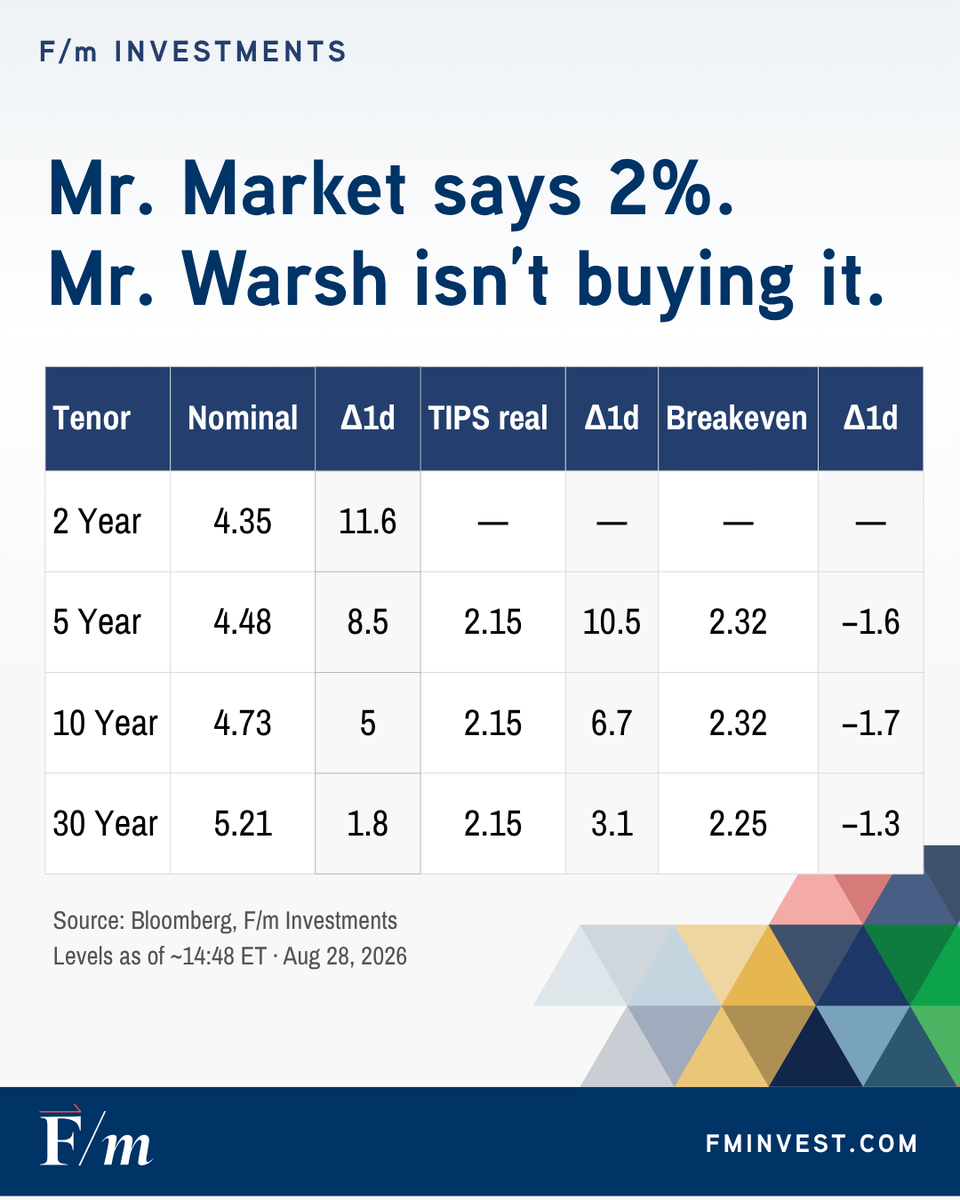
Following Jackson Hole, we saw a classic bear steepener. The front end rose; the back end was static. Break-evens tell the real story. The spread between TIPS and nominal bonds on a CPI basis is 2.3%. Ergo, Mr. Market is pricing in 2% long run inflation, yet Mr. Warsh does not seem to believe - at least, not without “some work” from the Fed.
The medium is the message. The media theorist Marshall McLuhan floated that idea a half-century ago, and the notion still resonates. McLuhan’s point: how a message is delivered shapes the way the information is received. Simple thought experiment: would you take this post less seriously if the font was Comic Sans?
You can use that lens to evaluate Treasury Secretary Scott Bessent’s push to use government cash to muzzle long-term \rates. Bessent’s vow to accelerate buybacks have at least temporarily slowed the rise in the 30-year yield, though at 5.17% it still sits just a quarter-point below the 2007 peak.
Bessent’s plans are relatively modest compared to the size of the market - total government debt recently hit $40 trillion, including $32 trillion of Treasury notes, bills, bonds and related instruments. Reuters says the program will add $14 billion of liquidity support, a drop in the proverbial bucket.
But the message is crystal: The Administration wants to stop rising yields, and it is willing to shell out tax dollars to slow the trend. Mind you those dollars were likely funded by the very debt now being re-purchased. As detailed in my last two posts, Bessent has dusted off an old strategy called yield curve control, issuing paper at the short end of the curve to fund purchases at the long end. The previous posts laid out how this approach generally ends in tears. But we’ll see.
Bessent’s move raises many questions, not the least of which is the contradiction in Bessent’s approach with the stance of Fed Chair Kevin Warsh. The Fed has been under pressure to hike short-term rates to respond to inflation persistently above its 2% target. The markets responded to the Treasury’s intervention by selling dollars, increasing the price of imports, incrementally adding to inflation.
Citadel Securities writes that Bessent’s approach “amounts to financial repression … policymakers attempting to suppress the market signal rather than resolve the underlying contradiction of pro-cyclical easing in the middle of a generational capex cycle at full employment,” adding that the bond market’s message is that either fiscal or monetary policy should be tighter. Since spending cuts seem unlikely, the alternative is higher rates.
The uptick in long rates reflects multiple factors: the growing U.S. deficit, a smaller Fed balance sheet, gigantic corporate debt issuance to fund the AI buildout, and the Iran war, among others. Bessent’s cure doesn’t address the disease.
The most enduring issue could be tension between the Fed and the Treasury. Morgan Stanley wonders if we’re seeing “a divergence in thinking between the institutions on what level of long-term interest rates is viewed as acceptable.”
You’d hope to get clarity from Warsh when he speaks at the Jackson Hole Economic Symposium on Friday. But the bet here is that Warsh will stick to his vow to say as little as possible and to let the markets sort things out - no matter Bessent’s preference for action.
In yesterday’s dispatch, which focused on Treasury Secretary Scott Bessent’s crusade to muffle long-dated bond yields, we promised a follow up with a lesson on prudent sovereign treasury management. With a side of German language instruction. So here we go.
The secret word of the day is “Finanzagentur,” Germany’s federal debt management office. Via its “Marktpflege” process - German for market making - the Finanzagentur typically retains a 20% slice of each government debt auction.
The Bundesbank – the German Fed - feeds inventory into the secondary markets over time, also buying paper back when prudent to support liquidity. The process is planned, deliberate, and clearly communicated.
Bessent’s foray into yield curve control, dipping into government coffers to buy bonds, seems neither planned nor well communicated. We’re in sync with Stanley Druckenmiller, who wrote in Tuesday’s WSJ that Bessent is making a risky blunder.
“Once markets believe Treasury is defending a price, every rise in yields becomes a test of official resolve, and the operations must grow to survive the tests,” Druck wrote. “Governments defending prices against fundamentals always lose.”
YCC generally ends in heartache. Here are a couple of memorable near misses where the savior was smart comms.
The 🇪🇺 Bank of England purchased gilts in a financial stability triage in 2022 with a hard expiry date. The program lasted 14 days. Bailey was responding to a yield spike that reduced the value of paper held by UK pension funds, pushing them to the brink. The BoE bought £19.3 billion of long-dated gilts, staving off a UK pension collapse.
In 2021, the 🇮🇳 RBI - the Reserve Bank of India - ran a 6% soft cap on the 10-year via G-SAP, the country’s Government Securities Acquisition Programme and got away with it precisely because it never made that promise out loud. While the 10-year yield still rose, it was generally viewed as a soft landing.
In March 2020, the 🇪🇺 European Central Bank launched PEPP, the €1.85 trillion Pandemic Emergency Purchase Programme, which wrapped in March 2022, after staving off a Covid-related financial collapse. A few months later, ECB launched TPI, the Transmission Protection Instrument, a tool “to counter unwarranted, disorderly market dynamics that pose a serious threat to the transmission of monetary policy across the euro area.” Both worked because they were spread, not price, controls, a more defensible beast.
One YCC-adjacent play was the 🇨🇭 Swiss National Bank’s defense of the 1.2 Swiss francs-to-Euro exchange rate, from 2011 to 2015. The SNB gave up when it got too expensive to maintain. When it ended, on a random January morning without notice, the CHF surged 30% against the Euro.
A final note: Bessent’s move has hurt the dollar, making imports pricier, countering the Fed’s focus on fighting inflation. How does Kevin Warsh view Bessent’s move? We might get clues Friday when he speaks in Jackson Hole.





![alexmorrisfm's tweet photo. Wednesday morning brought a rare bit of upbeat inflation news for consumers and Fed voters alike. The Fed’s preferred inflation measure, PCE or Personal Consumption Expenditures, actually came in a little lighter than feared, releasing a little of the pressure for higher short-term interest rates, and potentially delaying (but not eliminating) a second 2026 Fed rate hike.
Headline PCE matched consensus at +0.3% on a month-over-month basis, but was below consensus on a core basis, +0.2%, vs +0.3% expected. On an annual basis, PCE was up 3.4%, or 3.0% for core, a smidge better than feared, though still well above the Fed’s 2% target. Still “work to do,” as Warsh said.
For many years, faster-reacting PCE lagged behind the more widely followed Consumer Price Index (which prices TIPS), but of late PCE has pushed above CPI, a reflection of some differences in the measures, in particular how they account for healthcare. CPI in August rose 0.4% on a seasonally adjusted basis, up 3.4% from a year earlier. The Fed has become increasingly frustrated with the stubborn persistence of inflation above target – it has been running above the 2% level for more than five years. That helps explain the FOMC’s recent quarter-point hike in the Fed Funds target range to between 3.75% and 4% - and the market’s conviction that more rate hikes await. Just a few days ago, there was consensus that the next hike will arrive at the FOMC meeting in late October, less than a week ahead of the midterms – but the PCE report has spurred a consensus reversal. The conventional wisdom is that the Fed will stay put in October, and hike in December.
In a speech Monday, Fed Governor Lisa Cook made it clear that no quick fix for inflation is likely. “[I]n coming months I expect to see continued pressure on inflation from the AI buildout,” she said, “and from the pass-through of higher oil prices and supply chain disruptions associated with the conflict in the Middle East.”
Meanwhile, one potential outcome of upticking yields - the long-bond sits at 5.63%, the highest since June 2002 - could be a shift in the Treasury’s issuance strategy to simply suspend selling 20- and 30-year bonds. Uncle Sam could focus at the other end of the curve and save some money for taxpayers over time.
That sounds radical, but the government has often changed issuance strategy. In 1986, the Reagan Administration stopped issuing 20-year bonds. Bill Clinton’s Treasury eliminated seven-year notes and reduced 30-year auctions. When George W. Bush was president, the Treasury suspended 30-year bond auctions for more than four years, from October 31, 2001, until Feb. 9, 2006. The question is not whether Treasury can remove these maturities—it has, it can—but whether the savings justify the resulting financing and interest-rate risks. If PCE comes in hot, expect another uptick in rates - and heated whispering about what the Fed - and the Treasury - might do in response.](https://pbs.twimg.com/media/HUDyKLuXAAAk378.jpg)
![alexmorrisfm's tweet photo. A Modest Proposal
For Preventing the American Dream from Interfering with the Proper Functioning of the Economy, and for Making the Disappointments of Aspiring Homeowners a Cause for Public Rejoicing.
The Wall Street Journal columnist Allysia Finley recently wrote a piece headlined “Hurray for Higher Mortgage Rates,” which details the advantages of soaring costs for home loans.
Sound economics underpins her argument. Higher rates reduce demand. Fewer marginal buyers bid on houses. Investors retreat. Prices adjust. Capital gets re-allocated. Finley notes approvingly that foreclosures have risen, returning more houses to the market. And that is where Finley-nomics starts to sound downright Swiftian.
It’s the “hurray” I struggle with in particular.
She seems to have absorbed the form but not the true message of Jonathan Swift’s A Modest Proposal. In case you never read it, Swift’s legendary 1729 essay suggested that impoverished Irish parents sell their young children as food to wealthy English landlords. “[A] young healthy child well nursed, is, at a year old, a most delicious nourishing and wholesome food, whether stewed, roasted, baked, or boiled; and I make no doubt that it will equally serve in a fricassee, or a ragout,” he writes.
Swift's narrator cloaks the appalling proposal in the language of economic benefits. But beware the elegant calculation that requires overlooking the people being counted.
Perhaps a few other modest proposals:
We could ease wage pressure by encouraging layoffs. We could improve pension finances by moving retirement to age 100. Making groceries outrageously expensive - we’re already experimenting with that one - ought to cure excess consumption, while addressing obesity to boot. To discourage spendthrifts, repeal usury laws.
Former Fed Chair Jerome Powell, while running one of the most aggressive tightening cycles in decades, regularly ended his remarks with some version of: “We understand that our actions affect communities, families, and businesses across the country.”
Powell understood the tradeoffs. Many economists miss the forest for the trees. The yield curve is fascinating. Financial conditions are measurable. “Demand destruction” fits nicely into a research note. A basis point can be ignored until you multiply it by a mortgage.
Consider the first house someone can’t buy. Or the move nearer family you cannot make. Or the business that never opens, and the employee who isn’t hired.
Of course, sometimes the economy needs to slow. Sometimes, credit should be tighter. Sometimes, the Fed’s job is to make financial conditions uncomfortable.
But don’t cheer human discomfort. Markets turn lives into numbers so we can understand them. Good policy remembers to turn the numbers back into people. Let’s save “hurray” for a soft landing.](https://pbs.twimg.com/media/HUDyA7eXAAA1f-g.jpg)