Cambridge scientists have shown that girls and boys show differences in what they pay attention to, even at birth 👶
The results could help explain why girls, on average, learn to talk earlier and develop social skills faster than boys, and whether early sex differences contribute to later differences in children’s minds, brains and behaviour.
Find out more 👇
https://t.co/u47Yfihl5t
My new book A BILLION YEARS OF SEX DIFFERENCES is out today!
It's about the evolution of human sex differences and why they matter.
Available in hardback: https://t.co/fEUph9OgNm
...and audiobook: https://t.co/CQzsoPkxZW
Here's a sample of reactions to the book... 👇
According to one theory, the importance of intelligence for job performance fades out with time: as employees gain more experience, less intelligent people catch up to their smarter coworkers. A recent article tested this "convergence hypothesis" and found little support for it.
Across 31 military occupations, the most common finding was that the correlation between IQ and objective job performance measures was constant. That means that across all levels of experience, smarter employees were better at their jobs.
This does NOT mean that experience is unimportant. In fact, for many jobs (especially in the Navy and the Air Force), time in service was a better predictor of job performance than IQ. What this study shows is that IQ and experience usually both contribute to job performance independently; neither variable amplifies or diminishes the other.
What does this mean for employers? Try to hire someone who is smart AND experienced.
Read the article here:
https://t.co/OFAmnctnPM
🧠 Is creativity mostly just high intelligence?
A new twin study in @ICAJournal says no. There’s a large genetically independent component.
@timothycbates analyzed intelligence test scores and creativity data in three domains: business, military, politics/leadership). Key findings:
➡️Creative achievement is highly heritable (h² ≈ .56), shared environment ≈ 0
➡️Latent creativity and general intelligence are genetically independent.
➡️g explains only ~10% of the genetic variance in creative achievement
These findings support a hybrid view: g helps in many domains, but creativity has substantial unique genetic architecture. As Bates explains, "the genetic architecture of real-world creative achievement is not merely a downstream consequence of general intelligence but reflects a separate, heritable system that operates across artistic, scientific, and enterprising domains" (p. 6).
Read the full open-access paper: https://t.co/OxFZ7d0h7y
A new must-read article from the Plomin lab was published this week in @ICAJournal.
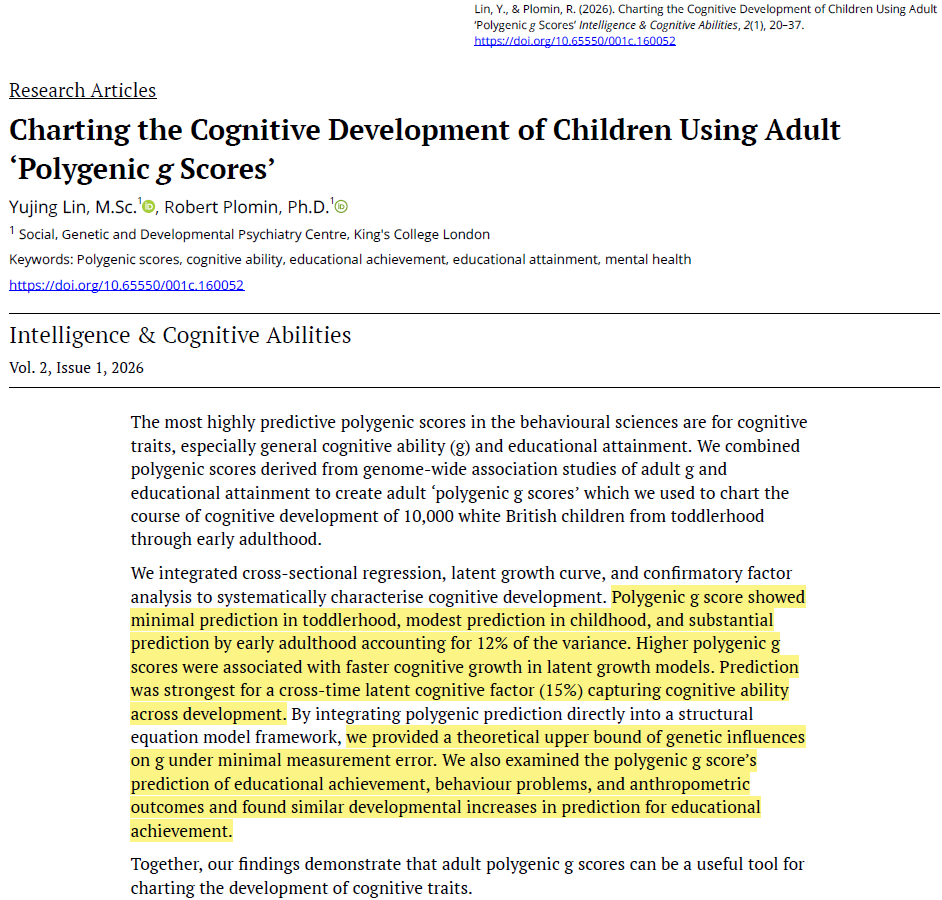
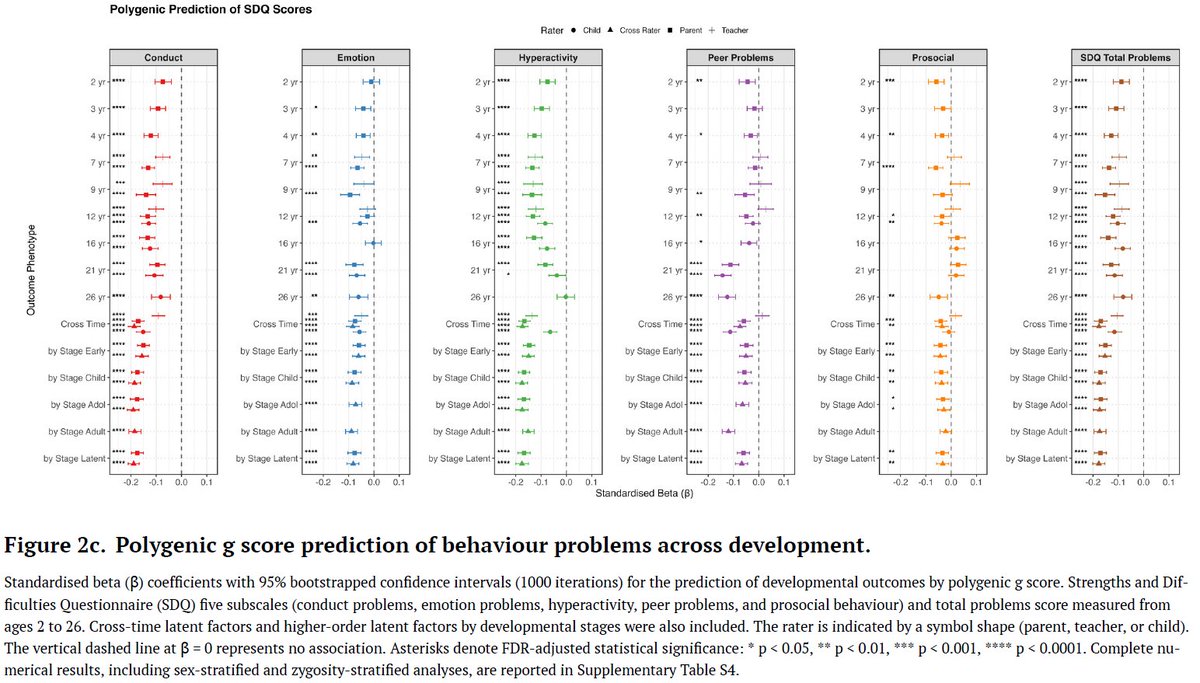
Lin and Plomin used polygenic scores (derived from DNA variation in people) predict life outcomes from ages 2 to 25 in the same sample. Results showed that the scores predicted cognitive abilities (including IQ) and educational attainment well (up to r = .37). But they could also predict some non-cognitive outcomes, such as conduct problems and hyperactivity.
Predictions of IQ started weak (r = .03 at age 2) and increased steadily through adulthood (r = .37 at age 25). Predictions of educational outcomes also increased throughout childhood, peaking at age 16. Non-cognitive predictions were weaker (all r's between 0 and .25), but that was expected because the polygenic scores were designed to maximally predict IQ and educational outcomes.
Because this was a longitudinal study, the authors could also see whether they could predict trends and growth. They found that children with higher polygenic scores started off with higher IQs and educational attainment and had faster growth over time. (In other words, "the rich got richer.")
The results confirm findings from other behavioral genetics studies using other methodologies. For example, the study supports the claim that heritability of IQ increases with age. The study also supports the idea that genes and environment become more strongly correlated as children grown into adulthood.
It's great work that pushes the field forward and confirms that children's phenotypes can be predicted with polygenic score derived from adult data. Read the full open-access article here:
https://t.co/uxMuQpZ3CY
New preprint: In ~38k people, general cognitive function ('g') is supported by a widely distributed white matter network, spanning all cortical lobes + key subcortical structures, with long-range inter-lobar connections playing a key role. Effects strengthen with age.
"IQ remains the strongest predictor of educational success, yet many teachers misunderstand it, underestimate the role of genetics, and embrace widely debunked ideas like Gardner’s multiple intelligences."
[Link below.]
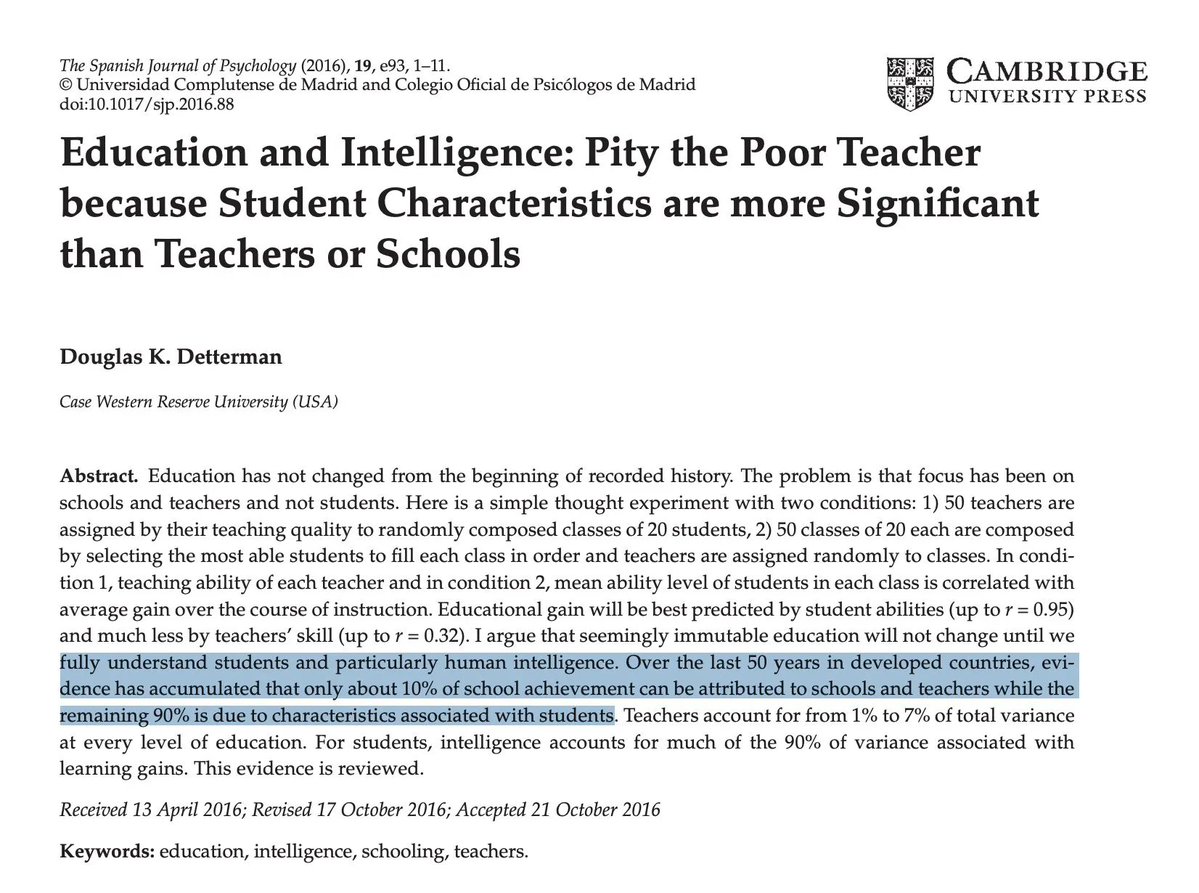
A teacher's teaching quality has very little impact on school achievement (less than 10%).
The remaining 90% is due to characteristics associated with students.
"No one likes that idea"
Jordan Peterson: IQ is largely unitary, highly heritable, and brutally unfair.
It predicts long-term success in complex jobs better than almost anything. Smart parents → smart kids (but regression to mean pulls toward average 100).
Identical twins separated at birth? By age 60, IQs so similar it's like testing the same person—environment barely diverges them.
You can't train general IQ up with games/puzzles (task gains don't transfer). But cardio + weights help maintain it as you age; early nutrition (breastfeeding adds ~3-4 points per year) + stimulation matter in childhood.
No one's figured out how to meaningfully raise it—yet.
This 3:58 clip confronts why the "cards aren't dealt equally."
Does knowing IQ is mostly genetic change how you view opportunity, merit, or inequality?
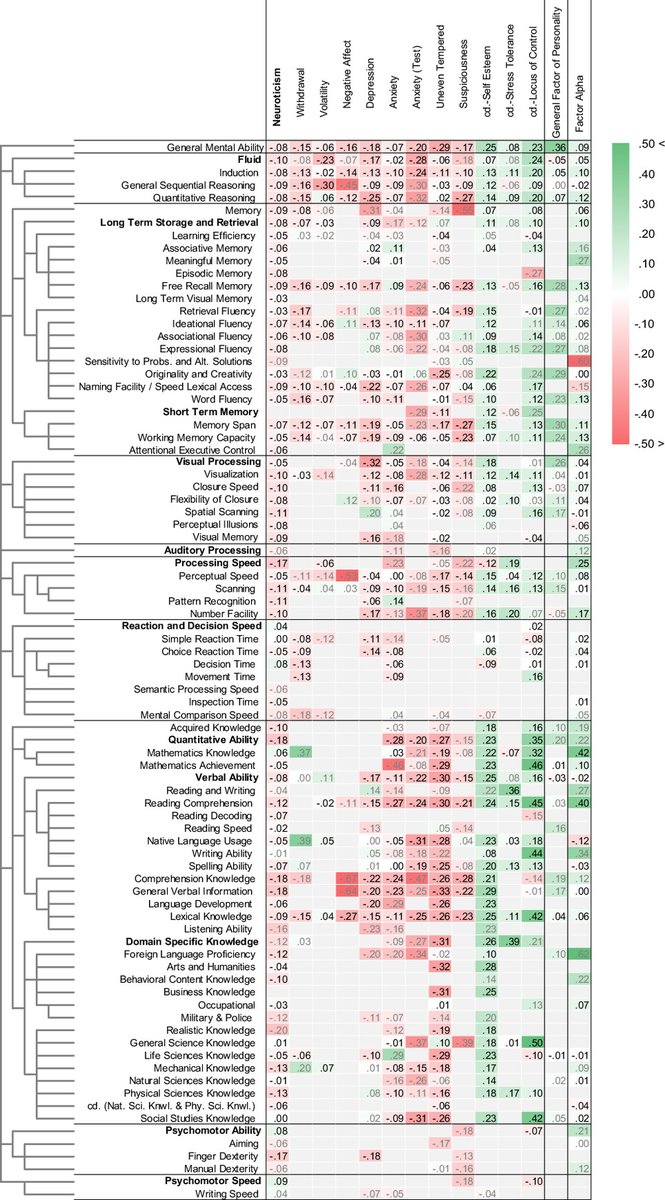
This is the most detailed study on personality and intelligence ever done:
First, the Big Five: Neuroticism is robustly associated with lower intelligence, particularly processing speed and quantitative ability.
🚨New podcast episode🚨
This chat w/@rjhaier covers more ground than any other episode. Topics include:
➡️The newest frontiers in neuroscience & IQ
➡️Whether society is warming up to IQ research
➡️New orgs that advance the field of intelligence
Watch:
https://t.co/F7s1FqhFg4
🧠 New Cambridge research reveals that our brains undergo major s👦🧓🧓tructural shifts at key ages through our lives, not just at childhood and adolescence.
Which finding from @mrccbu surprises you the most?
Explore the research 👉 https://t.co/6rKxuDc0jD








![SteveStuWill's tweet photo. "IQ remains the strongest predictor of educational success, yet many teachers misunderstand it, underestimate the role of genetics, and embrace widely debunked ideas like Gardner’s multiple intelligences."
[Link below.] https://t.co/PHFcjqgNOL](https://pbs.twimg.com/media/HFaYJ2Za8AI1rcb.jpg)