(En version here)
"The Ambiguous Rules of Polymarkets, Irrational Pricing, and Inspiration from UMA Attacks"
I. Starting with the "Alien Files": A Living Lesson in Progress
About a week ago, Polymarket launched several contracts around themes such as "Trump declassifies UFO files" and "Has the US confirmed the existence of extraterrestrials?" The two most typical ones were:
Trump declassifies UFO files in 2025?
Trump declassifies UFO files before 2027?
The rules for both are almost identical, except the deadlines are December 31, 2025 and December 31, 2026, respectively.
Fueled by the UFO topic, Trump's aura, and the narrative of "aliens finally making an official announcement," some markets were driven up to nearly 99% implied probability, while the 2027 market price was significantly discounted—logically creating a strange phenomenon where "a longer window actually results in a lower probability."
Even more outrageous is the fact that the 2025 market was repeatedly submitted as "YES" based on a so-called "declassified document" from September 2025; yet, when discussing the 2027 market, Polymarket/UMA attempted to use a vague English phrase in the rules to "exclude" the same document from the longer-term market.
This controversy has severely damaged Polymarket's image as a "truth market" and exposed three structural problems:
1) The rules are vaguely worded, allowing key clauses to be arbitrarily interpreted afterward;
2) Pricing contradicts basic probabilistic logic, revealing serious behavioral biases and room for manipulation;
3) The settlement mechanism, reliant on UMA governance, leaves room for governance attacks that could "buy the truth."
II. Mismatch Between Headlines and the Essence of the Event:
The Misleading Narrative of "Trump Declassifies"
Let's look at the headlines of these two markets:
Trump declassifies UFO files in 2025?
Trump declassifies UFO files before 2027?
For an average participant, such headlines easily induce the following intuitive understanding:
"If Trump, during his term, personally authorized/approved the declassification of a batch of documents related to aliens/UFOs, then it's YES."
In other words, the headlines paint a psychological picture:
This is an event strongly linked to Trump's personal actions;
This is a dramatic event with a strong "whistleblower" feel—"Trump has finally unleashed his secret, revealing aliens."
However, looking further into the rules, it's a completely different story:
This market will resolve to "Yes" if the Trump administration declassifies any previously classified files pertaining to extraterrestrial life and/or unexplained arial phenomena by...
Several questions immediately arise:
What exactly does "Trump administration" refer to?
Does it refer to the declassification decisions made directly by Trump and his cabinet?
Or does it refer to all documents "declassified by any federal agency through normal procedures during the term of this administration"?
If it's the latter, then theoretically, any release of UAP-related materials by a department (such as AARO) during normal workflow could be considered "Trump administration declassifies"—even if Trump himself was completely unaware of it.
The personified verb "declassifies" in the title further reinforces the misleading nature.
The title isn't "UFO files are declassified under Trump,"
but rather "Trump declassifies…."
In English, this personifies a highly bureaucratic process as "Trump personally lifting the lid." This approach panders to the emotions of the media and individual investors, but deliberately downplays the institutional context of the event and the normality of the declassification process.
The actual "declassification action" is most likely just routine updates by agencies like AARO.
Based on the operational methods of the AARO website, it's clear that the so-called "UAP-related documents" are likely just routine "unexplained phenomena investigation + regular archiving," with the vast majority categorized as balloons, birds, and drones, and the remainder listed as "unexplained." This is entirely different from the public's perception of "official recognition by an extraterrestrial civilization."
However, in Polymarket's headline narrative, these are packaged as "Trump declassifies UFO files"—not only attributing the event to Trump personally but also implying that he has a shocking secret to reveal.
Therefore, from a communication perspective, this headline design has a strong tendency towards narrative amplification and misleading:
It packages what is essentially a mundane bureaucratic process as a dramatic presidential decision;
It simplifies what is essentially "declassification of any UFO/UAP-related documents" into "Trump personally declassifying alien files";
It simplifies the "official information + media consensus" principle into a sensational question mark sentence, misleading uninformed retail investors into believing they are betting on a "historic moment."
This laid fertile ground for subsequent pricing distortions and settlement disputes.
III. Double Standards Regarding Timeframes: Is the same September 2025 document only "valid" for the 2025 market?
Let's look at the core of the controversial rule:
Announcements of declassifications that are not implemented within this market's timeframe will not count.
This was originally intended to exclude a scenario where an official prematurely informs the media: "We intend to declassify certain documents";
but the actual declassification (classification change, public release) is delayed beyond the timeframe.
Therefore, the rule emphasizes:
"Announcements that are merely 'announced' but not actually declassified within the timeframe are not counted."
However, in the UFO market controversy, Polymarket/UMA's interpretation of this statement clearly demonstrates a double standard regarding timeframes.
1. Timeline Recap
Real-world event:
September 2025: A so-called "declassified document" related to UFOs/UAP appears, which is used as key evidence by the YES side.
Two Markets:
2025 Market
Title: Trump declassifies UFO files in 2025?
Creation Date: April 18, 2025
Deadline: December 31, 2025
2027 Market
Title: Trump declassifies UFO files before 2027?
Creation Date: November 5, 2025
Deadline: December 31, 2026
In practice, the logic was handled as follows:
For the 2025 Market:
The September event occurred after the April creation and before the December deadline ⇒ It was naturally included in the timeframe, becoming the main basis for a YES result.
Regarding the 2027 market: The same September document was interpreted as:
"Events occurring before this market was created (September < November 5th) are not included in this market's timeframe and are not counted."
In other words, the timeframe was implicitly defined as the period "from the market's creation date to the deadline."
This was never explicitly stated in the rule text, yet it was used afterward to exclude the impact of the same event on longer-term markets.
2. Why is this a serious rule rewrite?
(1) Contradicts the intuitive meaning of the title
"in 2025" is naturally understood as "the entire year of 2025";
"before 2027" is naturally understood as "anytime before 2027".
No normal reader would intuitively understand this as:
"only declassifications that happen after this market is created and before the deadline."
(2) Rewriting the prediction market into a monster that "only predicts future sub-periods"
Following this logic,
even if a genuine UFO file declassification occurred in January 2025,
if the market only went live after April 2025,
this actual declassification would be treated as "never having existed."
This deviates from the fundamental mission of prediction markets—to aggregate information about the true state of the world.
Markets should not "forget" events that have already occurred, nor should they forcibly erase facts by using creation time.
(3) Most crucial: The same real-world event is treated completely differently in two markets
In the 2025 market: this September document is the core evidence for YES;
In the 2027 market: the same document is excluded by the "time interval" clause.
In other words, within the same world, two contradictory "versions of fact" exist on the blockchain: In one contract, the document is treated as "the Trump administration declassified UFO-related documents"; in another contract with a longer timeframe and identical rules, the system pretends the document never happened.
This is a classic example of: exploiting ambiguity in the rules to rewrite the timeframe after the settlement phase, serving a preference for rulings on a specific market outcome.
If Polymarket/UMA genuinely believes that:
"the timeframe must start from the market creation date,"
this condition must be clearly stated at market creation:
"from the market's creation until December 31, 2025/2026,"
instead of "picking out" a vague term from the rules after a dispute arises,
to explain why the same September document is only counted in the 2025 market and not in the 2027 market.
IV. Irrational Pricing:
When prices are no longer bets on "events" but on "arbitration,"
based on the two problems mentioned above (misleading titles + double standards in timeframes), market prices will naturally become severely distorted.
However, in reality, a structural inversion has emerged: "2025 = 99%, 2027 ≈ 95%."
The reason is that most participants are actually betting not on "whether the real world will be declassified," but rather on:
how UMA/Polymarket will ultimately interpret the rules and settle the 2025 dispute.
Regarding the 2025 market, many believe that "under immense public pressure and the interplay of existing positions, UMA is more likely to force a 'YES' interpretation for 2025."
However, regarding the 2027 market, expectations are different:
There's still plenty of time;
The controversies have already surfaced;
UMA is unlikely to repeat such a radical interpretation in the future;
Therefore, the 2027 market will not "automatically follow 2025 and become 'YES'."
Thus, the market with higher prices is actually the one that people are more likely to believe will be "determined to become 'YES'."
This is not information aggregation, but speculation on the "governance outcome." The closer the price is to 100%, the less certain the event is, and more certain it is that:
"Everyone is more convinced that this will be arbitrated as YES—even if this YES contradicts the original rules and common sense."
V. UMA Oracles and Governance Attacks of "Buying the Truth"
All these markets on Polymarket ultimately settle through the UMA Optimistic Oracle:
After the market closes, anyone can submit an "answer" and deposit a security deposit;
If no one challenges it within a short time, the answer automatically takes effect, and the market settles accordingly;
If someone challenges it, it enters the UMA governance layer, where UMA token holders vote to decide "which answer is correct."
Theoretically, this mechanism relies on an optimistic assumption:
"As long as a majority of voters are willing to uphold the truth,
then attackers would need to pay an extremely high price and therefore would not easily manipulate the results."
However, there have been publicly documented cases of **"UMA governance attacks"**:
Attackers hold a large number of UMA voting rights;
After a high-value market event concludes, they use concentrated voting to change events that should have been YES to NO (or vice versa);
Ultimately, they tamper with the on-chain "truth" at extremely low cost and profit from applications like Polymarket.
In this structure, highly emotional markets like UFOs/aliens, with extreme information asymmetry and a jumbled set of rules, are almost ideal targets for governance attacks:
The title provides attackers with narrative ammunition for emotional mobilization—"Trump is going to reveal aliens";
The ambiguous rules provide attackers with ample room for interpretation—"Is this considered a decryption? Is it an announcement or implementation?";
The double standard of time intervals is a convenient tool for rewriting the results afterward—"This deal can only be considered 2025, not 2027."
Therefore, in these scenarios, the so-called "prediction market" is more like:
"Whoever controls the discourse and governance has the ability to write their preferred version of history on the blockchain."
VI. Conclusion: When the "Truth Market" Meets "Narrative Economics"
Polymarket imagines itself as a truth machine that "makes prices tell the truth";
However, in the extreme narrative race of UFO documents and aliens, we see a different picture:
Headlines are deliberately personified and dramatized, reinforcing the emotional link between Trump personally and alien conspiracy theories;
Key rules are vague, especially the timeframe, which is later interpreted as an implicit lower limit "from the creation date," creating a double standard in time intervals;
Market prices are more about betting on "how the UMA will settle this dispute," rather than betting on "whether declassification has occurred in the real world."
@Polymarket
#predictions #UMA
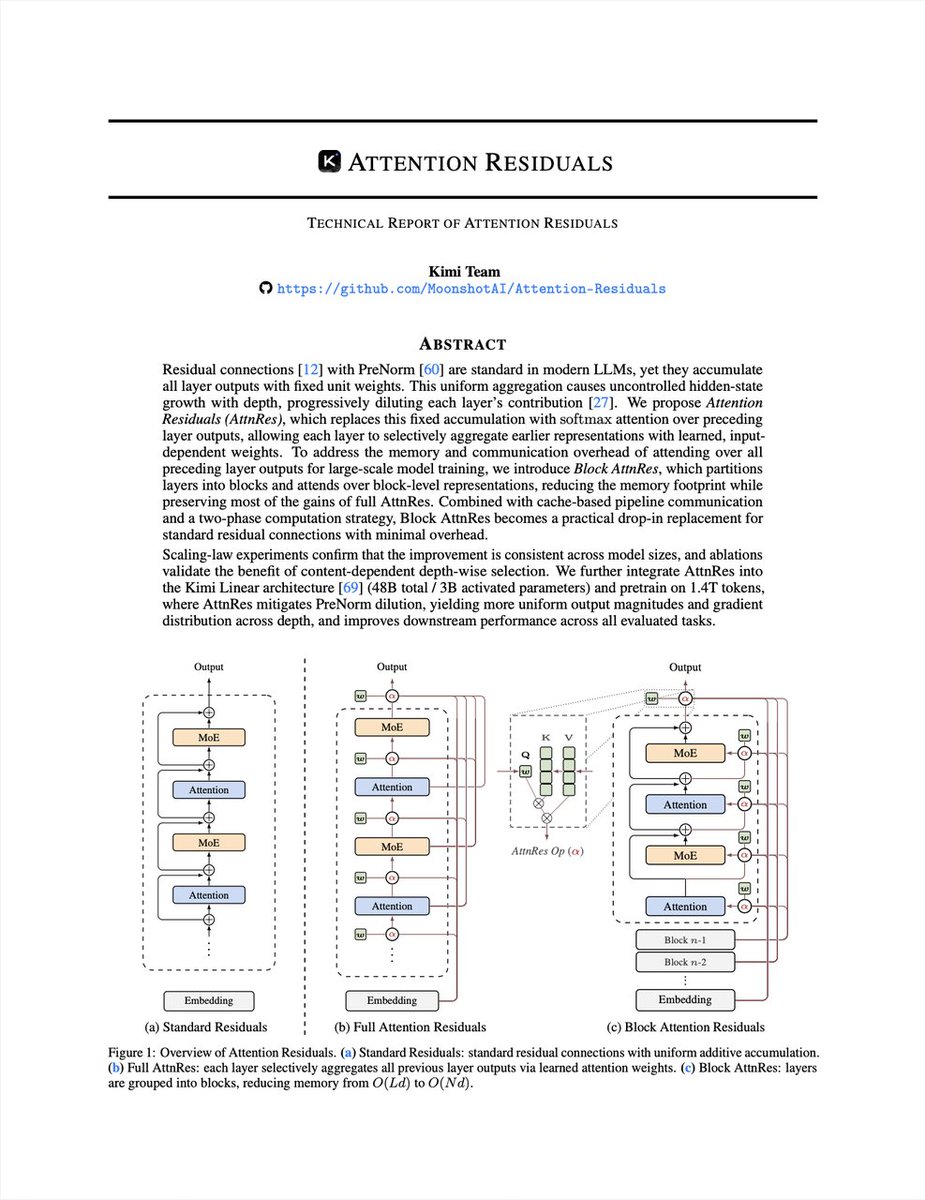
Introducing 𝑨𝒕𝒕𝒆𝒏𝒕𝒊𝒐𝒏 𝑹𝒆𝒔𝒊𝒅𝒖𝒂𝒍𝒔: Rethinking depth-wise aggregation.
Residual connections have long relied on fixed, uniform accumulation. Inspired by the duality of time and depth, we introduce Attention Residuals, replacing standard depth-wise recurrence with learned, input-dependent attention over preceding layers.
🔹 Enables networks to selectively retrieve past representations, naturally mitigating dilution and hidden-state growth.
🔹 Introduces Block AttnRes, partitioning layers into compressed blocks to make cross-layer attention practical at scale.
🔹 Serves as an efficient drop-in replacement, demonstrating a 1.25x compute advantage with negligible (<2%) inference latency overhead.
🔹 Validated on the Kimi Linear architecture (48B total, 3B activated parameters), delivering consistent downstream performance gains.
🔗Full report:
https://t.co/u3EHICG05h