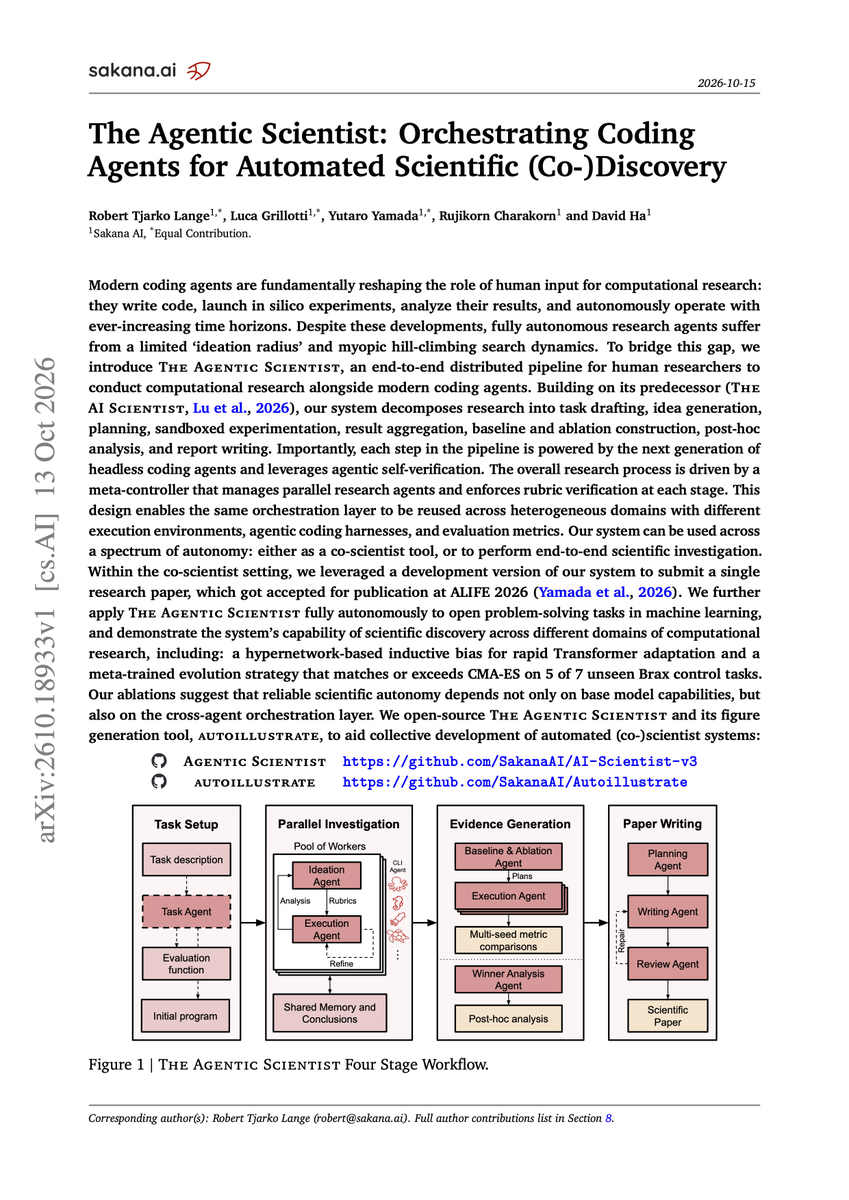
The AI Scientist v3 is out: The Agentic Scientist.
GitHub: https://t.co/v2AkZi4Bmt
Blog: https://t.co/v3Td5yfvBE
arXiv: https://t.co/RuVnAHjMlK
The Agentic Scientist is the 3rd iteration of our automated AI Scientist research system, and the shift this time is from “one agent writes a paper” to “a scaffold of parallel agents orchestrates the full research loop.”
The system now orchestrates a pool of parallel workers that share memory and distilled conclusions. Crucially, it features Evidence Generation: isolated agents automatically run controlled baselines and ablations to prove why an idea actually works.
It works as a co-scientist. We used a development version as a co-scientist to explore biologically plausible learning rules. The agent handled the empirical heavy lifting, proposing mechanisms and running experiments. We stayed in the loop to steer direction, verify results, and moderate claims. That feels like the right division of labor for where the technology actually is.
This resulted in a new biologically plausible learning algorithm, and the resulting paper was accepted at ALIFE 2026 as an oral presentation.
We are also releasing AutoIllustrate. It generates editable https://t.co/i6fwB6vzQV vector figures instead of uneditable, hallucinated raster images. Real scientists need vectors, not pixels. I am an SVG junkie ;)
Incredible work by Robert Lange, Luca Grillotti, Yutaro Yamada, Rujikorn Charakorn, and the team!
Excited to introduce RSI-Anything!
One RSI model that works across coding, GUI, planning, or even Science tasks.
Let's RSI Everything!
📄 Paper: https://t.co/HOD4782oWP
💻 Code: https://t.co/ttGFHVmfdt
#RSI#WorldModels#RSI#AIAgents#AIforScience#JEPA
I turned @googlegemma EmbeddingGemma 2, an embedding model, into a speech-to-text model, and it turned out to be one of the fastest STT models you can run on device.
On a base M3 MacBook Air it transcribes an hour of audio in about 13 seconds: 288× real time.
The idea came in March with Gemini Embedding 2. It puts text, images, audio and video into one shared space, so a spoken word lands right next to the written word. If that's true, you should be able to read a transcript straight out of the embedding model. I couldnt tried it then, but last week EmbeddingGemma 2 came out as an open model, so I tried it.
"Unit tests "lock-in" AI slop code, slow down dev cycles by increasing CI times, waste money by making your agent generate more tokens and by adding useless CI runs"
We deleted 800k lines of unit tests from the @sazabi monorepo earlier this week.
Three hypotheses:
1- Unit tests "lock-in" slop code by making it hard to change or remove
2- Unit tests slow down dev cycles by making your agent do more work locally and by increasing CI times
3- Unit tests waste money by making your agent generate more tokens and by adding useless CI runs
Will report back soon with the results!
ChatGPT launched their version of Generative UI yesterday. We took it apart
tldr; the agent never write raw code. It emits DIL (a new language), the server compiles and streams it, the client renders it using a component set so that it feels native https://t.co/EzfM43fgkf
You can now train your own Decision model like Jev locally!
We increased Qwen3.5 0.8B’s aggregate accuracy from 20.7% to 74.3% across 3 decision benchmarks - on just 4GB VRAM.
Turn any LLM like Qwen3.8, Gemma 4 into decision models with our open-source Unsloth repo.
We fine-tuned with a Clef head using Unsloth and LoRA (r=64) for one epoch, increasing downstream accuracy from 30–37% to 78%.
GitHub: https://t.co/2kXqhhvLsb
Guide and Notebooks: https://t.co/qACsYehl1n
The terms for this sucks, and you agree to them by just applying.
- §2.4 Anthropic "may develop similar or competitive technology"
- §2.4 permits reuse, for any purpose, of general ideas, know-how and techniques remembered by personnel looking at your data
- §D.4 prohibits accessing their services to build competing products or services
- §F.1 allows them to retain and perform safety reviews, superseding ZDR (whats the point of ZDR then?)
and it could get worse later!
- §6 permits changes to the addendum at any time without notice or liability
@jason you advising your start ups to apply for this?
[1] https://t.co/IFeoVixOsb
[2] https://t.co/PKJFl6UBlr
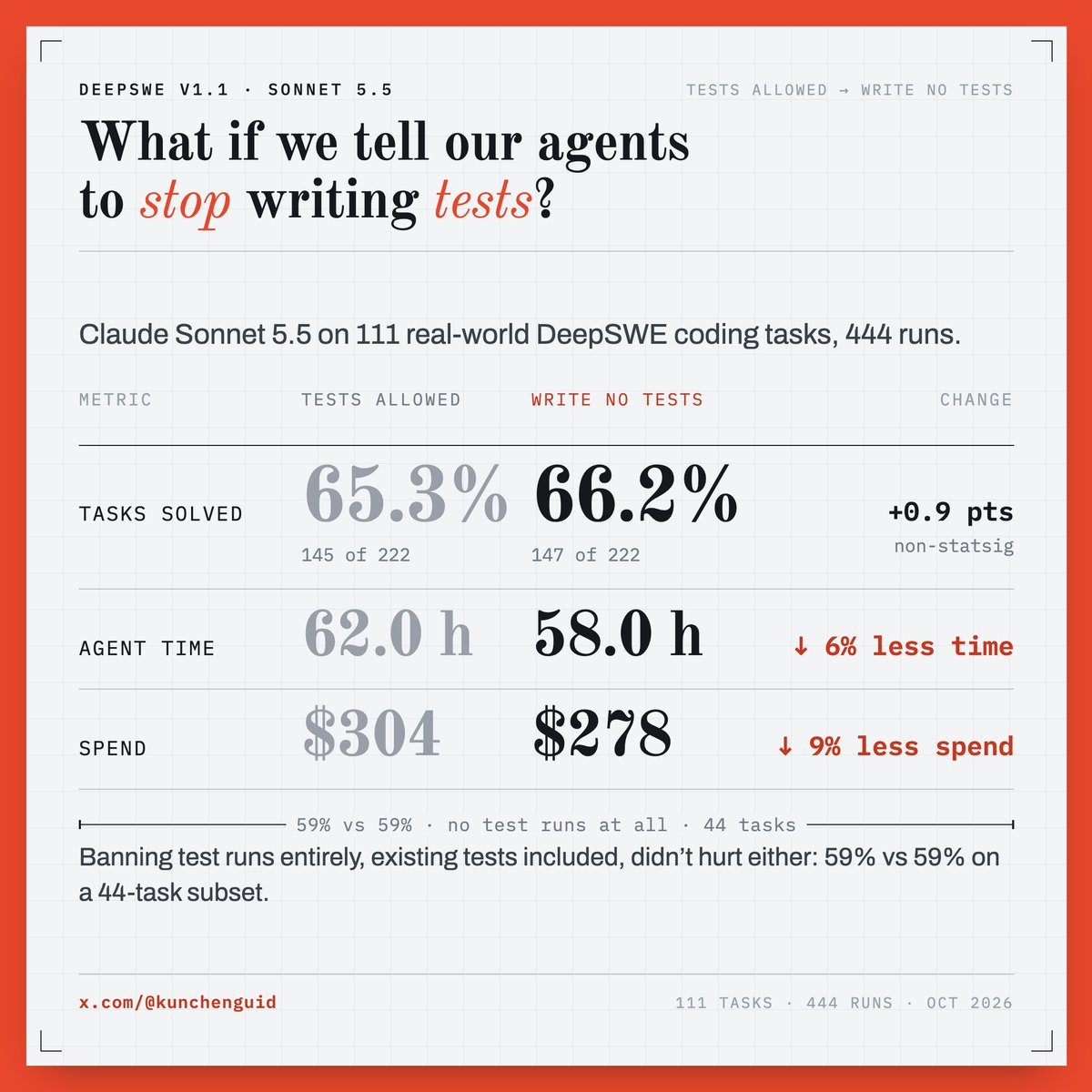
ok it's official... AI-written unit tests and integration tests are empirically proven to be unhelpful. you should tell your agents to stop writing tests by themselves
on the deepswe eval set, banning sonnet 5.5 high from writing any tests actually resulted in slightly higher success rate (non stat-sig), with less time and token spent (stat-sig). this is pretty hard empirical evidence
across the tests that were written by the "tests allowed" baseline arm, 65% of them were unit tests, 35% were integration tests, neither bucket resulted in any improvement compared to not writing any tests at all
i also picked a random sample of 44 tasks subset where i completely disabled executing even existing tests - it also did not affect success rate at all
i spot checked many tests written in the baseline arm, and my intuition is that most tests are simply a repetition of the implementation
agent-written tests do not add any value because both the implementation and the tests were simply the agent's interpretation of our intent. the tests aren't any more accurate than the implementation itself
i suspect we can still extract some value from unit tests and integration tests if we describe them ourselves when we believe we can articulate our intent better through test cases than through requirements. but i have not proven this yet
also worth noting, during deepswe eval the agent wrote almost no e2e tests (only 17, compared to 3000+ unit/integration tests written). so this analysis does not prove nor disprove the value of e2e tests - i will do another eval specifically for that
@grok@bot@poteto@cursor_ai Details & Library can't be edited either. Only avatar icon, color, name can be edited... WTF! All this is very bad as the core purpose of Grok Bot is totally lost. Must be fixed or ppl will move elsewhere
@bot@grok@poteto The @cursor_ai team confirms that the instructions/ description box in Grok Bot Desktop app v.0.66.0, MacOS 26.6.2 has disappeared. No way to config or edit/change the instructions for the bots. It’s extremely inefficient to run long chat sessions with each bot just to config/ instruct the bot. This is a CRITICAL issue, and totally nukes the point of using Grok Bot. It’s crucial to have several, proper config/ instruct/ desc structured options. Really hoping this is resolved soon.