One candle shows rejection.
Three signals build confluence. 📈
One of the biggest mistakes traders make is buying a stock just because they see a Hammer candlestick.
Professional traders look for confirmation before entering a reversal trade.
The CCI + EMA 50 + Hammer Strategy:
🟢 CCI → Identifies potential oversold conditions
🟢 EMA 50 → Defines the broader trend
🟢 Hammer → Signals rejection of lower prices
When all three align, you have a structured setup to evaluate—not a guaranteed winning trade.
📊 My checklist before every trade:
✅ Price approaches a key support zone
✅ CCI moves below -100 and turns upward
✅ A Hammer forms near support
✅ Price reclaims EMA 50 or confirms bullish strength above it
✅ Entry above the Hammer's high after confirmation
✅ Stop-loss below the Hammer's low
✅ Target offers at least a 1:2 risk-reward ratio
🚫 Avoid forcing trades when:
❌ CCI is oversold but price keeps falling
❌ The Hammer forms without meaningful support
❌ Price remains in a strong downtrend below EMA 50
❌ There is no bullish follow-through
📌 Remember:
CCI identifies the condition.
EMA 50 provides trend context.
The Hammer shows price rejection.
Confluence helps you build a trading plan. Risk management helps you survive the market.
💬 Question for traders:
Which signal do you trust the most for reversal trading?
1️⃣ CCI
2️⃣ EMA 50
3️⃣ Hammer Candlestick
4️⃣ All three together
Drop your answer below. 👇
❤️ Like • 🔁 Repost • 🔖 Bookmark this for your next chart review.
Educational purposes only | Not a buy/sell recommendation
SEBI RA INH000025151
Follow @TradesByAnand for daily trading notes, price action education, and practical trading strategies.
#StockMarketIndia #Nifty50 #TechnicalAnalysis #IntradayTrading #ShareMarket
12 lessons from The Psychology of Money
• Behaviour matters more than intelligence
• Luck & risk always play a role
• Define what “enough” means
• Compounding needs patience
• Buy time, not things
• Save before investing
• Think in decades
• Wealth is often invisible
• Leave room for mistakes
• Play your own financial game
• Avoid greed-driven decisions
• Focus on what truly matters
Biggest money traps:
Status chasing
Comparison
Overconfidence
Short-term panic
All-or-nothing bets
In one line:
Building wealth is less about brilliance and more about behavior consistency.
📚 Liked this?
Download the The Psychology of Money Book Summary in high resolution here: https://t.co/CDlQtNNhUe
Long before neural networks existed, convolution was already one of the most important mathematical tools in engineering.
Its applications go back decades before modern AI, from electrical circuits and communication systems to signal processing, acoustics, and image processing.
In signal processing, convolution describes how a linear, time-invariant system responds to an input when its impulse response is known. Engineers use this mathematics to design filters, analyze signals, and understand how systems respond over time.
In image processing, convolution with carefully chosen filters can blur images, sharpen details, and detect edges.
Convolutional neural networks brought a related idea into machine learning. Instead of manually designing every filter, the network learns filter weights during training. These filters are applied across different positions to extract useful features. Technically, most CNN implementations use cross-correlation, which is closely related to convolution.
What makes this mathematics so interesting is how widely it applies. The same foundations appear in problems involving sound, images, electronics, and machine learning.
It is a beautiful reminder of how much of modern AI is built on mathematical ideas that engineers have been studying for generations.
The vacuum could be stable for eons without occupying the lowest possible energy.
A false vacuum is a metastable field state separated from a deeper minimum by a barrier. Quantum tunnelling could nucleate a bubble of the lower-energy phase. Below a critical size it collapses; above that size, the energy difference can drive expansion near light speed.
This is a hypothetical mechanism, not evidence of an approaching event. The lifetime depends exponentially on uncertain field parameters and high-energy physics.
This basic algebra cheat sheet hides a loophole that breaks calculus software.
Most miss the edge cases in Rule 6 and 8.
Keep this mental math reference handy.
This simulation visualizes the Maxwell Boltzmann distribution by showing how gas particles move at different speeds.
The emerging bell curve highlights the statistical probability of finding molecules at specific velocity states.
Every number belongs somewhere in this hierarchy.
Counting numbers sit inside whole numbers, which sit inside integers, which sit inside rationals, which sit inside reals. Irrationals separate the reals from the rationals, while algebraic numbers hold every root of a polynomial with rational coefficients—including √2 and i.
Transcendentals such as π and e lie beyond every algebraic equation. Pure imaginaries extend the same distinction into the complex plane: some satisfy polynomials, others do not.
The whole landscape of numbers is ordered by nested inclusion and sharp exclusion.
Here's how the equation of a circle comes to life using the Pythagorean theorem on a coordinate plane.
Watch this quick visual breakdown to easily master geometry formulas.
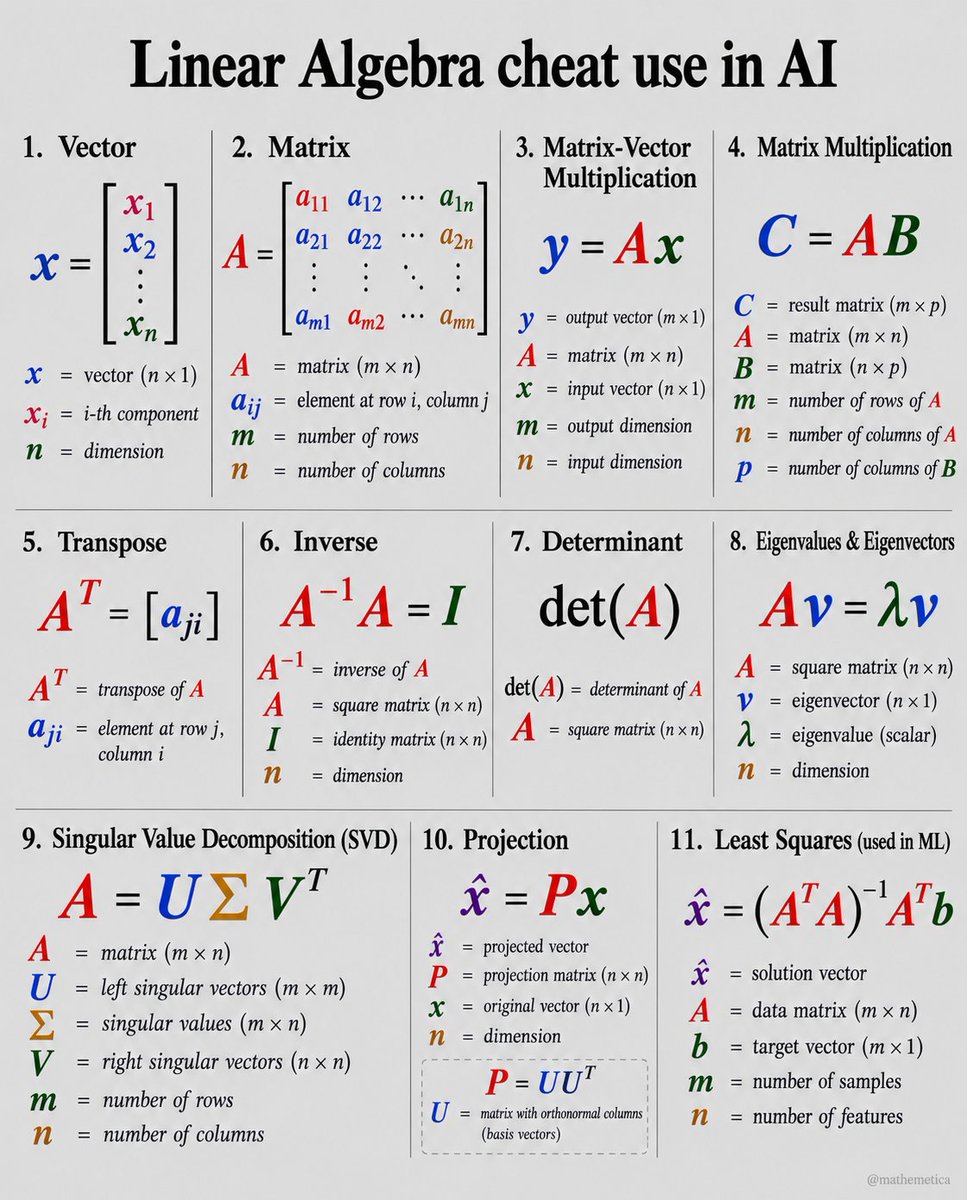
Behind every intelligent algorithm lies the quiet power of geometry in motion.
From transformations written as Ax = y to optimal approximations formed by x̂ = (AᵀA)⁻¹Aᵀb, linear algebra turns abstract multi-dimensional spaces into actionable human insights.
Matrices do not merely calculate, they hold the entire geometry of intelligence.
🚨 𝗜𝗦 𝗬𝗢𝗨𝗥 𝗙𝗔𝗩𝗢𝗨𝗥𝗜𝗧𝗘 𝗦𝗧𝗢𝗖𝗞 𝗔𝗖𝗧𝗨𝗔𝗟𝗟𝗬 𝗢𝗩𝗘𝗥𝗩𝗔𝗟𝗨𝗘𝗗?
A rising stock price doesn’t always mean a good investment.
Before getting impressed by the chart, check:
📊 P/E & PEG
📈 Price vs earnings growth
📘 P/B valuation
💸 Cash flow quality
🔥 Theme/hype
🚨 Insider selling
𝗧𝗵𝗲 𝗯𝗶𝗴 𝗾𝘂𝗲𝘀𝘁𝗶𝗼𝗻: Is the business growing fast enough to justify its valuation?
Save this checklist for your next stock analysis.
#StockMarket #Investing #Valuation #ChartGuruji
Educational content only. No Buy/Sell recommendation. No Target/SL.