Alginte — build and run Kafka Streams topologies, self-hosted. Point at a topic, draw the graph, write the logic, deploy from the console. Free Community edition, no registration, nothing leaves your infrastructure.
https://t.co/MwubVWNAIe
Alginte is now on the React Flow showcase: https://t.co/gVvOsIvmaB
Our #KafkaStreams builder is a React Flow canvas: you draw the topology, test each step on real records, and deploy it.
Thank you @xyflowdev.
@MatthiasJSax@kafkastreams In a test only: RocksDB on 4.4.0, the setting on, 12,000 writes. estimate-num-keys read the same as with it off, under ALOS and EOS. Nothing under load yet.
About 480 new CVEs a day. One in five arrives without a severity.
We ask #TypeSafe#Jev to judge those from the description, inside a #KafkaStreams topology.
What if every new CVE got a judgment? One Enrich step in a #KafkaStreams topology, asking @TypeSafe’s Jev per record. Simulated in the preview, real in production.
I couldn't agree more.
I get that people are afraid etc. But the sooner you stop calling everything AI-generated "slop", the better.
Humans produce slop, too. AI can produce slop or amazing things. It lowers barriers. Get over it
A blocking call in a #KafkaStreams mapValues caps each thread at one record per call: 3.3 a second at 300 ms. We sized the threads by Little's law, put a deadline around every call, and measured what breaks.
https://t.co/g7N2mc1kCr
Asking an AI model about every record in a Kafka Streams app? Each answer is a slow call on the stream thread.
Enrich node simulates the answer in the preview, so testing costs no tokens. Threads are checked before deploy.
https://t.co/r7vAm1OKvd
Confluent just republished 15 #KafkaStreams deep dives from the Responsive blog:
https://t.co/E2oX1ZzaDv
Two of them gave us rules we then put to the test: what poll interval really bounds when every call in a stream is slow, measured run by run.
https://t.co/bbtsTChHFe
Every call in your Kafka Streams app fits within its poll interval, but the thread can still be evicted from the group.
We measured why: the poll interval bounds a round of calls, not one call. The write-up, run by run:
https://t.co/ZiI9ZtkBln
#KafkaStreams
The team had spent time with the R community, he said, and "found a room full of people who loved working with data and hated databases. Not the theory. They hated the install, the server process, the connection string, that process of asking your sysadmin for permission."
[ICYMI:] DuckDB’s co-creator on why SQL won 🏁
In this interview with @letsdatascience , DuckDB co-creator Hannes Mühleisen argues that the data industry misdiagnosed SQL’s problems a decade ago.
What developers *actually* hated in 2013 was the install, the server, and the client protocol, not the language itself. In the end, the NoSQL systems that tried to replace SQL only grew back into something SQL-shaped – minus 40 years of experience. 🫤
Hannes points to public workload data from Snowflake and Amazon showing that only a small fraction of a percent of analytical queries actually need a cluster, but that the database field spent 2 decades building for that edge case anyways. He also confirmed an unannounced DuckDB launch expected later this year.
Catch the full interview here: https://t.co/gB3wDqV9UK
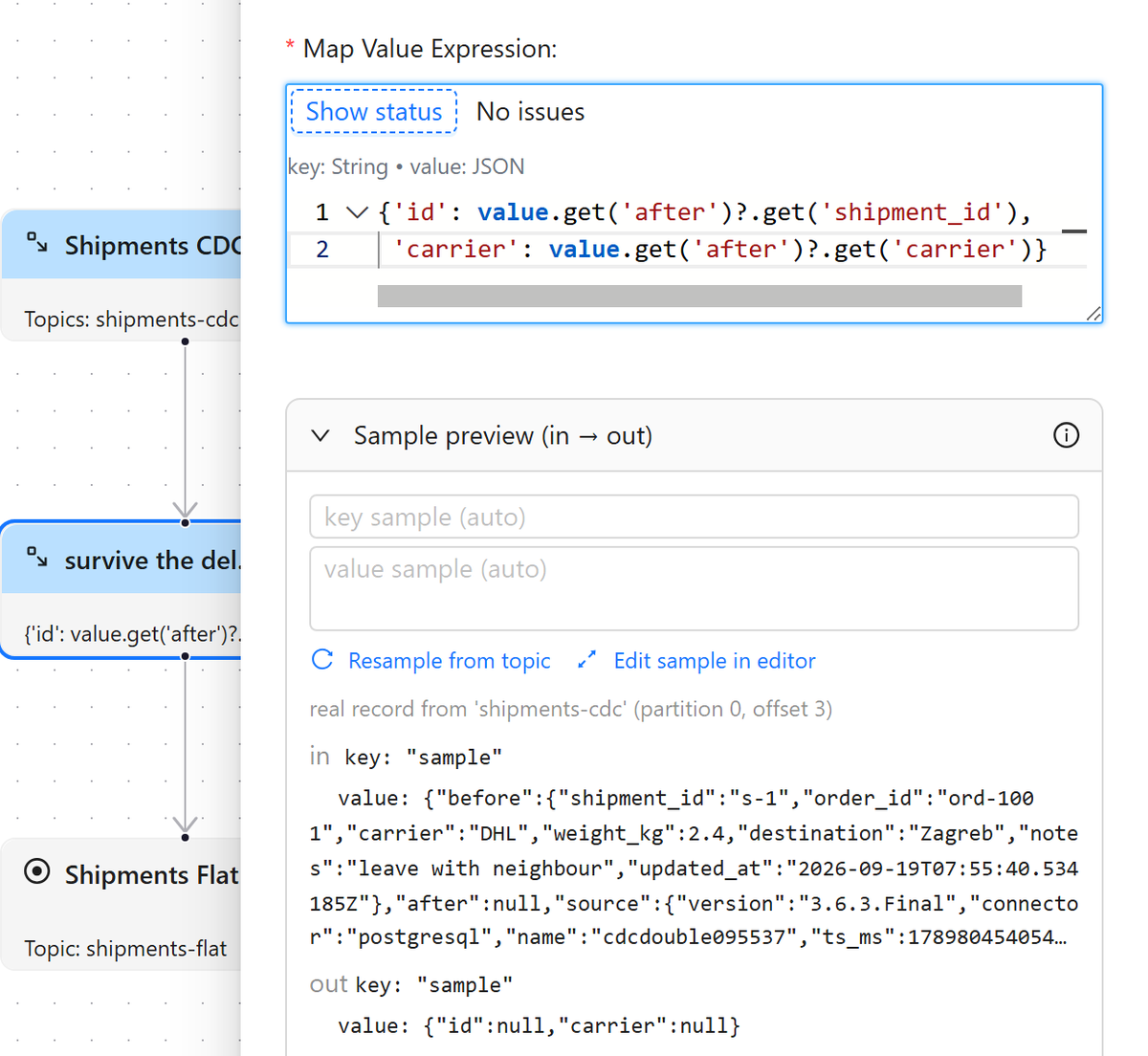
#Debezium change events in #KafkaStreams: flatten after, route by op, survive the delete. One expression each, and each one proved against a captured change event before it runs anywhere that matters.
https://t.co/whm6sxm6kB
#ApacheKafka
Start a #KafkaStreams topology in a sandbox: your schemas, a sample of your records, and a broker you can throw away. Prove the logic there, then carry the design to the real #ApacheKafka cluster as a file.
https://t.co/shv466FU49
Alginte 0.12.0 is out. The standalone JAR is downloadable, for machines where a container is not an option. Plus: the #SpEL reference and cookbook, custom #functions in Java, reset #KafkaStreams to an input position.
https://t.co/AmgyyvIked
Most #Kafka consoles read the cluster: topics, groups, lag. A #KafkaStreams app's state lives in the process. The cluster shows a stable group while the app replays millions of records.
We built the console around the stream instead. Why: https://t.co/RgkoB1TuAf
FAQ: #KafkaStreams: "Is it still restoring?"
Restoring a 7.5M-record state store. Left: caught at 39%. Right: done 29 seconds later, with the events that led there.
Coming to #Alginte in the next release.
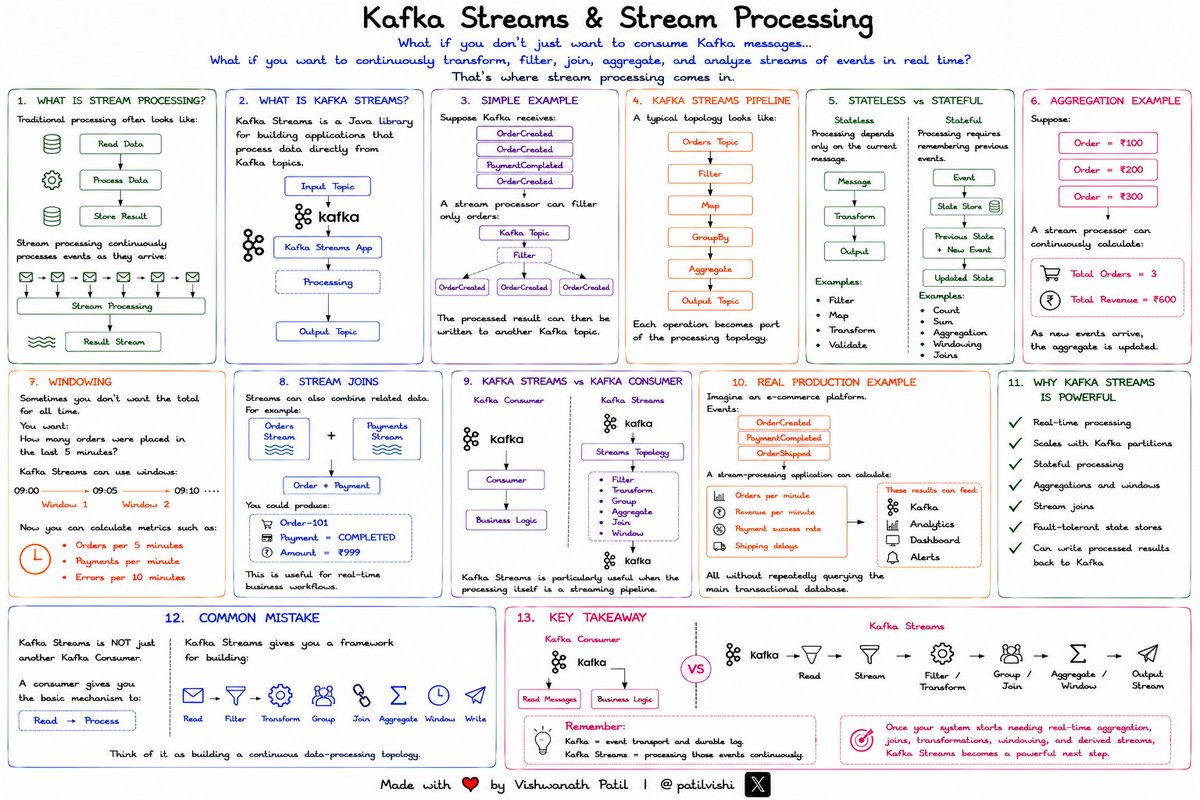
System Design - EDA and Messaging - Day 61 - Kafka Streams & Stream Processing
What if you don't just want to consume Kafka messages…
What if you want to continuously transform, filter, join, aggregate, and analyze streams of events in real time?
That's where stream processing comes in.
-------------------------
What Is Stream Processing?
Traditional processing often looks like
Read Data
↓
Process Data
↓
Store Result
Stream processing continuously processes events as they arrive:
Event → Event → Event → Event
↓ ↓ ↓ ↓
Stream Processing
↓
Result Stream
----------------
What Is Kafka Streams?
Kafka Streams is a Java library for building applications that process data directly from Kafka topics.
Input Topic
↓
Kafka Streams App
↓
Processing
↓
Output Topic
You don't need a separate streaming cluster just to use Kafka Streams.
--------------------
Simple Example
Suppose Kafka receives:
OrderCreated
OrderCreated
PaymentCompleted
OrderCreated
A stream processor can filter only orders:
Kafka Topic
↓
Filter
↓
OrderCreated
OrderCreated
OrderCreated
The processed result can then be written to another Kafka topic.
-------------------------
Kafka Streams Pipeline
A typical topology looks like:
Orders Topic
↓
Filter
↓
Map
↓
GroupBy
↓
Aggregate
↓
Output Topic
Each operation becomes part of the processing topology.
----------------
Stateless vs Stateful Processing
This distinction is extremely important.
Stateless
Processing depends only on the current message.
Message
↓
Transform
↓
Output
Examples:
Filter
Map
Transform
Validate
Stateful
Processing requires remembering previous events.
Event
↓
State Store
↓
Previous State + New Event
↓
Updated State
Examples:
Count
Sum
Aggregation
Windowing
Joins
------------------------
Aggregation Example
Suppose:
Order = ₹100
Order = ₹200
Order = ₹300
A stream processor can continuously calculate:
Total Orders = 3
Total Revenue = ₹600
As new events arrive, the aggregate is updated.
--------------------
Windowing
Sometimes you don't want the total for all time.
You want:
How many orders were placed in the last 5 minutes?
Kafka Streams can use windows:
09:00 ───────── 09:05
Window 1
09:05 ───────── 09:10
Window 2
Now you can calculate metrics such as:
Orders per 5 minutes
Payments per minute
Errors per 10 minutes
--------------------------------
Stream Joins
Streams can also combine related data.
For example:
Orders Stream
+
Payments Stream
↓
Order + Payment
You could produce:
Order-101
Payment = COMPLETED
Amount = ₹999
This is useful for real-time business workflows.
------------------------
Kafka Streams vs Kafka Consumer
A normal Kafka Consumer typically does:
Kafka
↓
Consumer
↓
Business Logic
Kafka Streams provides higher-level processing capabilities:
Kafka
↓
Streams Topology
├── Filter
├── Transform
├── Group
├── Aggregate
├── Join
└── Window
↓
Kafka
Kafka Streams is particularly useful when the processing itself is a streaming pipeline.
---------------------------------
Real Production Example
Imagine an e-commerce platform.
Events:
OrderCreated
PaymentCompleted
OrderShipped
A stream-processing application can calculate:
Orders per minute
Revenue per minute
Payment success rate
Shipping delays
These results can feed:
Kafka
↓
Analytics
Dashboard
Alerts
All without repeatedly querying the main transactional database.
------------------------------------
Why Kafka Streams Is Powerful
- Real-time processing
- Scales with Kafka partitions
- Stateful processing
- Aggregations and windows
- Stream joins
- Fault-tolerant state stores
- Can write processed results back to Kafka
-----------------------------
Common Mistake
Kafka Streams is not just another Kafka Consumer.
A consumer gives you the basic mechanism to:
Read → Process
Kafka Streams gives you a framework for building:
Read
↓
Transform
↓
Filter
↓
Group
↓
Join
↓
Aggregate
↓
Window
↓
Write
Think of it as building a continuous data-processing topology.
----------------------------
Key Takeaway
Kafka Consumer
Kafka
↓
Read Messages
↓
Business Logic
vs
Kafka Streams
Kafka
↓
Stream
↓
Filter / Transform
↓
Group / Join
↓
Aggregate / Window
↓
Output Stream
------------------------------------
Remember
Kafka = event transport and durable log.
Kafka Streams = processing those events continuously.
Once your system starts needing real-time aggregation, joins, transformations, windowing, and derived streams, Kafka Streams becomes a powerful next step......