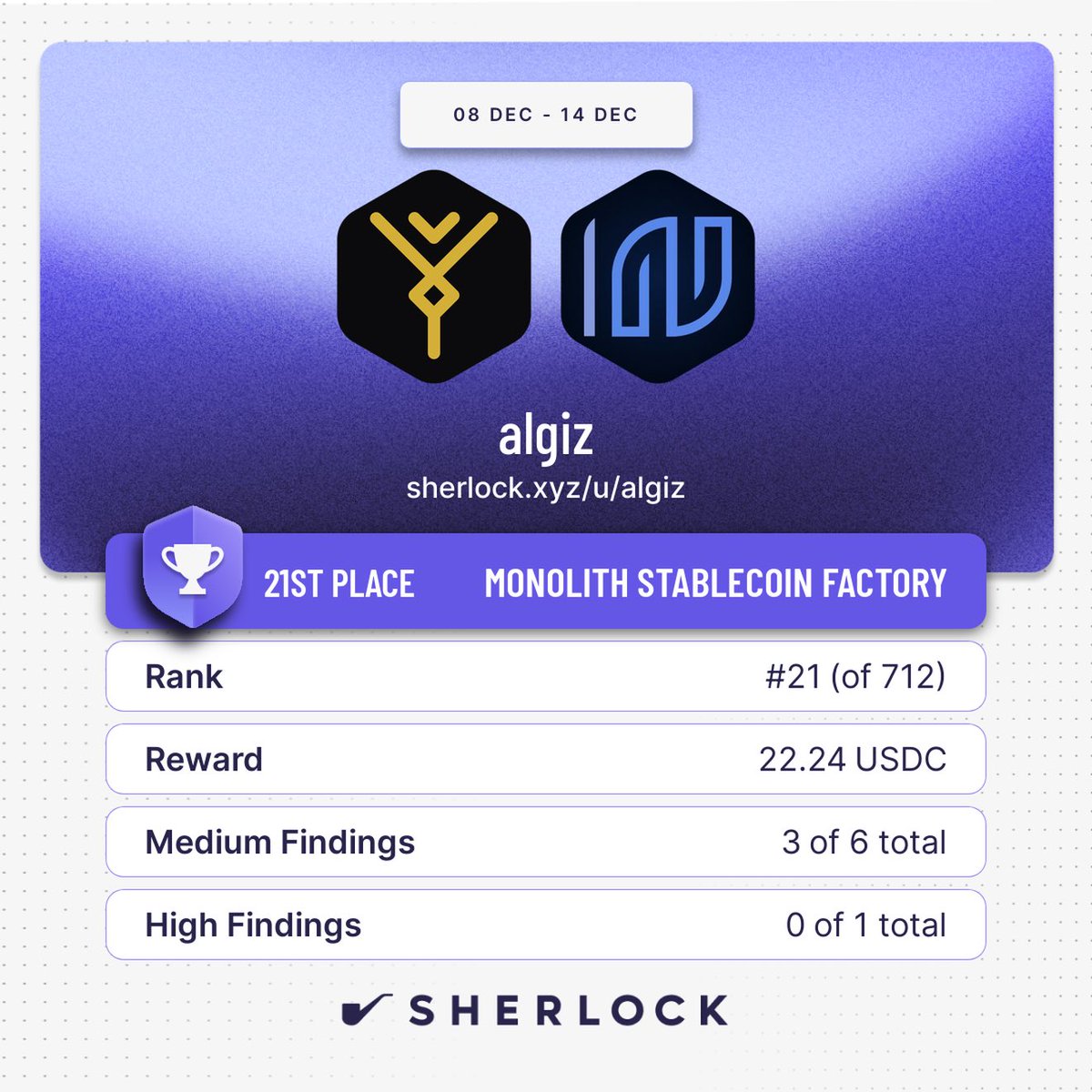
Results from the @InverseFinance contest last December:
3/6 Mediums, #21 out of 700+.
Not a top finish - but honest work and good lessons.
Missed one Medium due to poorly framed impact/conditions. Fair judging.
A reminder that in contests, precision in describing impact matters as much as finding the issue.
Pleased to announce our security partnership with @rgbclash_xyz 🤝
Color - RgbClash brings competitive drawing-guessing PvP gaming on-chain - NFT drawing and staking for passive yield, multiplayer lobbies and tournaments with on-chain prize settlement on Base.
Very smooth collaboration, super exciting project and a really great team! 🫡
That’s exactly why boutique audit teams like ours exist - to partner with early-stage protocols and help them ship with confidence, not block them from launching.
Security in web3 isn’t optional. You can’t scale TVL or attract serious capital if users aren’t confident their funds are safe.
And it’s not a one-time checkbox - it has to be iterative. As protocols evolve and complexity grows, teams need to double down on security and plan for multiple reviews over time, often by different firms.
One of the biggest reasons why it's hard to experiment in crypto is security audits and their costs.
I've spoken to more than 10 teams in the last month who are all currently ready to launch on mainnet, but are held back by audits and their insane cost.
A basic audit can cost up to 50k for a small codebase, which makes it hard for bootstrapped projects to launch and explore if they should even be spending their time on this.
The industry did a terrible job of overpricing security audits and it has strongly held the space back.
@HanjiProtocol@monad Congrats on top 2 volume on Monad. Fully on-chain CLOB with custom matching + vault-based liquidity is novel architecture - challenging from security POV.
Recently, we ensured that Tobyworld's PATIENCE and TABOSHI tokens for @toadgod1017 are secured - as the great ToadGang community would say - BUSHIDO.🛡️
As always, our pleasure. 🫡
Solid insights from @HackenProof's report.
The data is clear: security budgets tend to expand after incidents, not before them.
The more sustainable approach is boring - but effective:
📌 private audits before launches, upgrades, or major architectural changes
📌 broader audit competitions for additional coverage
📌 continuous programs (bug bounties) to maintain security over time
In most cases, the total cost of doing this right is far lower than the cost of losing user funds - and trust.
Planning security early should be a top priority.
Our goals are ambitious, but never at any cost.
We aim high while staying true to ourselves: providing real value and helping small protocol teams scale with confidence.
We're here for the long run.
As 2025 comes to an end, a quick thank you to everyone who has been part of our journey so far.
Algiz was born this year with one simple belief: security should be accessible to every serious builder.
In a short time, we’ve supported teams, secured live protocols, and shown that a small, zero-overhead team can deliver world-class work.
In 2026, we’re not changing direction - we’re sharpening it.
We will keep improving every part of how we work, striving to provide exceptional service to Web3 builders.
Our focus remains simple: become the trusted security partner behind the next wave of protocols.
Here’s to building securely. 🛡️
Happy New Year!