Mental toughness is not about always feeling good. It’s about staying anchored when you don’t. You can feel nerves and still perform at your best. You can feel down and still support a loved one. You can feel insecure and still step into the arena. Your brain is plastic. Your mind is adaptive. You are not fixed. Every time you sit with discomfort, approach challenges, and return after setbacks, you’re building capacity, you’re building mental toughness.
Japan sits at 6% obesity. The US sits at 43%.
And the biggest reason is environment.
I saw it firsthand traveling to Japan. In 2 weeks there, I rarely saw anyone overweight.
Not because they were dieting. Because of how they lived.
They walk everywhere. Their version of "fast food" has whole ingredients, high protein, rich in fiber. Meals are built around real food by default, not by discipline.
Nobody was counting macros. Nobody had a meal plan app.
There is no body positivity. Being slim is the standard and they take it seriously.
Meanwhile, the most obese countries on this list share the same pattern: car culture, processed food access, sedentary defaults, and acceptance as part of their culture.
You can't move to Japane. But you can build your own environment.
Walk more. Eat real food. Make the healthy choice the easy choice.
My life got a lot better when I viewed every problem as a skill issue. Out of shape? Skill issue. Ugly bank account? Skill issue. Anxious thoughts? Skill issue. I affirmed to myself these would go away if I got better. And magically, they did, once “I” did.
In order to be successful, you have to do five things. There’s a sequence to it.
1. Have (audacious) goals.
2. Identify and don't tolerate problems.
3. Diagnose the problems to get at their root causes.
4. Design a path to fix those things.
5. Push through to results.
This is what I call looping. Go for your goals, identify your problems, get to the root cause, design a path, and push through. Life is basically just doing that over and over again. If you do that, you'll make the advances.
#Principles #RayDalio #PersonalGrowth
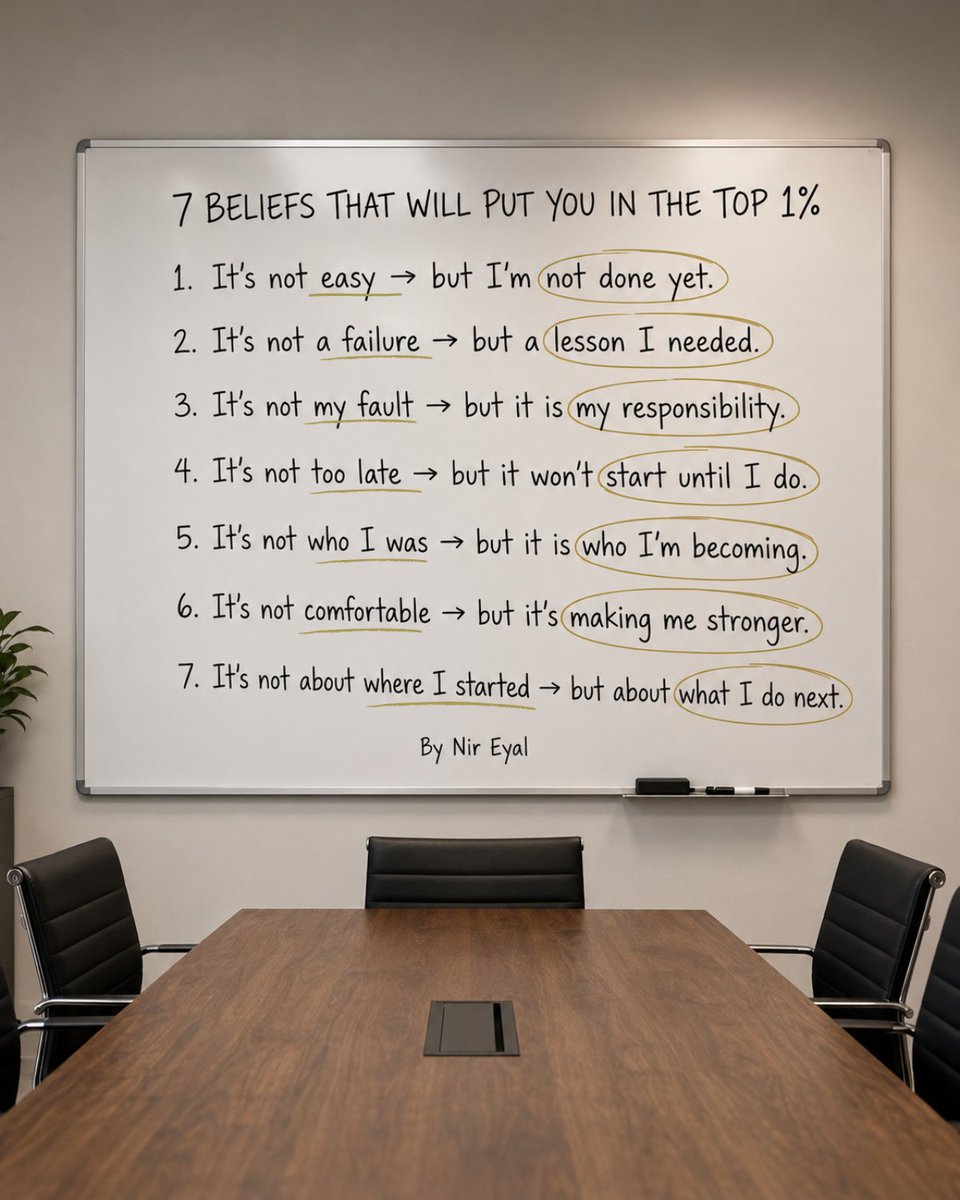
Most self-help tells you to work harder. The research says something stranger: the people who pull ahead don't have better discipline. They have better beliefs.
Beliefs aren't facts. They're tools. And when you understand how they work, you can swap the ones that aren't serving you for ones that do.
Here are seven I've found worth holding — each one backed by a study I keep returning to.
1. Willpower isn't a limited resource.
Carol Dweck's lab showed that signs of ego depletion only appeared in people who believed willpower was finite. Everyone else kept going. The belief was doing the work, not the glucose.
2. Distraction starts from within.
The phone isn't the cause. It's the cope. Notice the discomfort you're trying to escape — boredom, anxiety, loneliness — and you've done more than any app blocker can.
3. The opposite of distraction is traction.
Both come from the Latin trahere, to pull. You can only say you got distracted if you know what you got distracted from. Open the calendar first.
4. Identity precedes behavior.
Vegetarians don't debate bacon. People who call themselves indistractable don't negotiate with the notification. The label does the lifting.
5. Time management is pain management.
All behavior is an attempt to escape discomfort. Productivity is the skill of sitting with that discomfort long enough to do what matters.
6. You can't be addicted to something you can quit.
The casual use of "addiction" flatters us — it locates the problem out there. For most people, the honest word is overuse, and overuse is a design problem you can fix.
7. Beliefs are tools, not truths.
This is the meta-belief that holds the others up. If a belief stops working, you're allowed to put it down.
The top 1% aren't grinding harder. They're carrying lighter assumptions.
Those who seek stillness must
Develop a strong moral compass
Steer clear of envy and jealousy and harmful desires.
Come to terms with the painful wounds of their childhood
The most underrated trait for a happy life: decisiveness.
Our intuition is that it’s best to keep our options open. But as long as you try to keep every door open, you’ll never be able to walk through the one that matters.
Conor Neill, profesor de MBA, lo dice sin rodeos: la vida premia la acción, no la inteligencia.
Y cuanto más listo eres, mejores excusas te inventas para no actuar.
8 ideas para dejar de pensar y empezar a moverte:
1/ Haz una sola cosa. Y luego otra. Y otra...
Use your unfair advantage.
“You're supposed to use every unfair advantage you have.
Looks, genetics, connections, dad's money, whatever.
There's nothing noble about choosing the hardest path just to feel like an underdog.” — @PathOfMen_