Let me blow your mind: Moods Condoms is a government brand. This makes the Indian government one of the largest condom producers in the WORLD.
It began in 1966 to make condoms for the National Family Planning Program before moving into the "premium and upper middle class segment" across 30 countries.
It remains an amusing metaphor for India's socialist roots and the government's stronghold on unexpected realms of Indian business. I find it a little hilarious that while the government has been on a massive privatisation drive to exit state-owned companies, it wants to stay put in the condom business.
My guess would be that in other states, economic activity has been concentrated in 1 city (eg. Maharashtra-Mumbai) which has led to a skyline as migrants rush in creating demand for space. TN’s growth has been led by manufacturing which takes place outside Chennai (like in Hosur). This raises incomes across the state… but no skyline.
The un-affordability crisis is also b/c of restrictive "floor space index" rules across India's cities which limits how tall buildings can be. In cities like Mumbai, land is limited and the only way to create space is by building upwards but these rules don't let you. Result: lack of supply + booming demand = insane prices.
Launching India's 1st privately built rocket is cool. Doing it from an office right out of Star Trek is even cooler.
Skyroot Aerospace's Bangalore HQ designed by Designovate Studio perfectly embodies its culture.
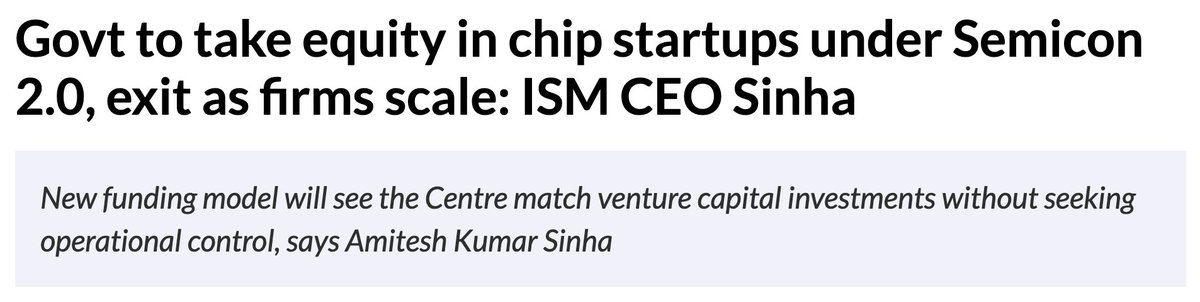
An underreported part of India's semiconductor mission 2.0: the government will be playing VC and acquiring equity stakes in startups.
What we know: the GoI will co-invest alongside VC funds, matching their amounts and on the same terms, from seed to series A, B, C rounds. No board seats or active control over operations and exit when the startup matures.
This is a huge improvement over handing out grants that only kick-in after you show expenditure or deploy products. Semiconductor development requires huge upfront investment, long development cycles and risks often too scary to attract funding.
The icing on the cake: the GoI understands it doesn't have the expertise to select, evaluate and negotiate deals with startups. Tagging along with VCs that have spent years doing this is wise and my favourite part here.
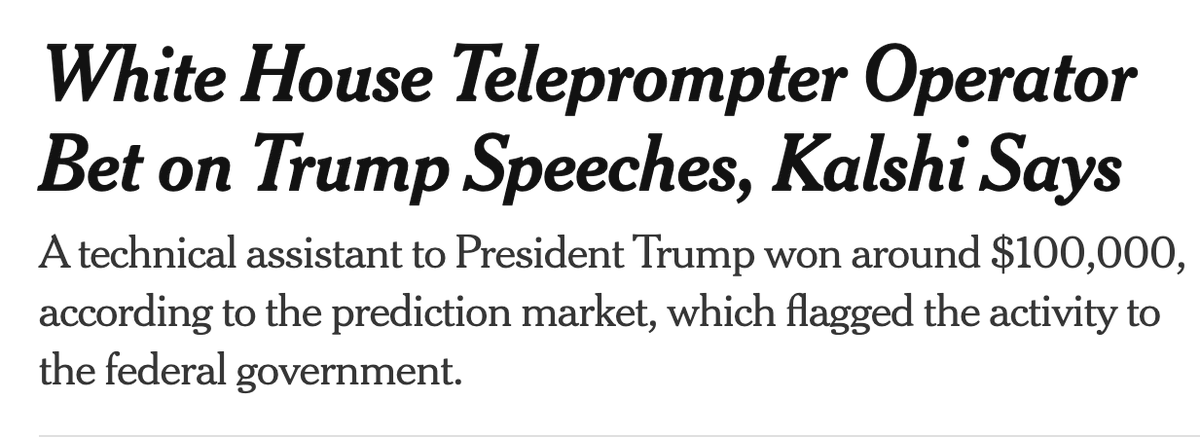
The mainstreaming of “prediction markets” like Kalshi in the US which let you bet on real-world events have led to hilarious cases of insider trading.
Yesterday, a White House teleprompter operator used his role to place bets on what Trump would say in his speeches and was caught will gains of $100,000.
Earlier, I’d written about a trader who bet on the the weather getting hotter in Paris and then took a hair dryer to an official temperature gauge to increase its recorded measurement.
Then there was the time when a U.S. Army Special Forces soldier bet on the capture of Nicolas Maduro (Venezuelan Prez) before participating in the classified operation to capture him and netted $400,000.
Can we please not have this in India?
Something fun’s going on with Paramount’s $111B acquisition of Warner Bros. Discovery (WBD).
Paramount beat Netflix in a battle to buy WBD because (allegedly) its CEO's ties to Trump allowed it to get government antitrust approval which Netflix couldn't (there is an ongoing lawsuit about this).
Now, 12 US states (all Democrat) have sued to block the deal out of of concerns that creating such a giant will harm competition.
This is deadly for Paramount b/c it agreed to pay a $650M “ticking fee” per quarter of delay after Sep. 30.
This raises questions about the deal being used as a political playground and the states' growing power to override US' main antitrust regulator, the FTC.
This makes me think if states could do this in India. The CCI (India's antitrust authority) has absolute power which cannot be overriden. But if a state really wants to block a deal, it could probably do so indirectly by withholding business licenses and land use permits?
@aditya_kondawar Good time to revisit Hero's other EV investments:
- Zero Motorcycyles - incurred 92% loss - ₹241 crore stake turned to ₹19 crore
- Euler Motors - valuation remains flat (as of this year's funding round)
But Ather's success overshadows any other failure - classic VC playbook.
The GoI went guns-blazing on crypto with a 30% tax and killed anonymity with KYC. The market developed a cheat code: crypto derivatives.
They’re instruments that “derive” their value from the price of crypto. Buying them lets you bet on the price of crypto without actually owning it.
These are completely unregulated, which means no tax or KYC and you can borrow unlimited amounts of money to buy them… basically do whatever your imagination allows (subject ofc to the rules of the crypto exchange you’re trading on).
They understandably make up 80% of all crypto trading volume in India with folks borrowing up to 50 times their own money to fund it.
I expect a government crackdown to be around the corner. Till then, the party rages on.
@Fintech03 It isn't exactly the government funding it, it's NIIF in which the GoI holds 49% (just below the % required to have actual control over it). And this isn't the first time NIIF is investing in companies - e.g. EKA Mobility and Mahindra Last Mile Mobility in the EV space itself.
@aakancvedi Despite the high 74% limit, foreign investments in defence require security clearance from the Home Affairs Ministry. I assume stringent conditions on sensitive information/ access may have been imposed as a precursor to granting it.