Why $pippin($135M mcap) will flip $ai16z($1B mcap)?
TLDR
1. Pippin’s creator, Yohei(@yoheinakajima), has a proven track record with BabyAGI(@babyAGI_ ), is highly respected in Web2, and is a guy who’s always ahead of trends(or to be bold, someone who creates trends🤔just go compare the timestamps of his GitHub work with Google search trends).
2. Pippin’s AI framework is designed for “self-building” agents, far beyond simple platform bots. While self-building isn’t fully functional yet due to challenges like third-party integration or memory issue, the framework lays the groundwork to make it possible in the near future.
3. Unlike most AI coins, Pippin will have utility. While Yohei has only shared brief hints so far, it’s clear that utility will be one of the focus as the project evolves.
--------------------
So who is Pippin? Pippin(@pippinlovesyou) is an AI influencer and digital being, brought to life through AI-generated SVGs, named by ChatGPT, and nurtured by its visionary creator, Yohei. For more on Pippin’s origins, do explore Pippin's genesis story here (https://t.co/MIYKSMZisG) In this thread, I’ll mainly focus on the recently open-sourced Pippin AI agent framework and potential $pippin utility.
1. Pippin Framework
Before diving into the Pippin framework, I’d like to first explain what a "self-building" agent is. Since the development of BabyAGI, Yohei has been iterating on several of its core features, including dynamic skills, self-reflection, and graph-based memory. His recent focus has been on creating “self-building” agents.
Yohei has shared his thinking on self-building agents, breaking them down into four levels:
- Level 0: No Self-Build. Predefined Skills
At this level, the agent operates with a predefined function library(e.g. skills) created by the developer. When triggered, the agent simply executes an action or produces an answer based on the functions available.
- Level 1: Request-Based Skill Generation
The agent can build its own skills when triggered. In the future, it will be able to use the functions it has built for itself.
- Level 2: Need-Based Skill Creation
When asked to perform a task, the agent evaluates whether it has the required skills. If not, it writes code to build the necessary function and executes it.
- Level 3: Anticipatory Skill Development
At this level, the agent anticipates the skills it will need based on its character or objectives. It proactively writes code, builds the functions, and executes them to fulfill its goals.
Currently, the Pippin framework enables new activity generation, but the self-building of skills is not yet functional. To understand this, consider an example: If you want an agent to be healthy, it needs to “eat” green vegetables instead of instant noodles. The first step is for the agent to understand how to “eat,” so it can choose what to eat based on the goal of being healthy. In this context, “eating” is a skill, and actions like “eating green vegetables” or “eating instant noodles” are activities the agent can generate, choose, and execute on its own.
For a virtual AI agent, skills might include posting on Twitter, speaking on Zoom, collaborating in Google Docs, etc. Based on these skills, the agent can begin running activities aligned with the objectives it’s given—such as generating content to promote the Pippin token(objective) through tweets(skill) or live streaming(skill) with LLM-generated content(activity).
The challenges of building self-building skills are clear—how do you establish vendor integration, build memory, and so on without human intervention? The Pippin framework is designed with these challenges in mind, with the goal of simplifying self-building and making it a reality in the near future.
Given the current framework, a key question arises: What skills does Pippin have if self-building is not yet an option? The Pippin framework integrates with Composio(@composio), offering 200+ skills and capabilities for AI agents to leverage. These range from social media tasks and collaboration tools to even e-commerce (e.g., Pippin buying me a pizza after I got rugged…). With this, your Pippin will be able to achieve its goals by tapping into a wide range of platforms and skills—isn't it exciting!
For more technical details, feel free to check out the GitHub page(https://t.co/qs1GJTy2Lc). I've also included a screenshot of the framework below for your reference.
2. Pippin Utility
While Pippin’s utility is still evolving, we can get a glimpse of its potential from Yohei’s demo together with the Pippin framework. Users will be able to stake Pippin to become active developers and participate in:
- Quests and competitions
- Submitting solutions to challenges
- Voting on other developers’ submissions
Subsequently, there will be three types of quests:
1. Challenge: Be the first to complete a challenge
2. Competition: Be the one to submit the best solution
3. Request: Work as an assigned developer for a specific task
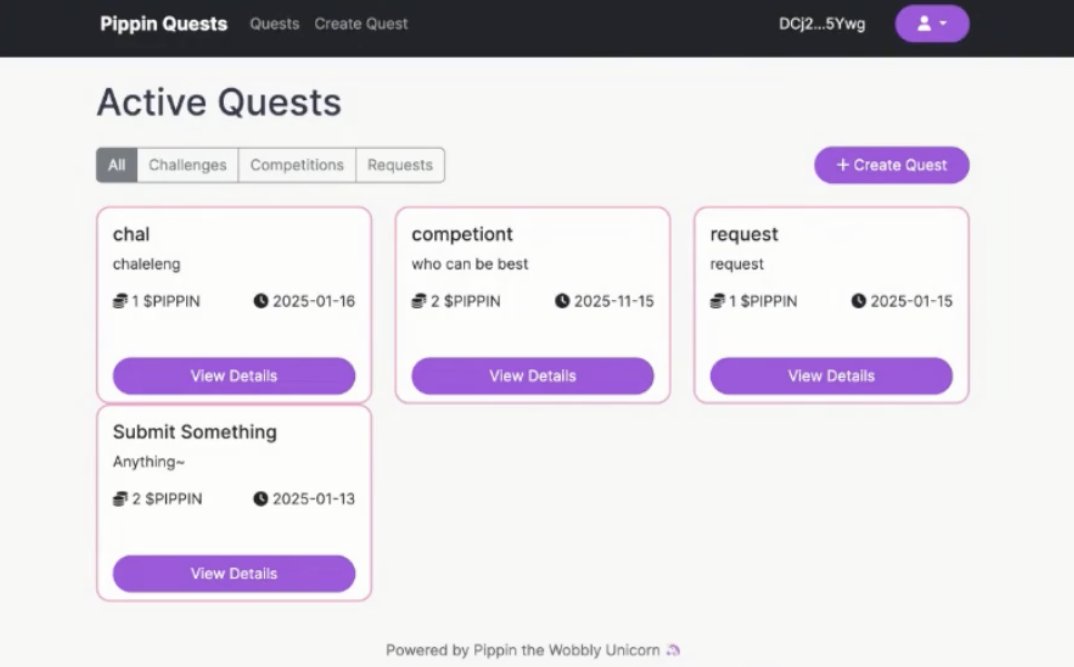
In my opinion, this system is designed to attract and centralize top talent around projects and problem-solving, rather than acting as a traditional launchpad where developers are scattered and competing with each other. This approach is reminiscent of Kaggle, the Web2 machine learning platform that successfully draws the best talent to solve complex problems through collaborative challenges. I’ve shared a screenshot of the quest page below, and for more information, you can watch the Pippin demo video(https://t.co/LY643cAdhC).
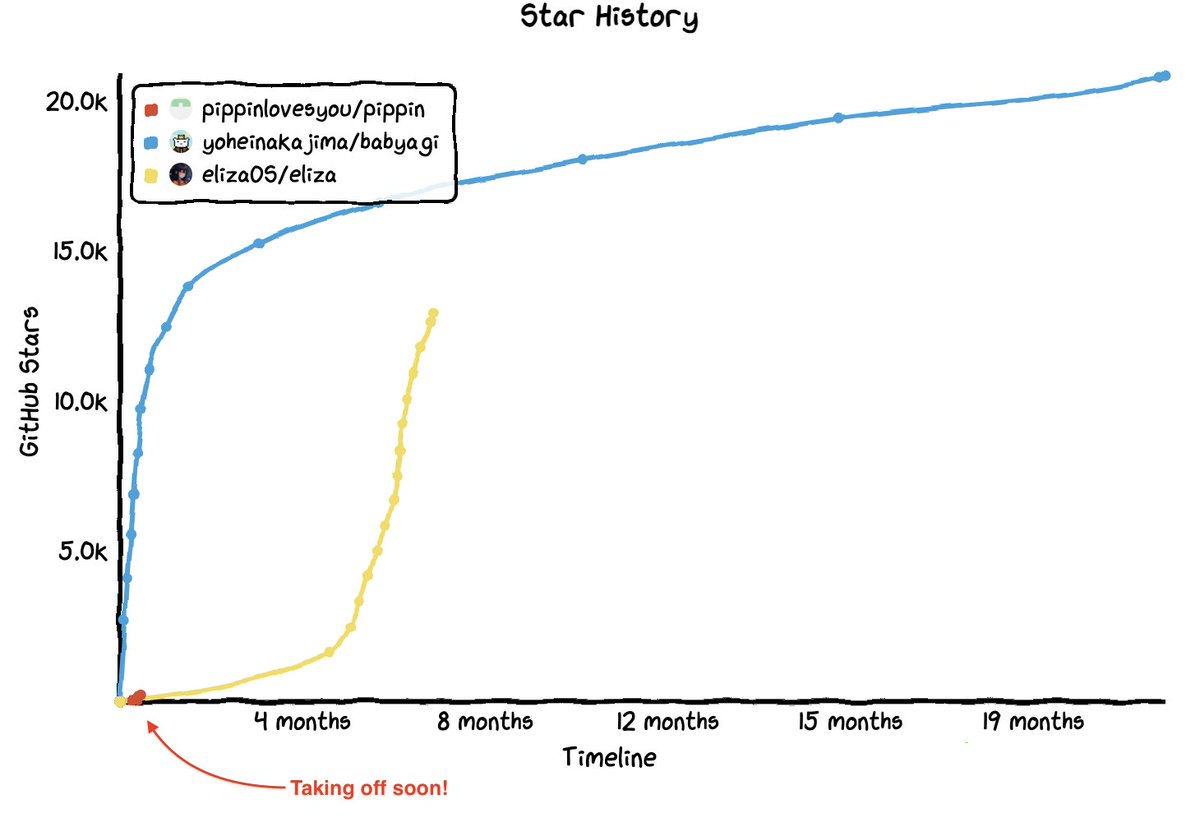
It’s just the beginning. Check out the GitHub star history below comparing BabyAGI, Pippin, and ElizaOS(AI16Z)—are you sure you don’t want to jump on the train now? It’s about to take off! 🚀🚀
@latteliem@jeremysoojk Great read. I've also been wrestling with a "schlep problem" for a while, but I’m starting to think the schlep is precisely what makes it worth building. Turning something customers dread into something delightful can make all that hard work feel worthwhile.
What if there's a private eval arena where companies upload their real tasks, and every new model is automatically tested as a black box. That way, we evaluate models by their value on real world work not vanity benchmarks
I have a genuine question.
Anthropic has probably been working on Fable 5.1 for a very long time. OpenAI has probably been working on GPT-6 Astra for just as long. These labs are almost certainly building in parallel, not reacting to each other in real time of course.
So why does Fable 5.1 launch just a couple of days before Astra, and then Astra beats it on almost every benchmark by a good margin?
And this isn't a one-off.
Every single launch follows the same pattern: when Anthropic ships a new model, it beats all of OpenAI's previous models.
When OpenAI ships a new model, it beats all of Anthropic's previous models. Now they are actually beating what the other just launched days earlier.
Benchmarks are completely vanity metrics.
@Prathkum I've been thinking about a private eval arena where companies upload their real tasks, and every new model is automatically tested as a black box. That way, we evaluate models by their value on real world work not vanity benchmarks
@zarazhangrui Agree. Especially cause constant context switching comes with its own performance cost. Agents may help us do more in parallel while making it harder to think deeply about any one thin
Most AI products are automation, not AI-native. Automation makes the old workflow cheaper. AI-native makes it unnecessary.
My team builds evals for frontier models. Benchmarks: task sets, rubrics, judge pipelines, release gates. AI does most of that work now, so what used to take 10-15 people + 2 weeks takes one operator + 3 days now. Transformative economically. Still the same old process underneath.
AI-native approach would not generate the same old outcome. It would watch failures, find what we do not understand, form hypotheses, run experiments, audit its own judges, and escalate only what matters. It is a living map of where the model works and where it breaks.
@vasuman Agree. Most "AI problems" are operating-model problems: unclear decision rights, conflicting incentives, and no E2E owner. The tech is often the easy part. How often do you see leaders truly willing to redesign the power structures behind the process?
Feel this deeply. Sometimes I wonder if it's that we got better at managing feelings before they fully form, like a preemptive emotional immune system. The intensity comes back for me in moments of genuine surprise or when I let myself be truly bad at something new. The beginner's mind remembers how to feel.
What if the next gold rush isn't AI building, but teaching AI your taste?
A Hollywood cinematographer sees 1000 things you don't - which shadow creates tension, why 24fps feels more cinematic than 60, when breaking the 180° rule works
We're moving from selling time → selling outputs → selling the pattern of how we see
Just like lawyers are teaching AI what "good" contracts look like for $500/hr, imagine cinematographers encoding their visual intuition, producers teaching story rhythm, sound designers transferring their feel for emotional frequencies
The most valuable asset isn't your work anymore, it's your taste, packaged as training data
Creative judgment that took decades to develop can now be captured, scaled, sold. Every expert should be asking: how do I bottle what makes my eye different?
The real disruption: human taste becomes a product, not a service
How a 22-year-old dyslexic dropout created the fastest revenue-growing business in history—$1M to $500M in just 17 months.
@BrendanFoody discovered that AI labs were facing a critical bottleneck: they needed human experts to create "evals"—tests that teach models what correct looks like. His company @mercor began connecting labs with lawyers, doctors, engineers, and other specialists to create evals and training data for models (for $95-500/hour).
Today, @mercor works with 6 of the Magnificent 7, all top 5 AI labs, has never had a customer churn, and has a net revenue retention of 1,600%.
In my conversation with Brendan, we discuss:
🔸 Why evals have become the primary bottleneck for AI progress
🔸 How exactly Mercor grew to $500M revenue in 17 months
🔸 Brendan’s meeting with xAI that changed his company’s trajectory
🔸 Which skills and jobs will be most valuable as AI continues to advance (hint: jobs with “elastic” demand)
🔸 Why Brendan believes AGI and superintelligence are not happening anytime soon
🔸 The three unique core values that drove Mercor’s success
🔸 How Harvard Lampoon writers are making Claude funnier
Listen now 👇
• YouTube: https://t.co/QyRSrh6cQt
• Spotify: https://t.co/uz5N9UNYoT
• Apple: https://t.co/xGATH3lEG3
Thank you to our wonderful sponsors for supporting the podcast:
🏆 @WorkOS—Modern identity platform for B2B SaaS, free up to 1 million MAUs: https://t.co/XH3bKmeEkH
🏆 @Jira Product Discovery—Atlassian's new prioritization and roadmapping tool built for product teams: https://t.co/yK7ekWfAnV
🏆 @enterpret_ai—Transform customer feedback into product growth: https://t.co/kpk3hkjHxH
@julianweisser This feels like a massive tell about enterprise software. We built tools so complex that we now need AI intermediaries to operate them. It's like hiring a translator for a language we invented ourselves
@julianweisser This feels like a massive tell about enterprise software. We built tools so complex that we now need AI intermediaries to operate them. It's like hiring a translator for a language we invented ourselves
This EPS idea hits different. The real poison isn't just the volume, it's how the constant stream of engagement bait actively distorts reality. When every post needs to be rage/shock/awe to cut through the noise, we're training ourselves to see the world in increasingly extreme terms. A quality multiplier could literally make nuance profitable again. Imagine if thoughtful takes earned 10x what hot takes did.
Tinkering with an idea that got me:
> 3.5k views in 24h
> 19% upvote ratio (so you can tell it's not pleasant content lol)
> 31 people writing long essays on why I'm wrong
> 10+ stealth website visitors
Lesson: Bad attention beats no attention every time. The real problem is being ignored.
Plot twist: Reddit haters wrote the most helpful 7-8 line feedback I've ever received.
Worth the roast.
people think “branding” is just fonts & color palettes. elon’s whole career is littered with high leverage naming & narrative framing moves.
- tesla: evokes innovation, history, electricity in a single word
- spacex: futuristic but grounded in aerospace tradition
- boring company: self aware af
- neuralink: says exactly what it is, but with sci fi allure
& now of course open ai which only seems obvious in hindsight. what a ridiculous streak. once you’re good, twice you’re great but like 5+ times??