Very excited to share our recent work to improve cell replacement therapies for restoring vision lost to glaucoma and other optic neuropathies! @BaranovLab@Levi_J_Todd@HMSeye@MassEyeAndEar
https://t.co/LXu9PsZom6
LLM APIs let you build NLP systems in seconds; just write a prompt and use it as you wish. But APIs cost money and have privacy concerns.
Our new library Prompt2Model turns a prompt into a small expert model that can match LLM performance but runs locally!
https://t.co/bdohmjpZMV
📢 I am excited to share that I will be starting as an Assistant Professor @OhioState@OhioStateCSE in Fall 2024 🥳. Before that, I will spend a year as a postdoc in the @ai2_allennlp team @allen_ai!
Text clustering is widely used but unpredictable, because there are many "right" ways to cluster data. Semi-supervised clustering tries to solve this, but too often it requires a lot of user feedback to be useful. We explore the problem of “few-shot clustering” using LLMs.
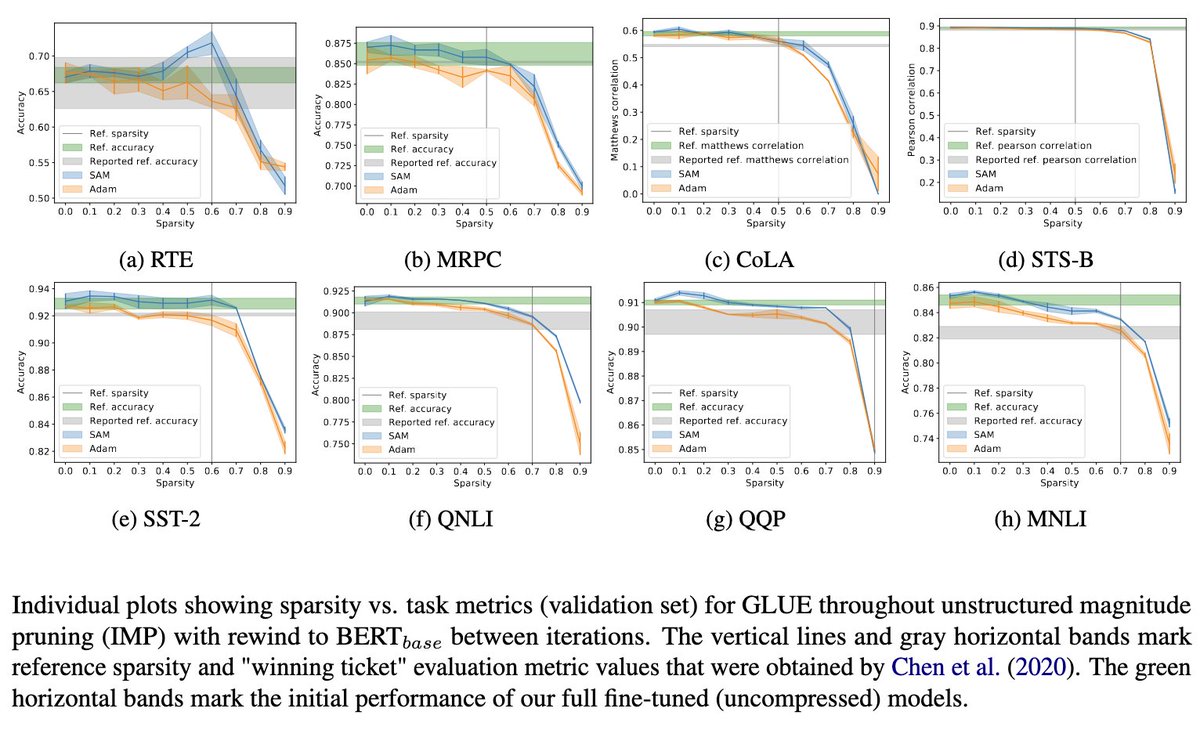
Excited to share our paper (w/ @sanketvmehta & @strubell), "Train Flat, Then Compress: Sharpness-Aware Minimization Learns More Compressible Models," to appear at #EMNLP2022 Findings (will be presented at SustaiNLP 2022)!
Paper here 👉 https://t.co/DnpT0l0xml
🧵👇 (1/n)
It really takes a village of wonderful, responsible, and creative volunteers to pull together such an amazing 60th edition of the ACL. THANK YOU! i enjoyed meeting people and hearing about all the exciting research happening #acl2022@AlineVillav@preslav_nakov@SmaraMuresanNLP
@Vit_Bhandari Thank you! :) Yes, for sure, that is one limitation. Ideally you’d want a model to predict these preferences, so you won’t have to rely on labeled data every time
Do you speak multiple languages and alternate between them in conversations? Do you *code-switch* depending on who you talk to and how comfortable you are with each language? These are some questions we explore in our work, to appear in #ACL2022 🍀🇮🇪 (https://t.co/uzpAS25IN9)
We believe our approach can apply to other speaker-driven tasks, too! For details please see our preprint (https://t.co/uzpAS25IN9).
Hope to see you in Dublin!
Using the SelfExplain framework from @tsvetshop, we thoroughly analyze key features driving code-switch predictions. For example, we find that speakers tend to accommodate the preferences of their conversational partners, which is in line with prior sociolinguistic studies!
This project was joint work with @Sid_Arora_18, Alissa Ostapenko and @siddalmia05, and advised by Florian Metze, Shinji Watanabe, and Alan W Black, all from @LTIatCMU. (9/9)