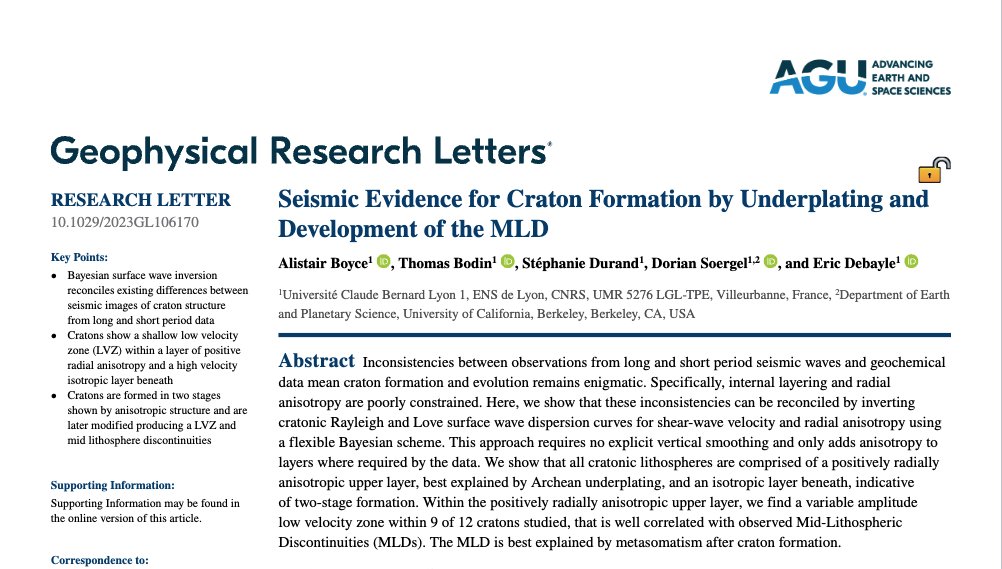
(1/4) 📜 #NewPaperAlert 💥 in @theAGU#AGUGRL 👉🏻 Seismic Evidence for Craton Formation by Underplating and Development of the MLD 🌎
https://t.co/pozBWmfrQu
We discuss the formation and evolution of #Cratons 🗺 using a novel approach ✅
#Seismology#OpenAccess
(1/4) 📜 #NewPaperAlert 💥 in @theAGU#AGUGRL 👉🏻 Seismic Evidence for Craton Formation by Underplating and Development of the MLD 🌎
https://t.co/pozBWmfrQu
We discuss the formation and evolution of #Cratons 🗺 using a novel approach ✅
#Seismology#OpenAccess
(1/4) 📜 #NewPaperAlert 💥 in @theAGU#AGUGRL 👉🏻 Seismic Evidence for Craton Formation by Underplating and Development of the MLD 🌎
https://t.co/pozBWmfrQu
We discuss the formation and evolution of #Cratons 🗺 using a novel approach ✅
#Seismology#OpenAccess
(3/4) Results show:
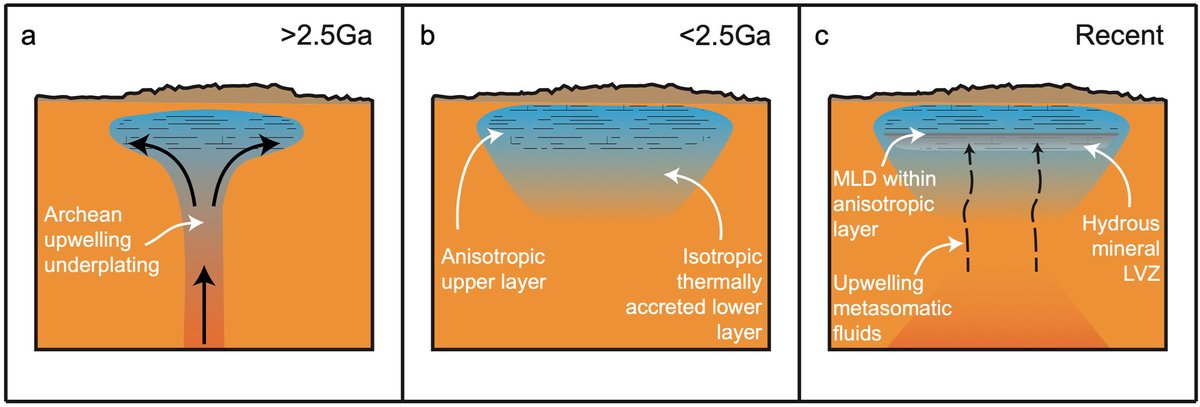
1. Cratons possess a shallow low velocity zone (LVZ) within a layer of positive radial anisotropy and a high velocity isotropic layer beneath
2. Cratons are formed in two stages shown by anisotropic structure and are later modified producing a LVZ and MLD
The final work of the now Dr Pugh: Looking at seismological signatures of the 'X-discontinuity' in the upper mantle beneath Africa to potentially track compositions and temperature. Now available: https://t.co/ZmRZAxF7ey @EarthSciCam@NERCscience
Delighted to see that our paper on Crustal Structure within the Turkana Depression in the East African Rift System is now published. Many thanks to @IanBastowRSM@rita_kounoudis and our US, Ethiopian and Kenyan-based collaborators for their awesome work!
https://t.co/5EFgspDZ6f
(2/3) Beginning as an idea with @SummaMeologica during our PhDs at @ESEImperial, we focus discussion on #Canada and #Alaska#Tectonics
Model here: https://t.co/KLmWhHWXgo.
Data, software and plotting here: https://t.co/Ve5PSXzjcE.