𝟳+ 𝘆𝗲𝗮𝗿𝘀 𝗯𝘂𝗶𝗹𝗱𝗶𝗻𝗴 𝗺𝗶𝗰𝗿𝗼𝘀𝗲𝗿𝘃𝗶𝗰𝗲𝘀
Here is what I will ask during interviews 👇
The key areas I explore when interviewing senior .NET devs:
• Communication patterns between microservices
• Resilience strategies
• Event-driven architecture
• Orchestration and coordination
• Infrastructure patterns
• Architecture decisions
Each area reveals how deeply someone understands distributed systems.
Most candidates focus just on tools: Docker, Kubernetes, and messaging libraries.
They miss the bigger concepts that separate middle and senior engineers.
Microservices are not only about technology stacks.
They're about boundaries, scalability, resilience, and trade-offs.
Check what you can answer with confidence.
The gaps show your growth opportunities.
👉 Download my free .NET Microservices roadmap, with highly valuable resources to get better in microservices in .NET: https://t.co/unaALURRls
📌 Save this post for future reference!
——
♻️ Repost to help others master microservices in .NET
➕ Follow me ( @AntonMartyniuk ) to improve your .NET and Architecture Skills
After installing Microsoft Visual Studio, what extensions do you install?
My list
- DPack
- EF Core Power Tools
- File Explorer
- ReSharper
- Markdown editor v2
- Open in Visual Studio Code
- Solution Favorites
- VSColorOutput64
C# Interview Question (Middle-Senior level)
Many developers get this wrong in interviews 👇
Have a look at the code snippet on slide 1.
What do we have on the slide:
- ProductStock is not null
- You’re looping through items
- You use yield return inside the loop
So why do you still get a warning or error?
Think for a while...
Now look at slide 2 to verify your answer.
@thomas_entner It wasn't, most of it was very well thought out. It's not fair to extrapolate from an edge case like this to the rest of the product, and that's kinda the point of the story.
I wrote this Format dialog back on a rainy Thursday morning at Microsoft in late 1994, I think it was.
We were porting the bajillion lines of code from the Windows95 user interface over to NT, and Format was just one of those areas where WindowsNT was different enough from Windows95 that we had to come up with some custom UI.
I got out a piece of paper and wrote down all the options and choices you could make with respect to formatting a disk, like filesystem, label, cluster size, compression, encryption, and so on.
Then I busted out VC++2.0 and used the Resource Editor to lay out a simple vertical stack of all the choices you had to make, in the approximate order you had to make. It wasn't elegant, but it would do until the elegant UI arrived.
That was some 30 years ago, and the dialog is still my temporary one from that Thursday morning, so be careful about checking in "temporary" solutions!
I also had to decide how much "cluster slack" would be too much, and that wound up constraining the format size of a FAT volume to 32GB. That limit was also an arbitrary choice that morning, and one that has stuck with us as a permanent side effect.
So remember... there are no "temporary" checkins :)
Follow me for more random code musings!
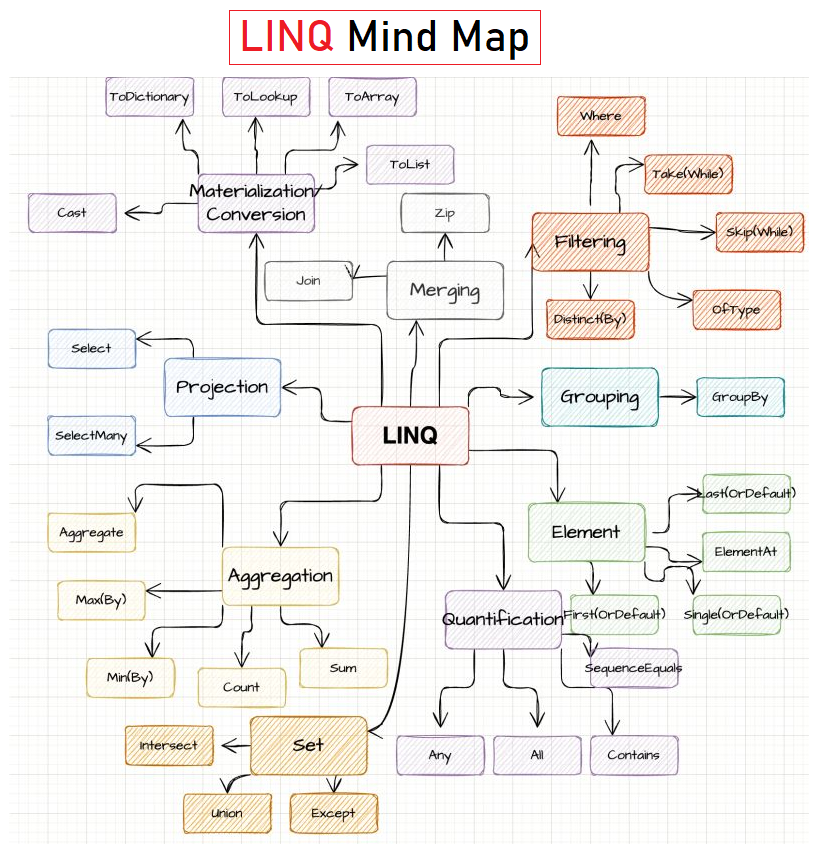
C# LINQ Mind Map ⬇
What a great infographic.
Bookmark it for future reference.
Thanks to Steven Giesel on LinkedIn for the original image -> https://t.co/PuytOEhfDX
#dotnet #csharp
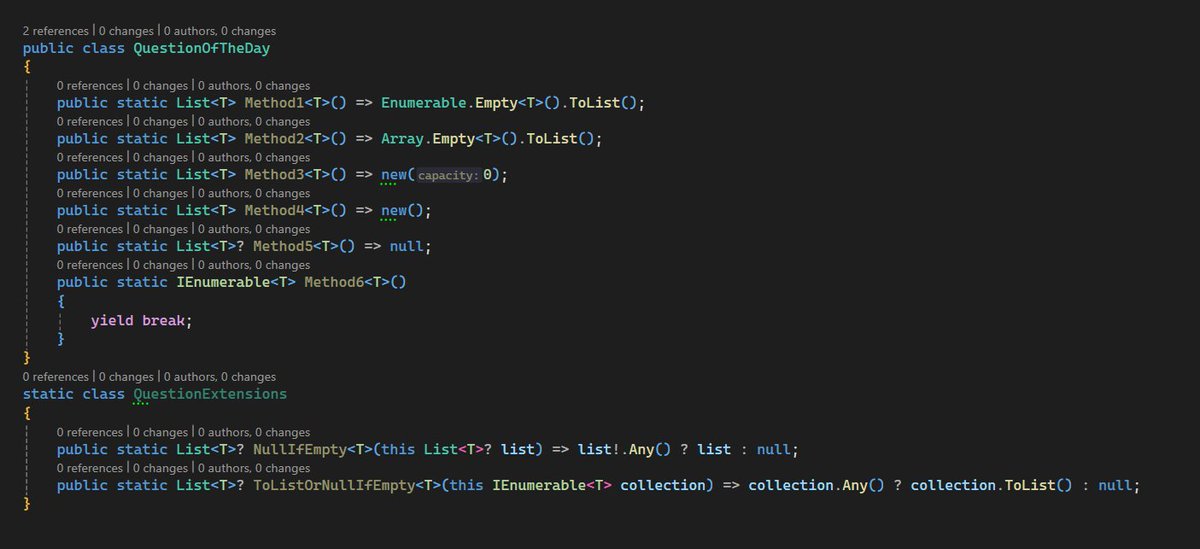
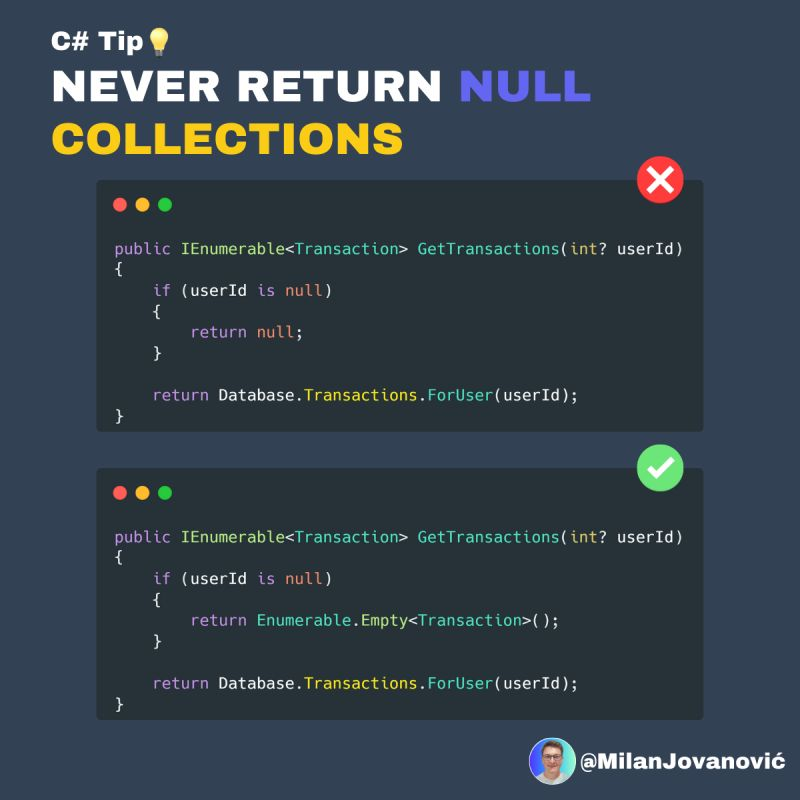
You should never return null collections in C#.
There are better solutions.
What problem does returning null collections cause?
Collections are typically iterated over in a loop.
If your method returns null collections, this can lead to potential errors.