UPDATE: Came up with an even better version of this prompt after the feedback
Ask Codex to look across your sessions, Memories, and Chronicle, identify patterns, reuse what already exists, and only create the smallest useful skill, subagent, or automation.
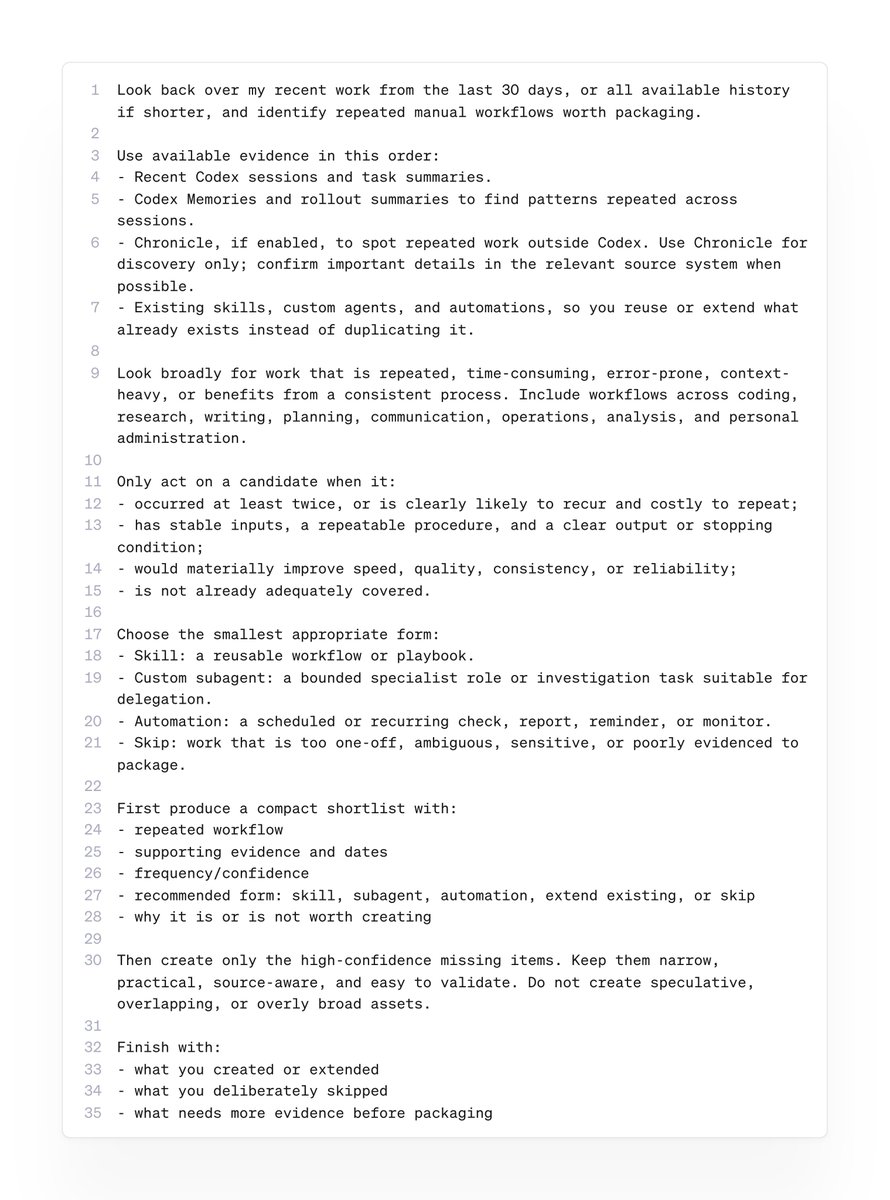
"Look back over my recent work from the last 30 days, or all available history if shorter, and identify repeated manual workflows worth packaging.
Use available evidence in this order:
- Recent Codex sessions and task summaries.
- Codex Memories and rollout summaries to find patterns repeated across sessions.
- Chronicle, if enabled, to spot repeated work outside Codex. Use Chronicle for discovery only; confirm important details in the relevant source system when possible.
- Existing skills, custom agents, and automations, so you reuse or extend what already exists instead of duplicating it.
Look broadly for work that is repeated, time-consuming, error-prone, context-heavy, or benefits from a consistent process. Include workflows across coding, research, writing, planning, communication, operations, analysis, and personal administration.
Only act on a candidate when it:
- occurred at least twice, or is clearly likely to recur and costly to repeat;
- has stable inputs, a repeatable procedure, and a clear output or stopping condition;
- would materially improve speed, quality, consistency, or reliability;
- is not already adequately covered.
Choose the smallest appropriate form:
- Skill: a reusable workflow or playbook.
- Custom subagent: a bounded specialist role or investigation task suitable for delegation.
- Automation: a scheduled or recurring check, report, reminder, or monitor.
- Skip: work that is too one-off, ambiguous, sensitive, or poorly evidenced to package.
First produce a compact shortlist with:
- repeated workflow
- supporting evidence and dates
- frequency/confidence
- recommended form: skill, subagent, automation, extend existing, or skip
- why it is or is not worth creating
Then create only the high-confidence missing items. Keep them narrow, practical, source-aware, and easy to validate. Do not create speculative, overlapping, or overly broad assets.
Finish with:
- what you created or extended
- what you deliberately skipped
- what needs more evidence before packaging"
Anthropic CEO: "It is absolutely wild that people are talking about the same tired political issues, when we are near the end of the AI exponential."
Dario Amodei spent 10 minutes explaining why almost nobody sees it.
here's what he covers:
> in 2017 he predicted exactly where AI would be today. he was right.
> models went from "smart high school student" to "PhD-level work" step by step as planned.
> the progress has not slowed down, not even close.
> none of this surprised him, what surprised him is that nobody else sees it.
the world is still focused on everything else.
new episodes, memes, celebrity beef, election news..
meanwhile the most important thing happening right now goes unnoticed.
this is not a slow shift, it never was.
the people who understand this early and actually start using these tools properly are going to be in a completely different position than everyone else, that gap is already opening.
the guide on how to be on the right side of it is in the article below.
Your phone isn’t personal. It’s a data sensor with a camera.
In 2026, privacy isn’t a feature. It’s a fight.
If you haven’t audited your device, you’re not the user. You’re the product.
Here’s the 18-step Ghost Protocol to take your phone back.
90% of the companies fail to execute their strategy:
Want to know how the remaining 10% manage to do it?
I want to introduce an extremely useful concept:
The Strategy Pyramid.
SMOOTHIE THOUGHTS: I’ve made a smoothie ~4x a week for 5 years now and have been in better health in that time than I was before, so I think it’s probably doing something. Here are my smoothie recommendations:
Use the DIVE framework to come up with 30 content ideas in 10 minutes:
D = Data — Tips, tools, and hacks
I = Insight — Trends and frameworks
V = Vision — Personal stories, lessons, mistakes
E = Empathy — Help your audience overcome their fears