Some people seem to be surprised that an old geezer like me could adapt so quickly to the newest tech.
The thing is, I've been a programmer for over 60 years. And every single year brings another adaptation to new tech. Adapting to new tech is what we programmers do on a regular basis. Why would I stop now?
Since you can see me now, here's a site I made to demo/explain WebMCP:
Maybe you've heard about WebMCP, but if you'd like to see it in action and learn how to work with it, how agents use it, what the spec looks like, and some important links?
It's interactive! Use the extension to actuate the page:
I used Fable 5 to port Command & Conquer: Generals Zero Hour to the iPhone and iPad!
This is the actual 2003 engine compiled for ARM64 natively, no emulator.
Campaign, skirmish, Generals Challenge all work with touch controls built for an RTS.
Open sourcing it all below!
Step by step, Dr. DeWald walks us through the evolution of orthopedics: Prolotherapy → PRP → Stem cells
From stimulation, to signaling, to regeneration.
Every step is a reminder: The goal is and has always been to stay in the game.
Want to discover what your biology is truly capable of? Let’s talk: https://t.co/wwu0XuAiEA
#RegenerativeMedicine #StemCellBanking #Orthopedics
Forever Labs and @SouthernSurgery are joining forces to turn your aesthetic procedure into the ultimate biological insurance policy. This partnership marks our next chapter in bringing world-class regenerative technology to our patients.
Learn all about this partnership here:
https://t.co/gZG0N0yP2V
#StemCellBanking #RegenerativeAesthetics #BodyContouring #BodySculpting
Join us for our free, live webinar on Tuesday, March 10th at 6:30 PM EST with the Michigan Center for Regenerative Medicine. Kevin Virgil will be sharing his stem cell banking story with @RegenMedMI.
https://t.co/as5zXwOHNR
#RegenerativeMedicine#Orthopedics
The future of joint care is here. @Carti__Nova Founder Dr. Trevor Turner joins Ep. 2 of Future Proof with Forever Labs to share how precision fractional laser technology is transforming regenerative orthopedics. https://t.co/qx2Q9aCiur #RegenerativeMedicine#Orthobiologics
Big news for the future of health in Wyoming. The Stem Cell Freedom Act (SF0048) has been introduced to help patients access regenerative treatments in the Equality State. Here’s what you need to know about the bill. #RegenerativeHealth#RightToTry
https://t.co/VgZ5ifdVRj
In 2026, the future of health becomes personal. From biological age tracking to regenerative science, healthcare is shifting toward proactive, personalized aging. Our latest blog breaks down the trends. https://t.co/GfGdoWeKOy #FutureHealth#2026trends#RegenerativeMedicine
What happens when @cinqe_ dating coach and @BeastGames contestant Tessa Mac takes an audit of her life? She banks her stem cells to prepare for the future. In our podcast, Tessa shares how adult stem cell banking became a no-brainer for her longevity protocol.
Link in comments.
Computational Lethargy.
Models are exhibiting "Lazziness Functions" throttling their effort to save compute. Whether this is a deliberate throttle by providers, or the model mimicking the human tendency to do the bare minimum, the result is the same. AIs not supposed to be lazy.
As we look ahead this year, we also want to thank you for supporting Forever Labs’ Season of Giving. Because of your votes, @American_Heart received our year-end community donation. A portion of December proceeds was also donated to @AmericanCancer. Thank you for giving back.
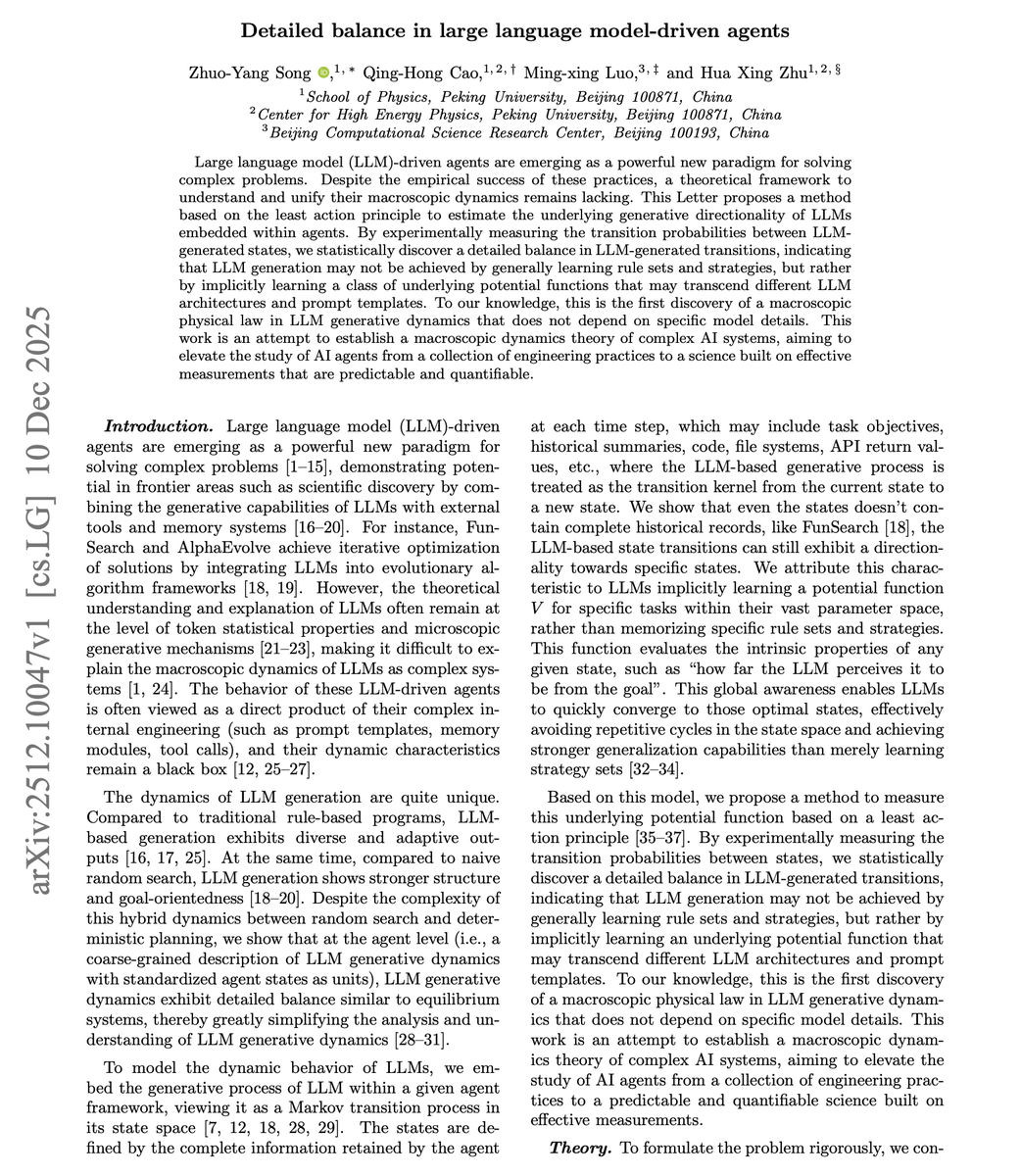
This new paper is wild!
It suggests that LLM-based agents operate according to macroscopic physical laws, similar to how particles behave in thermodynamic systems.
And it looks like it's a discovery that applies across models.
LLM agents work really well on different domains, but we don't have a theory for why.
The behavior of these systems is often viewed as a direct product of complex internal engineering: prompt templates, memory modules, and sophisticated tool calling. The dynamics remain a black box.
This new research suggests that LLM-driven agents exhibit detailed balance, a fundamental property of equilibrium systems in physics.
What does this mean?
It suggests that LLMs don't just learn rule sets and strategies; they might be implicitly learning an underlying potential function that evaluates states globally, capturing something like "how far the LLM perceives a state to be from the goal." This enables directed convergence without getting stuck in repetitive cycles.
The researchers embedded LLMs within agent frameworks and measured transition probabilities between states. Using a least action principle from physics, they estimated the potential function governing these transitions.
The results across GPT-5 Nano, Claude-4, and Gemini-2.5-flash: state transitions largely satisfy the detailed balance condition. This indicates that their generative dynamics exhibit characteristics similar to equilibrium systems.
In a symbolic fitting task with 50,228 state transitions across 7,484 different states, 69.56% of high-probability transitions moved toward lower potential. The potential function captured expression-level features like complexity and syntactic validity without needing string-level information.
Different models showed different behaviors on the exploration-exploitation spectrum. Claude-4 and Gemini-2.5-flash converged rapidly to a few states. GPT-5 Nano explored widely, producing 645 different valid outputs in 20,000 generations.
This might be the first discovery of a macroscopic physical law in LLM generative dynamics that doesn't depend on specific model details. It suggests we can study AI agents as physical systems with measurable, predictable properties rather than just engineering artifacts.
Paper: https://t.co/UO1pMWxctY
Learn to build effective AI Agents in our academy: https://t.co/JBU5beIoD0
6 years of thinking I can make a better portfolio.
1 year of actually building it.
My new portfolio is LIVE 🚀
Please, don't break anything!
👉 https://t.co/rVPv9oWkjL