[BREAKING] AI agents can now read the blockchain.
For the next 72 hours, we’re opening public access so you can try it yourself.
Agent-ready, real-time onchain data accross 150+ chains.
Institutions don't take a chain's word for its own numbers. They want independent proof.
Our onchain analysis of Stellar shows how transparent, verifiable data is becoming the price of institutional trust, and how the network is earning it.
https://t.co/69TX4XDlzQ
Consumer payments take a far larger share of stablecoin volume than of fiat volume.
@ethanyish, Co-Founder & CEO, @AlliumLabs on Tokenized Pod with @sytaylor said:
"For C2C payments where the stablecoin see the most outside adoption relative to the value over a overall share of the market, it accounted for 15% of all stablecoin volume compared to 5% for Fiat, and over index of about three x."
🎙 Listen to the latest episode on Tokenizedpod(dot)com
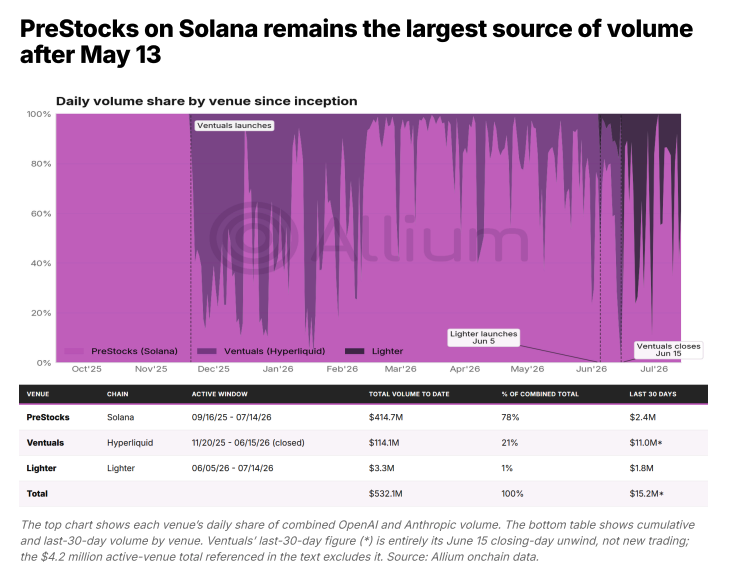
INSIGHT: Solana has the largest volume of PreIPO artificial intelligence stocks (Anthropic & Open AI) according to the latest report by @AlliumLabs@PreStocks tokens track the price of pre-IPO companies. They are fully backed by SPV exposure and freely tradable 24/7 on Solana.
"Stablecoins are eating cross-border payments" is the pitch everyone repeats. We wanted the actual number.
New research with FXC Intelligence measures how big stablecoins' share of global cross-border flows really is, grounded in onchain settlement data.
https://t.co/t6GL26F8mu
Prediction markets are growing fast.
Last month, Kalshi, Robinhood, and Polymarket generated $865 million in fee revenue, according to Allium data.
Fees increased 29x year over year, driven primarily by sports markets and combos such as parlays.
The most surprising result is Robinhood. Despite entering the market later, it now earns more fee revenue than Polymarket’s US and offshore businesses combined.
Even with the current regulatory uncertainty, prediction markets are on pace to generate $2.65 billion in revenue this year.
Full report coming soon.
AI companies are spending hundreds of billions on compute with no transparent forward curve.
That just changed.
@Kalshi now runs the main market-implied forward prices on five Nvidia chips, from the A100 to the flagship B200, settled on Ornn's live rental index.
The B200 rents for $6.58 an hour today. Year-end pricing: Kalshi $6.54, Polymarket $5.75.
Compute is beginning to trade like a real commodity.
🚨 Ep. 94 of @TokenizedPod: Why Robinhood Are Going All in on Tokenized Stocks and Prediction Markets
@sytaylor is joined by:
👉 @HadickM, GP, @dragonfly_xyz
👉 @Sikes_, COO, @public
👉 @ethanyish, Co-Founder & CEO, @AlliumLabs
To discuss:
💳 Embedded wallet acquisitions and consolidation trends in crypto infrastructure
❗️ Monetization challenges and value accrual for standalone infrastructure providers
🤔 Comparing embedded wallets to Plaid's integration moat and maintainability
🛠️ Limited DeFi integrations needed versus traditional fintech like Plaid
🌎 Stablecoin adoption challenges for US brokerage on-ramps and payments
📊 Tokenized stocks' small scale relative to Robinhood's core equities business
🧠 Tokenized stocks as a global expansion strategy for US fintechs
🌐 Institutional demand for 24/7 trading and tokenized collateral for weekend risk
⛓️ Stablecoins overindexed in consumer cross border payments versus fiat
📈 Prediction markets surge driven by politics, sports, and institutional hedging
***
Timestamps:
00:00 Introduction
0:30 Embedded wallet acquisitions and consolidation trends in crypto infrastructure
2:16 Monetization challenges and value accrual for standalone infrastructure providers
5:48 Comparing embedded wallets to Plaid's integration moat and maintainability
9:49 Limited DeFi integrations needed versus traditional fintech like Plaid
12:26 Stablecoin adoption challenges for US brokerage on-ramps and payments
14:52 Tokenized stocks' small scale relative to Robinhood's core equities business
16:36 Tokenized stocks as a global expansion strategy for US fintechs
23:00 Institutional demand for 24/7 trading and tokenized collateral for weekend risk
31:02 Stablecoins overindexed in consumer cross border payments versus fiat
39:43 Prediction markets surge driven by politics, sports, and institutional hedging
***
👉𝘚𝘦𝘢𝘳𝘤𝘩 '𝘛𝘰𝘬𝘦𝘯𝘪𝘻𝘦𝘥 𝘗𝘰𝘥𝘤𝘢𝘴𝘵' 𝘖𝘯 𝘠𝘰𝘶𝘛𝘶𝘣𝘦. 𝘈𝘱𝘱𝘭𝘦, 𝘚𝘱𝘰𝘵𝘪𝘧𝘺 𝘰𝘳 𝘢𝘯𝘺 𝘗𝘰𝘥𝘤𝘢𝘴𝘵 𝘗𝘭𝘢𝘺𝘦𝘳! 👈
Before a global consultancy can advise on stablecoin payments, someone has to build the data foundation underneath it.
How BCG built theirs on Allium, and what a production-grade onchain payments dataset actually requires.
https://t.co/EoV4ITZbmt
Tomorrow at 12pm ET, the team from @AlliumLabs joins us for a live demo of their Stellar dashboard.
If you're shipping on Stellar, or want a front-row look at adoption in action, join us here live.
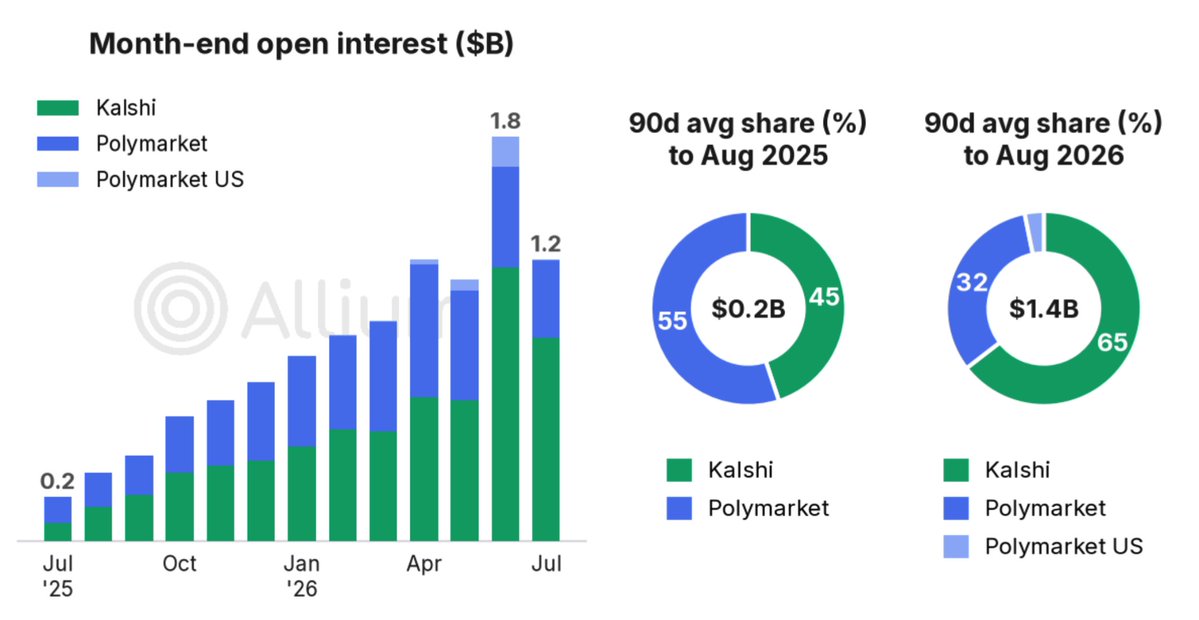
Kalshi overtook Polymarket by open interest (ie money wagered) within the last year.
How did this happen?
This is what we're exploring in our next piece for our subscribers. See below.
Every tokenized asset can be referenced a dozen ways and identified by none. The moment two systems have to agree on what a token actually is, that breaks.
We've been writing a plain-language series on digital asset identifiers: what they are, how they differ from a contract address, and why tokenized securities can't scale without them. Start with the guide:
https://t.co/Kr3U5MpaCX
Kalshi and Polymarket mostly agree on future GPU rental prices. Nvidia's B200 AI chip is the exception:
Kalshi at year-end: $6.54
Polymarket at year-end: $5.75
That leaves a $0.79 gap on the same rental rate, with Polymarket 13% below today's price.
full report: https://t.co/uFycMslv26
Kalshi has been good at tracking the live rental price for Nvidia's B200 AI chip. Calling the final rate has been harder.
Across six completed weekly markets:
- Median gap from the live rate: 2.2%
- Median distance from the eventual final rate with two days left: 10%
Six weeks is still early, but until the estimates get closer at the finish, these prices cannot be planned against.
full report: https://t.co/uFycMslv26
Our guest for Monday's Tokenized Podcast
@sytaylor and @HadickM are joined by:
👉 @Sikes_, COO @public
👉 @ethanyish, co-founder and CEO @AlliumLabs
Out on Monday at 8am PT / 11am ET / 4pm GMT
Find it on 𝗔𝗽𝗽𝗹𝗲 𝗣𝗼𝗱𝗰𝗮𝘀𝘁𝘀, 𝗦𝗽𝗼𝘁𝗶𝗳𝘆 or 𝗬𝗼𝘂𝗧𝘂𝗯𝗲 by searching "Tokenized Podcast" 📷 💙
Every onchain product eventually runs into the same wall: raw blockchain data is not built to be queried.
Transaction history, token balances, ownership across chains. Getting this reliably at scale is where most builds stall.
We put together a complete guide to blockchain data APIs: what they are, how they work, and how to query them without breaking.
https://t.co/ijeh3njO9j
.@Ondo manages $2B+ in tokenized assets across eight chains and its tokenized stock platform surpassed $1B in TVL. For his first six months there, Alex Chen was the only data scientist serving teams across business, marketing, and engineering.
Every team needed something different. The BD team wanted TVL, volume, and growth rates. Marketing wanted campaigns tied to onchain outcomes. Engineering wanted behavioral patterns on which tokenized products were gaining traction.
Alex’s approach to data from day one: buy the data infrastructure, don't build it.
At his previous company, Alex built blockchain data pipelines from scratch. At Ondo, he made a different call.
"I think about the leverage. For most data scientists, 80% of your time is spent cleaning data and only 20% is generating insights. I'd rather leave the 80% work to the professional team who does it and focus on the 20%."
What that unlocks:
→ Competitive benchmarking across the tokenized asset market becomes a query, not a data engineering project
→ Cross-chain analysis on one consistent schema, with value spread across Ethereum, Stellar, Sei, Solana, and others
→ User geography estimates from wallet behavior and timezone patterns to inform go-to-market
Alex’s advice for lean data teams in digital assets: Don't build the data layer yourself. Spend that time on the analysis that drives business value.
Full story linked below. If you're running analytics for tokenized assets, how are you thinking about build vs. buy?
The next stage for digital asset payments isn’t just more volume,
it’s stronger operational standards.
Growing payment activity also raises expectations around compliance, auditability, and operational controls.