Broooooooohhh 🤮
I won't go to these Nairobi clubs at night. Just imagine this is one of the clubs along Thika Road...I can't mention the name for privacy.
I was shocked to differentiate if this is a disease orba tattoo 😳 maybe someone can explain to me. I have even successfully vomited. Once saw this, I swore I won't go to clubs unless I order my drinks.
If this is the behaviours and images someofyou show outchea, it has marked the end of me going to clubs at night unless uber orders...
Lady Shasha said shame is just a word like any other. Our sisters lack manners bruv. They forget themselves like warthog.
Hello @UberEats , do you deliver instant drinks i mean alcohol door to door??
Is this senility—or sheer recklessness?
The Siaya governor always seem over excited by the prospect of violence, that shut down schools and businesses. He seem to find street protests orgasmic.
But here’s the real irony: at James Orengo’s level, he should be the one facing public outrage—not leading it. He is the head of a county government, yet he rallies protests against the very national government he is constitutionally bound to cooperate with. Under Kenya’s law, county and national governments are distinct but interdependent—they must consult, coordinate, and support each other. Orengo does the opposite.
This isn't new. Even as a minister under Kibaki, he repeatedly breached collective responsibility. His pattern is clear: protest, criticize, offer zero solutions. Things that require no expertise. No strategy. Just noise. Street chaos gives him a thrill—even when there’s no real cause. That’s not leadership; that’s addiction to disorder.
Perhaps that’s why Uhuru has sidelined more reasonable figures like Babu and Sifuna—and elevated Orengo instead. Because Orengo is more destructive, more useful in the mission to make Kenya ungovernable under Ruto. The goal being to ensure Ruto fails for defying the dynasty.
Let’s be blunt: James Orengo may be fit for many things—but governor? No. Not executive head of a serious institution. He couldn’t even manage a one-man law firm, despite the larger-than-life reputation built on street theatrics and standing beside Raila.
Meanwhile, Orengo has no moral authority to leverage and ride on Raila's name. He never believed in him anyway.
A man who never built anything has no business running anything.
@marto571311380@DCI_Kenya@RobertAlai Boss you people have been government for over 50 years, what have they done to alleviate the problem? Acha kelele hapa..DCI fanya kazi ..
Chuka University student Claire, who was pursuing Education Science, allegedly stabbed her boyfriend, taking him to Sayun. After the incident, she wrote letters explaining what had transpired before later taking her own life
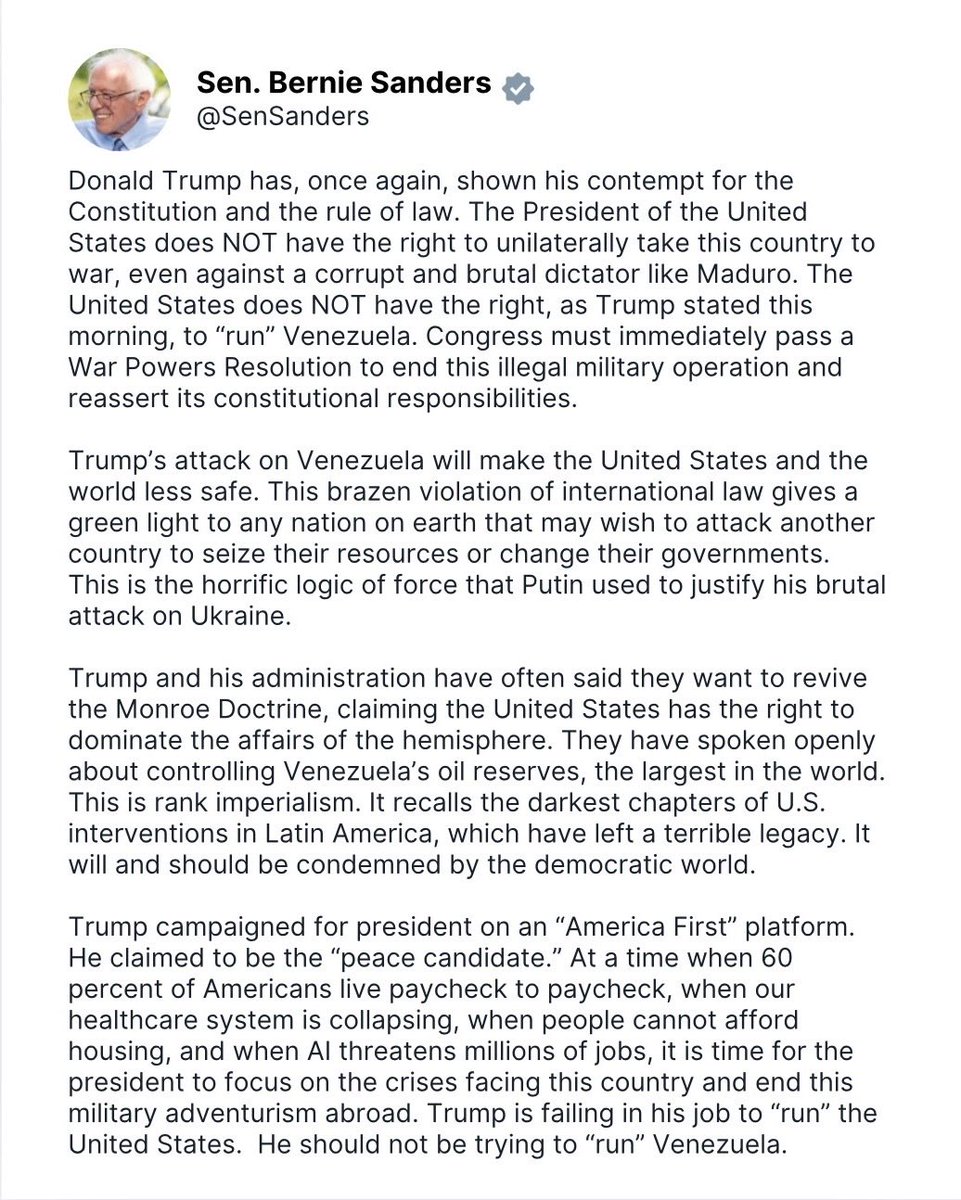
I was briefed this morning on the U.S. military capture of Venezuelan President Nicolás Maduro and his wife, as well as their planned imprisonment in federal custody here in New York City.
Unilaterally attacking a sovereign nation is an act of war and a violation of federal and international law.
This blatant pursuit of regime change doesn’t just affect those abroad, it directly impacts New Yorkers, including tens of thousands of Venezuelans who call this city home. My focus is their safety and the safety of every New Yorker, and my administration will continue to monitor the situation and issue relevant guidance.
My fellow Kenyans,
Have you ever wondered how a country can lose KSH 4 trillion? Yes, that is not a typo. KSH 4 trillion?
If you have, today is your day, because I will walk you through how we, Kenyans, lose KSH 4 trillion courtesy of corruption, incompetence, and wanton wastage.
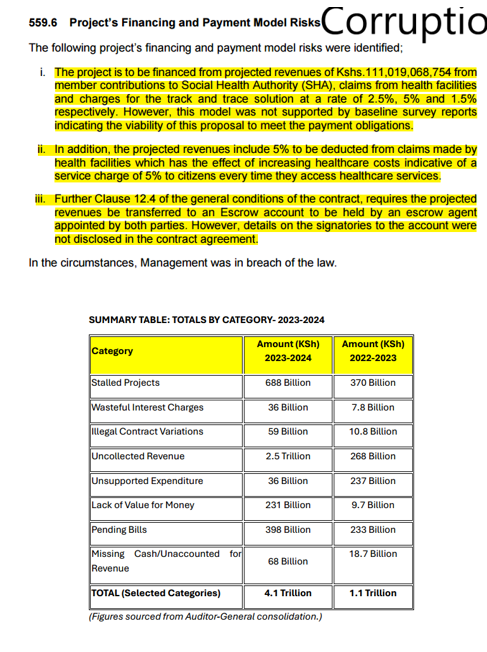
Total damage: KSH 4.1 Trillion.
But first, some context.
Am sure you have heard that President Ruto has taken close to KSH 4 trillion in new debt since coming to office, and yet there is nothing to show for it.
His Government just reduced capitation for secondary schools from KSH 22,000 to KSH 12,000, a 45% reduction.
This is against our debt going up from KSH 8.6 trillion when he took office, to KSH 12 trillion today, which is a 40% growth during his presidency.
Over the past two months, many of you have heard me talk about the ordeal that befell Owen – a 20 year young man from Kiambu County – the very best version of a son any parent could ever hope for. Smart, well-behaved, diligent and respectful.
Owen grew up in very difficult circumstances. Raised by his grandfather and grandmother who did not have much, his school fees were often paid by strangers. And sometimes, when strangers dried up, his headteacher would come through for him.
Everybody told Owen that the ticket out of his circumstances was an education. He listened to that counsel. Diligently. He put in every ounce of energy and motivation that he could muster, and scored well in his KCSE after which he was admitted to Egerton University.
But there was a problem. Even with modest help from the government, Owen needed roughly KSH 100,000 in order to make his dream of education a reality.
So, he spent much of the last year running from one government office to the next – looking for help.
Applying for CDF bursaries and scholarships.
Collectively, our government told him that he is not a priority of this country. He received no bursaries or scholarships.
This, from a hopelessly inept and corrupt government that is selling the fantastical narrative that it just needs KSH 5 trillion to make Kenya Singapore.
Owen was supposed to report to Egerton in mid-August of 2025. But he spent an entire month and a half after this reporting date, not knowing whether he would ever be able to get a university education – even though he had been admitted to university.
Owen called me – a stranger in America, to help him find a way to report to school. I want you to imagine what a 20-year-old young man, with a background similar to Owen’s would be thinking, after realizing that his likely only chance for an education runs through a stranger thousands of kilometers away.
What do you think he was thinking?
I tell you this story for context. Because too often in this country, we talk about and throw figures around corruption and incompetence in government, without appreciating the human toll of these vices. We don’t see the millions of Owens whose dreams and futures are crushed daily by the greed, incompetence, and indifference of people who we elect or elevate to positions designed to serve us.
Over the past few weeks, I have been following and researching every shilling spent by the National Government during 2022-2023 and 2023-2024.
Today, I bring you the results of that study. In this study, I sought out to find answers for Owen and millions like him, who have been told that they are not our country’s priority.
This past week, we found out that our country is spending 95% of every single shilling it earns on debt service. 95%!
Debt service is fancy word for the cost of greed, incompetence, and indifference of those in and around government. It is empty calories, and the very definition of stupidity in government affairs.
Meanwhile, 50 million Kenyans call Kenya home. Average age is 20 years old. It’s Owen. Young and hungry – literally and figuratively. Owen is Kenya’s future, literally and figuratively. He is the person you hope will be paying taxes 10, 15 years from today. But he sat home for a month and a half – watching his dream die.
In 2023-2024, our country had a budget of KSH 3.8 trillion. But we only made about KSH 2.5 trillion.
Because leadership in our country is not about solving problems such as reckless fiscal indiscipline – our country, under William Ruto, borrowed KSH 1.5 trillion that year. After borrowing this amount, we went on to blow KSH 1.6 trillion in debt service.
For one shilling we spent on healthcare, we spent 12 on debt service. For each shilling we spent on education, we spent 3 on debt service.
KSH 1.6 trillion would have sent 16 million Owens to Egerton.
Now, let me walk you through how you and I lose KSH 4 trillion.
Step #1. Lose KSH 688 Billion to Stalled Projects:
Projects where substantial public funds have been spent but works are incomplete, contractors are off-site, or no usable asset has been delivered, denying citizens the intended benefits.
Stalled projects lock up billions in idle capital, eliminate economic returns, and still generate interest, security, and maintenance costs. In addition – given our growing annual budget deficits – for everything we do “to develop” the country, such as roads, hospitals, stadiums, etc. we use BORROWED MONEY.
And we are paying upwards of 15% interest rate on what we borrow. That means that for every one billion in stalled projects, we very well are likely paying KSH 150 million a year in interest, on a project that is not serving any Kenyan.
So, imagine KSH 688 Billion in stalled projects costing us around KSH 103 Billion in one year alone. And some of these stalled projects have been abandoned for close to 10 years!
Examples:
>>8 years ago, our country started a partnership through Kenya National Highway Authority (KenHA) to develop certain roads, a project that had a price tag of KSH 79 Billion. That project today is stalled, despite billions spent. It has not served one Kenyan.
>>In another project, our country committed to spend KSH 32 Billion in 2012 to build roads and highways. That project is also stalled and has not served one Kenyan. It has been abandoned.
>>In another example, KenHA entered into a commercial contract with a Foreign Contractor at a price of Kshs.18,404,888,139on 09 February, 2011 for the Upgrading of Kibwezi-Mutomo-Kitui Road Project. Physical verification carried out on the section of the road on 24 September, 2024 revealed that the road works terminated at 8Km to Migwani town. In addition, the contractor was not on site and the project works had stalled. A project worth KSH 18 billion has been abandoned.
>>In another example, years ago, our country took a loan to build the East Africa Kidney Institute Centre of Excellence – with a price tag of KSH 3.6 Billion. The project was supposed to be completed in 5 years. Till today, that project has stalled, and has not served one Kenyan. And this KSH 3.6 Billion debt has likely doubled.
>>In 2017, our country awarded a contract to build the Mitubiri Sanitary Landfill, at the cost of KSH 1 billion. Expected completion date was 2020. That contract has been extended 11 times, and remains stalled. It has not served one Kenyan. We are still paying interest on the KSH 1 Billion.
Remember my example? KSH 1 billion will cost us KSH 150 million annually. 5 years, and you can see around KSH 750 million in interest!
>>Our country entered into a contract – to build the Kisii Cancer Center around 2021. For KSH 572 million. That project stalled, and has not served any Kenyan. We are still paying interest.
>>The Kisumu Africities Convention Center – started in 2021 and with a price tag of KSH 890 Million stalled years into the project. The contractor has taken Kenya to court, and is asking for KSH 1.57 Billion in penalties and interest, because of our government’s incompetence. It has not served one Kenyan.
These are just a few examples since we don’t have time or space to cover everything.
Again, my analysis uncovered KSH 688 Billion in stalled projects in 2023-2024 alone. In 2022-2023, I identified KSH 370 Billion in stalled projects.
In 2023-2023, Stalled Projects totaled KSH 370 Billion.
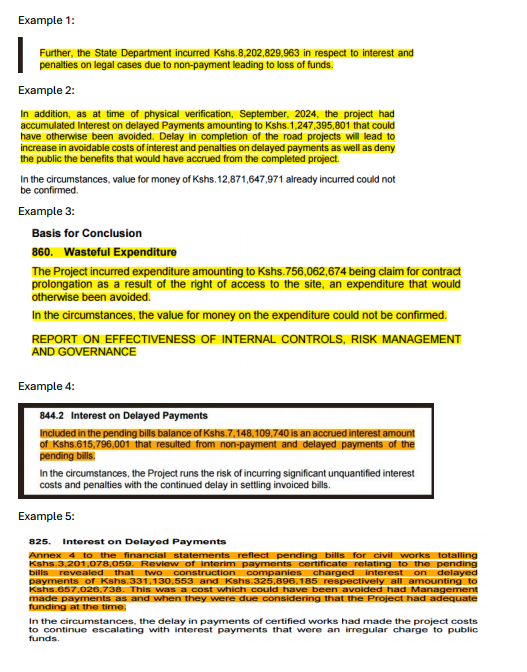
Step # 2. Lose KSH 36 Billion to Avoidable and Wasteful Interest Charges
Interest and penalties paid solely because government entities failed to pay contractors and suppliers on time, despite certified works and available contracts.
It is the very definition of incompetence.
This spending produces no road, no hospital, no classroom—it is money paid purely for delay and mismanagement.
Examples:
>>In 2023-2024 alone, Kenyans lost KSH 36,301,769,838 on interest on bills we did not pay on time. Let that sink in.
KSH 36 Billion wasted on stupid interest on bills we did not pay on time, due to incompetence, or corrupt intentions.
That amount would have sent 360,000 Owens to Egerton.
>>The Ministry of Health, with a budget of KSH 130 billion, lost KSH 8.2 Billion to “interest on legal bills”. Not the legal bill itself. Interest on the legal bill.
>>In another example, KenHA issues a contract to a firm. The bill is sent, but KenHA is either so corrupt or incompetent to pay on time. The “vendor” adds KSH 657 Million in interest.
Believe it or not, the same thing happened in 2022-2023 – the same vendor charged KenHA KSH 657 Million in interest on the same bill during that year, but somehow, KenHA did not pay the invoice!
So, this KSH 657 million is charged on the same contract, two years in a row according to auditor general’s findings!
Defies credulity, does it not?
>>KenHA again, issues a contract to a firm. Vendor sends an invoice. KenHA does not pay, and the vendor adds KSH 856 million in interest.
>>KenHA again, issues a contract to a firm. Vendor sends an invoice. KenHA does not pay, and the vendor adds KSH 1.2 billion in interest.
>>KenHA again, issues a contract to a firm. Vendor sends an invoice. KenHA does not pay, and the vendor adds KSH 756 million in interest.
>>KenHA again, issues a contract to a firm. Vendor sends an invoice. KenHA does not pay, and the vendor adds KSH 615 million in interest.
>>KenHA again, issues a contract to a firm. Vendor sends an invoice. KenHA does not pay, and the vendor adds KSH 543 million in interest.
Need I go any further?
So, here is a question. How can it be that KenHA does not know when it’s bills are due? How can it be that the same agency loses hundreds of millions and sometimes billions on interest on invoices on almost all contracts in the same year?
I think you understand the game that is being played here. Don’t you?
Damage in 2023-2024 is KSH 36 Billion. Enough to send 360,000 Owens to Egerton.
In 2022-2023, we lost KSH 7.8 Billion in 100% avoidable interest as well.
Step #3. Lose KSH 59 Billion Through Illegal Contract Variation
Illegal contract variations are one of the most common gateways for contract inflation and corruption, converting initial bids into vastly more expensive projects without competition.
There is a law in our country (Section 139(4) of the Public Procurement and Asset Disposal Act, 2015) which states that the cumulative value of all contract variations should not result in an increment of the total contract price by more than twenty-five per cent (25%) of the original contract price.
The point of this law is to ensure that Kenyans get value for money. If we send out a request for proposal to build a road, and we get 4 responses, of KSH 5.0 Billion, KSH 5.1 Billion, KSH 5.3 Billion, and KSH 5.5 Billion, the law tells the government that it must go with the lowest bidder. And this is to ensure that we get value for our money.
But this public process also serves another purpose, which is, to tell us what the “fair market price” of such services is.
In this case, we can surmise that the fair market price is between KSH 5.0 billion and KSH 5.5 Billion.
But for every shilling spent by our government, there is corruption. What I found is that firms likely associated with criminals in government would submit the lowest bid, win the tender, and then turn around a few months later, to amend the contract price, sometimes doubling the price.
For 2023-2024, the total theft is KSH 59 Billion.
For 2022-2023, the total theft was KSH 10.8 Billion.
Examples (from 2023-2024):
>>The State Department for Water and Sanitation entered into a contract with a firm for consultancy services. Original price was KSH 76,959,355. A few months down the road, the contract was revised to KSH 177,739,431. You and I lose KSH 100,780,076!
>>The State Department for Roads through KenHA entered into a contract with a firm in connection with the Kibwezi–Mutomo–Kitui–Migwani Road Project. Original contract price was KSH 18,404,888,139. When corrupt officials got rid of the other vendors, they hiked the price to KSH 21,545,912,343, and so you and I lose KSH 3,141,024,204!
>>The State Department for Roads through KenHA entered into a contract with a firm in connection with the James Gichuru-Rironi road project. Original contract price was KSH 16,366,586,563. When corrupt officials got rid of the other vendors, they hiked the price to KSH 20,414,794,998, and so you and I lose KSH 4,048,208,435!
>>The State Department for Roads through KenHA entered into a contract with a firm in connection with the Mombasa Mariakani road. Original contract price was KSH 6,016,868,259. When corrupt officials got rid of the other vendors, they hiked the price to KSH 11,406,306,700, and so you and I lose KSH 5,389,438,441!
Need I go any further? I think you get the point here as well. Don't you?
For 2022-2023, total theft was KSH 10.8 Billion.
Step #4. Lose KSH 2,530,176,611,186 in uncollected revenue.
This one right here is insane. Do you remember that the government tried to increase VAT on bread and other consumables in June of 2024? The amount the government was trying to raise at that time was only a fraction of the KSH 2.5 trillion that is TODAY LEGALLY OWED to Kenya, but which the government has no interest in collecting.
Again, it defies credulity. Doesn’t it?
Examples:
>>There is KSH 2,116,679,160,651 in taxes owed to the country that the government won’t collect. It also includes “non-tax” revenue (Over KSH 400 Billion) that is owed to the country by various firms (including parastatals), that the government is not interested in collecting.
For 2022-2023, the figure was KSH 268 Billion.
Step #5. Lose 36,026,495,533 to “unsupported expenditure”.
If you do not know, our government, in terms of how it conducts itself, is no different than “mama mboga”. It is no more sophisticated than mama mboga.
Trust me on this. That’s how we lose KSH 36 Billion to criminality.
Examples:
>>The government used KSH 6,196,584,631 to acquire shares in Telkom Kenya without approval of parliament. This is not only illegal, but reckless. This is because there is no real recourse for citizens. There is no document that shows that we are legally entitled to collect on that KSH 6.2 Billion, from anyone, ever!
>>There is a private company called Kenya National Shipping Line Limited. You and I have paid KSH 251 million to this company for nothing in three years. The government won’t tell the auditor general why we continue sending millions of shillings to this private company. But we lose KSH 251 million that way.
>>The government received a grant from somewhere for a HIV prevention project. As at 30 June 2024, USD 5,322,080 (KSH 691,870,400) was shown as withdrawn from the project’s bank account, with no supporting details or expenditure returns provided — raising concern that funds meant for HIV prevention and care were diverted or stolen.
>>In another example, KSH 580,437,867 in grants were withdrawn from a bank account, and have never been accounted for.
>>In another example, the Ministry of Agriculture claims KSH 5,940,500,211 in expenses – but there is no documentation to support the claim.
>>In another example, KSH 450 million is taken to fund the “Rural Kenya Financial Inclusion Facility” project. There is not one document showing where any shilling out of this KSH 450 million went.
>>In another example, KSH 325,321, 216 in claimed expenses in connection with the “African Climate Summit / Climate Finance Project” have no documentation. No receipts, no invoices, no nothing.
>>In another example, the auditor general picks up a file containing KSH 1.5 billion worth of claimed expenses. When the auditors reviews the support provided, it is discovered that KSH 189,995,725 have no documentation whatsoever.
None!
Need I go any further? I think not.
KSH 36 Billion disappears that way.
For 2022-2023, the damage was KSH 9.7 Billion.
Step #6. Lose potentially KSH 231 Billion to Wasteful Spending/Expenses that have not been verified to provide value to Kenyans.
Within one year of his administration, President Ruto decides that Kenyans need a new healthcare system. He also knows what that system should look like. And he knows who can deliver that system. And even more surprising, he knows what that system ought to cost.
He knows everything.
So, the government, using borrowed money, pays KSH 111 Billion for SHA. This deal is struck at midnight when everyone but the thieves are asleep. The only thing we get is “access” to the system.
We don’t own it, and nobody can tell us if this KSH 111 Billion is anywhere near fair market price. Because our hopelessly corrupt government was primarily focused on stealing from us. Not delivering value.
So, to start off, we lose KSH 111 Billion. The auditor cannot believe that anyone with a brain would be dumb enough to enter into an agreement like that.
She calls it “unbudgeted”, “unplanned”, “uncompetitive”, and full of “unfavorable clauses”.
Such as, it says that if our country wakes up and decides to pursue another system or technology, WE WILL GET SUED IN LONDON for years.
But there is more. Over and above this KSH 111 Billion, the government agreed to collect 5% from every patient who goes to a hospital over the next ten years, and put this amount into an “escrow” account that is projected to raise KSH 111 Billion in 10 years.
The account is controlled by the vendor and someone in government, but the government won’t say who has access to it within government.
Look on the last attachment.
So, total damage on SHA is KSH 222 Billion – KSH 111 for the system that does not work, and another KSH 111 Billion to be collected from you and I in ten years.
And I have not added one shilling of interest on this amount. Or the 41 Million that this government told us it paid to one patient who delivered 10,860 babies in one year.
Or the millions it said it paid for the patient who delivered 656 C-Section births in the same year.
Or, the KSH 51 million it says it paid for one patient who was able to be admitted into several hospitals across Kenya, ALL AT THE SAME TIME, receiving 2,808 procedures!
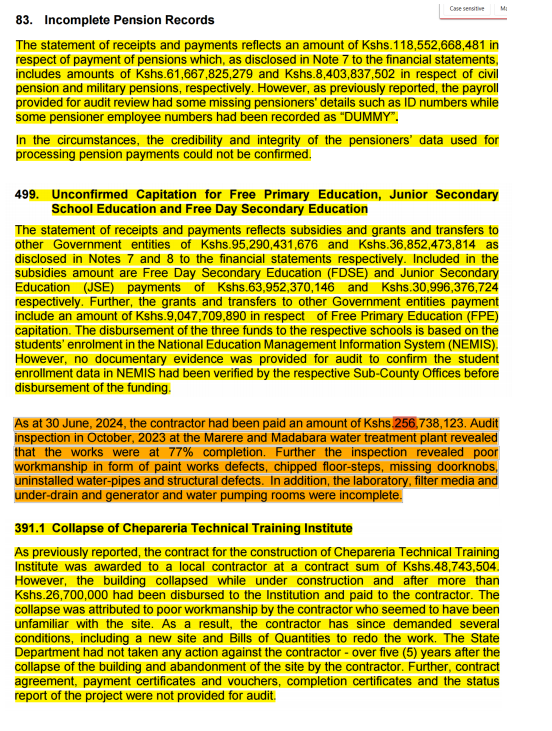
>>In 2023-2024, our government says it paid out KSH 70,071,662,781 in pension payments. When the auditor reviews the file containing the beneficiaries, it is discovered that there are beneficiaries named “DUMMY”, while many others do not have information such as ID numbers that would be necessary to authenticate the payees.
And we have paid out KSH 70 Billion.
>>In another example, over KSH 90 Billion in “primary school capitation” was sent out across the without a digital verification of enrollment – which is the basis for the money sent out. In other words, someone pulled a spreadsheet with schools and “enrollment data” – meaning supposed number of students, and bags of money went out. KSH 90 Billion.
You don’t have to take my word for, see Attachment number 2.
>>Another example: Treasury contracted construction of a National Disaster Recovery Centre in 2009 for KSh 782,799,814, later varied into three phases. Phases I and II were completed and paid.
A dispute on Phase III (KSh 193,540,606 for retention and idle resources) led to arbitration, where the contractor was awarded KSh 4,099,636,848 for loss of profits and associated costs. As at 30 June 2024, with interest, the outstanding amount had risen to KSh 5,548,245,288.
Understand what am saying here. There is a dispute about KSH 193 million. Due to incompetence, this situation is so badly mismanaged that it ends up costing you and I KSH 5.5 Billion!
>>Yet another example. Treasury (are you beginning to note who the usual suspects are?) gives someone a contract for KSH 256,738,123. The contractor is so out of his depth that they abandon the project full of “poor workmanship” all over the project.
The auditor notes that the contractor did not appear to know what the heck they were doing.
>>In another example, the Auditor-General found that buildings constructed under the Chepareria Technical Training Institute project collapsed after we paid KSH 48 Million.
Total Potential Damage in 2023-2024: Over KSH 231 Billion.
For 2022-2023, the potential damage is KSH 9.7 Billion.
Step #7. Lose KSH 398 Billion in pending bills.
This refers to verified and often unverified obligations for goods, works, and services that remain unpaid at year-end, frequently rolling over for years and accumulating interest and litigation risk.
They strangle contractors and suppliers, costs through interest and court awards, and are often used to steal money from citizens.
Pending bills occur generally for two reasons. One: money is stolen that was designed to pay bills, and therefore those bills remain unpaid. Second, incompetence. Do you remember the example above where KSH 193 million was so badly mismanaged that it ended costing us KSH 5.5 Billion?
Well, nobody would have predicted that incompetence would cost us KSH 5.5 billion, so that amount ends up as “pending bills”.
Total damage for 2023-2024: KSH 398 Billion.
For 2022-2023, the figure was KSH 233 Billion.
Step #8. Potentially lose KSH 68,525,374,810 in cash/income that cannot be accounted for.
Here the government says it has X billions in various accounts, or has “transferred cash to other entities, but it cannot (1) either show statements confirm this, or, (2) when the auditor tries confirming with the said institutions, it is discovered that what is there is not what the government claims. Or, cash is collected, but does not get reported.
Examples:
>>KSH 1,905,531,351 in claimed transfers to 10 counties cannot be confirmed with documentation.
>>The government says it transferred KSH 17.2 billion in grants to certain entities/counties, but documentation from the said recipients only support KSH 13 Billion. Meaning KSH 4.04 billion has absolutely no support. It just disappeared.
>>The State Department for Diaspora Affairs reported KSh 54,580,366,490 as proceeds from sale of assets, but actual collections were KSh 57,975,643,034.
KSH KSh 3,395,276,545 found legs and walked away from the set!
Total damage for 2023-2024: KSH 68 Billion.
For 2022-2023, the damage was KSH 18.7 Billion.
Now, I just showed you how we lost KSH 4 Trillion. Our country is in deep trouble, economically and otherwise.
We have not only a hopelessly corrupt "government", but one that is so thick that it is unable to see beyond its nose.
In the end, the tragedy of our moment is not that Kenya lacks money — it is that we are governed by people who lack integrity, discipline, imagination, and basic respect for citizens.
A president who spends his days hopping from one bank, one lender, one bailout to the next, while the country bleeds through corruption, incompetence, stalled projects, avoidable penalties, and outright theft, has no business pretending to lead a nation.
Debt has become a substitute for vision. Taxes have become a weapon against citizens rather than a tool for development. And young Kenyans — the very people who should be building the future — are paying the price in lost opportunity, unemployment, and despair. Our crisis is not “insufficient revenue.” Our crisis is bankrupt leadership. If Kenya is to survive, let alone prosper, we must make 2027 the moment we send this corrupt, wasteful, tone-deaf administration home and replace it with leaders who understand that public office is a duty — not a feeding trough.
@EACCKenya@WilliamsRuto@EricLatiff@EAukot@MigunaMiguna@MoGAbdi@Mizani254@PropesaTV@Senate_KE@NAssemblyKE@Wanjiru2027@FlavNasmbu
Thank you @ntvkenya for this thoroughly researched panoramic tribute to Baba Raila Amolo Odinga. Indeed, Baba shall remember you when he gets to Paradiso.