Andrew Ng just released a 1-hour course on building agentic knowledge Graphs from scratch:
• 00:00 - Introduction to agentic knowledge Graphs
• 03:07 - Construction of agentic Graphs
• 14:00 - Architecture of multi-agent systems
• 23:00 - Building agentic graphs with Google ADK
• 01:06:03 - Why Graphsare the future of agentic AI
Worth more than 10 articles on loop engineering.
Watch it today, then read how to become a graph engineer in the article below.
Software development is undergoing a renaissance in front of our eyes.
If you haven't used the tools recently, you likely are underestimating what you're missing. Since December, there's been a step function improvement in what tools like Codex can do. Some great engineers at OpenAI yesterday told me that their job has fundamentally changed since December. Prior to then, they could use Codex for unit tests; now it writes essentially all the code and does a great deal of their operations and debugging. Not everyone has yet made that leap, but it's usually because of factors besides the capability of the model.
Every company faces the same opportunity now, and navigating it well — just like with cloud computing or the Internet — requires careful thought. This post shares how OpenAI is currently approaching retooling our teams towards agentic software development. We're still learning and iterating, but here's how we're thinking about it right now:
As a first step, by March 31st, we're aiming that:
(1) For any technical task, the tool of first resort for humans is interacting with an agent rather than using an editor or terminal.
(2) The default way humans utilize agents is explicitly evaluated as safe, but also productive enough that most workflows do not need additional permissions.
In order to get there, here's what we recommended to the team a few weeks ago:
1. Take the time to try out the tools. The tools do sell themselves — many people have had amazing experiences with 5.2 in Codex, after having churned from codex web a few months ago. But many people are also so busy they haven't had a chance to try Codex yet or got stuck thinking "is there any way it could do X" rather than just trying.
- Designate an "agents captain" for your team — the primary person responsible for thinking about how agents can be brought into the teams' workflow.
- Share experiences or questions in a few designated internal channels
- Take a day for a company-wide Codex hackathon
2. Create skills and AGENTS[.md].
- Create and maintain an AGENTS[.md] for any project you work on; update the AGENTS[.md] whenever the agent does something wrong or struggles with a task.
- Write skills for anything that you get Codex to do, and commit it to the skills directory in a shared repository
3. Inventory and make accessible any internal tools.
- Maintain a list of tools that your team relies on, and make sure someone takes point on making it agent-accessible (such as via a CLI or MCP server).
4. Structure codebases to be agent-first. With the models changing so fast, this is still somewhat untrodden ground, and will require some exploration.
- Write tests which are quick to run, and create high-quality interfaces between components.
5. Say no to slop. Managing AI generated code at scale is an emerging problem, and will require new processes and conventions to keep code quality high
- Ensure that some human is accountable for any code that gets merged. As a code reviewer, maintain at least the same bar as you would for human-written code, and make sure the author understands what they're submitting.
6. Work on basic infra. There's a lot of room for everyone to build basic infrastructure, which can be guided by internal user feedback. The core tools are getting a lot better and more usable, but there's a lot of infrastructure that currently go around the tools, such as observability, tracking not just the committed code but the agent trajectories that led to them, and central management of the tools that agents are able to use.
Overall, adopting tools like Codex is not just a technical but also a deep cultural change, with a lot of downstream implications to figure out. We encourage every manager to drive this with their team, and to think through other action items — for example, per item 5 above, what else can prevent a lot of "functionally-correct but poorly-maintainable code" from creeping into codebases.
math isn’t school trivia. it’s the operating system of reality.
why you should actually learn it:
linear algebra → the language of robotics, graphics, ml
calculus → change, motion, optimization. physics lives here
probability → uncertainty, noise, decision making under risk
differential equations → how systems evolve over time
discrete math → algorithms, cryptography, networks
you don’t learn math to pass exams.
you learn it to see structure where others see noise, to model the world, to build things that actually work.
math is the closest thing to x-ray vision we have.
The CUDA C++ Programming Guide is excellent. Chapter 8 covers crucial performance topics: occupancy optimization, memory coalescing, shared memory bank conflicts, and warp divergence - core considerations for heterogeneous computing.
https://t.co/MlhZ1KnFVF
Deep Learning - bootcamp 2024
Jst 1 year old live bootcamp, teaching deep learning using #PyTorch and #TensorFlow.
A total 35 hours of vedio contents, having theoretical concepts along with the quizes and #Interview questions.
Link in comments 😎👇
C++ and DSA Foundation Course
Best detailed playlist, starting from introduction to C++ and also provides a detailed and hands-on foundation course.
Link in comments 😎 👇
#DSA#CompetitiveProgramming#100DaysOfCode#gfg160#Coding
If you want to learn real computer engineering or computer science with Linux or xv6, use the KianV SoC — a minimal RISC-V system with IPv6/IPv4 networking and GPIO, always running the latest Linux kernel. Write Unix-style C or C++ programs and run them directly on the SoC. The time of commercial SoCs and Arduino is over. A new era begins: KianV — learning Unix systems the right way.
https://t.co/9mUuEmwrVJ
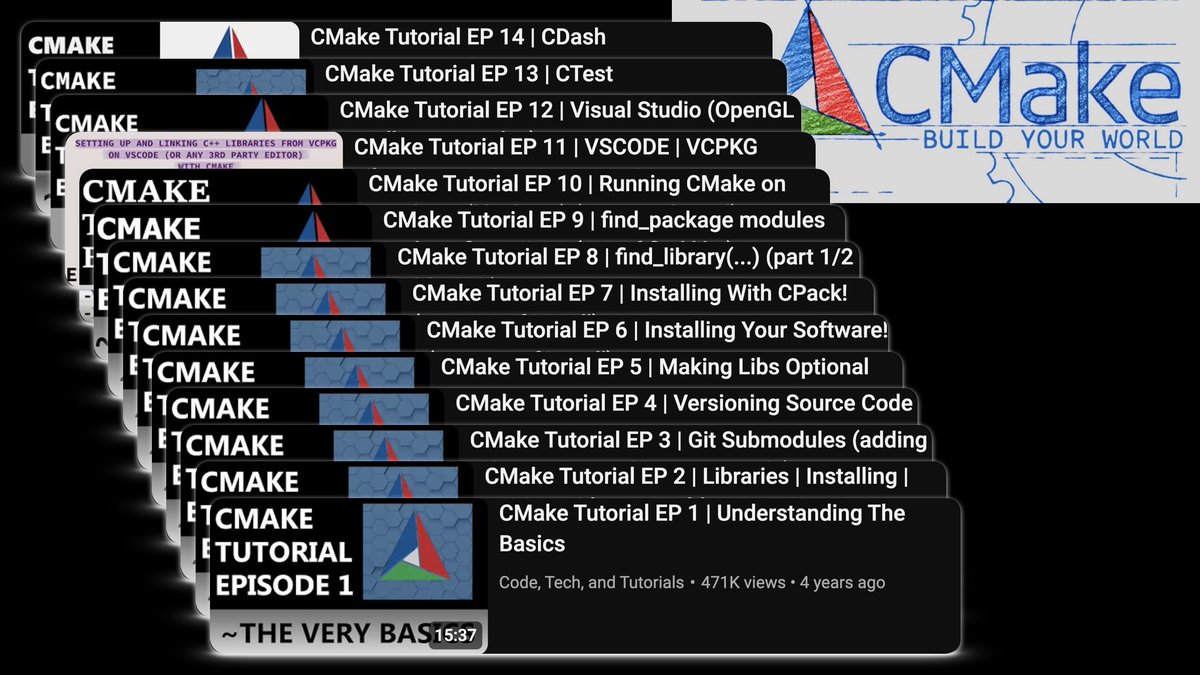
🛠️ CMake for Beginners
Many C, C++, and other projects utilize CMake as the build system. It's quite a powerful system with many features, but it can be overwhelming for beginners.
The two resources below will help you overcome it easily. The first is a video providing a quick intro to get you off the ground, and the other is a detailed playlist that will help you dive deep to understand all the bells and whistles.
𝗕𝗼𝗼𝗸𝘀 𝗘𝘃𝗲𝗿𝘆 𝗦𝗼𝗳𝘁𝘄𝗮𝗿𝗲 𝗘𝗻𝗴𝗶𝗻𝗲𝗲𝗿 𝗠𝘂𝘀𝘁 𝗥𝗲𝗮𝗱 𝗶𝗻 𝟮𝟬𝟮𝟱.
You probably already noticed that I'm a big fan of reading. You can learn from knowledgeable people by working directly with them or reading what they have written. The first option is the best, yet it is often impossible. We have books written by people who were probably the best at this in the world at the time of writing.
If we look at the software engineering world, there are many gems here, but I will recommend the best books per area of work. These books will help you not only to become good at specific technology but to become a great software engineer overall.
𝟭. 𝗚𝗲𝗻𝗲𝗿𝗮𝗹:
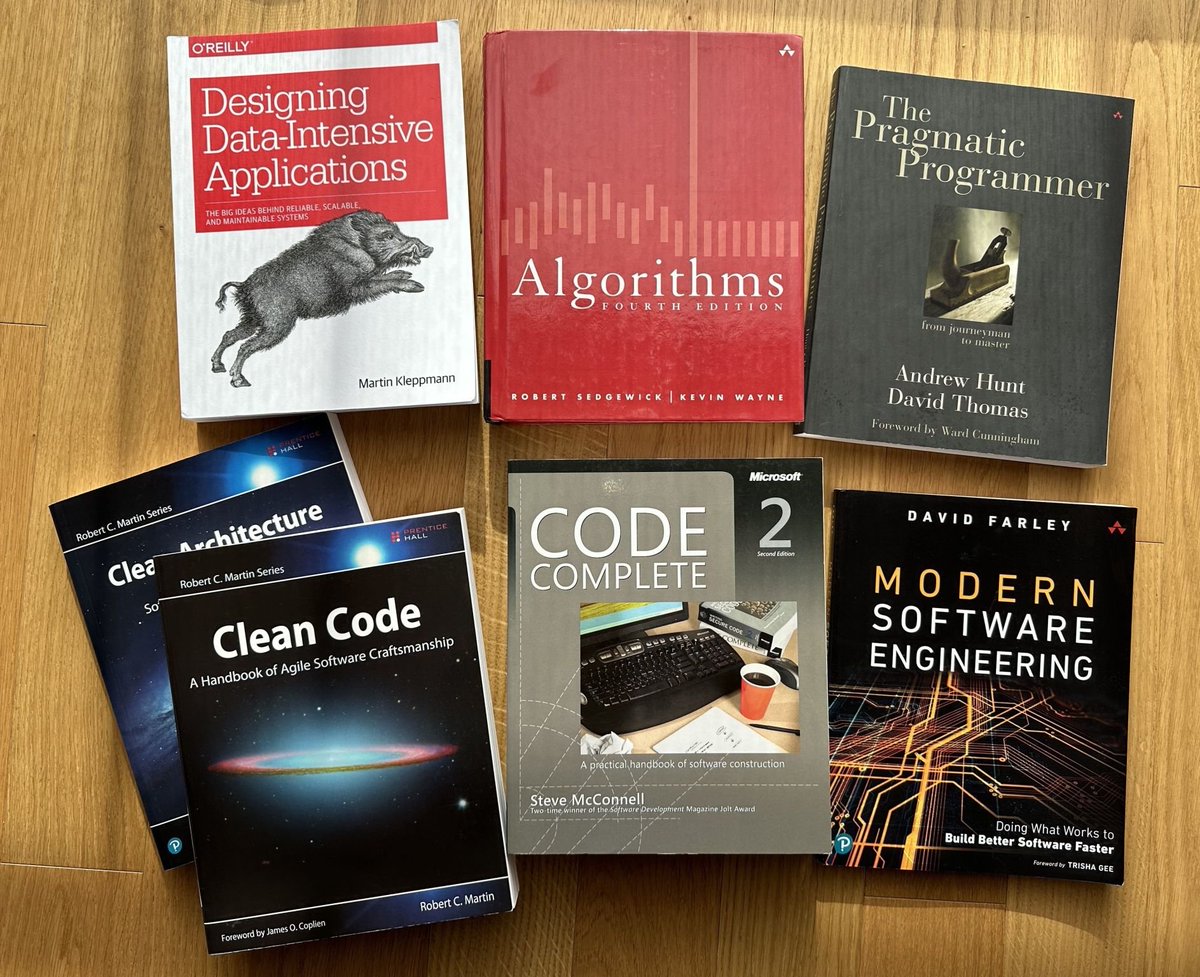
🔹 The Pragmatic Programmer by David Thomas and Andrew Hunt (https://t.co/NCSpr3ZhGb)
🔹 Code Complete: A Practical Handbook of Software Construction (https://t.co/OXMYyabHma)
🔹 Modern Software Engineering by David Farley (https://t.co/2X5eWCHcni)
🔹 Software Engineering at Google (https://t.co/GXZxoCbrva)
𝟮. 𝗖𝗼𝗱𝗶𝗻𝗴 𝗽𝗿𝗮𝗰𝘁𝗶𝗰𝗲𝘀:
🔹 Clean Code by Uncle Bob Martin (https://t.co/4Ml52XBKKb)
🔹 Head First Design Patterns by Eric Freeman (https://t.co/4jXkPd8vcK)
🔹 Refactoring by Martin Fowler (https://t.co/8fbR93LNy0)
𝟯. 𝗗𝗮𝘁𝗮 𝘀𝘁𝗿𝘂𝗰𝘁𝘂𝗿𝗲𝘀 𝗮𝗻𝗱 𝗮𝗹𝗴𝗼𝗿𝗶𝘁𝗵𝗺𝘀:
🔹 Grokking Algorithms (https://t.co/1q2hWfaONO)
𝟰. 𝗗𝗮𝘁𝗮:
🔹 Learning SQL by Alan Beaulieu (Free - https://t.co/RCcZjZr2Tl)
𝟱. 𝗧𝗲𝘀𝘁𝗶𝗻𝗴:
🔹 Growing OO Software by Tests by Steve Freeman (https://t.co/joi6Q8nm4W)
🔹 TDD by Example by Kent Beck (https://t.co/IxVGfJymQu)
🔹 Unit Testing Principles, Practices, and Patterns by Vladimir Khorikov (https://t.co/7VyFPkUpZS)
🔹 The Art of Unit Testing by Roy Osherove (https://t.co/rqNoqJH49t)
𝟲. 𝗔𝗿𝗰𝗵𝗶𝘁𝗲𝗰𝘁𝘂𝗿𝗲:
🔹 Fundamentals Of Software Architecture by Mark Richards and Neil Ford (https://t.co/LOnF7783bl)
🔹 A Philosophy of Software Design by John Ousterhout (https://t.co/rBeKHE0w6P)
🔹 Clean Architecture by Uncle Bob Martin (https://t.co/fojqHumHo3)
🔹 Domain-Driven Design Distilled by Vaughn Vernon (https://t.co/pT8GZQmrR5)
🔹 Software Architecture the Hard Parts (https://t.co/K7AqvDOoSN)
𝟳. 𝗗𝗶𝘀𝘁𝗿𝗶𝗯𝘂𝘁𝗲𝗱 𝘀𝘆𝘀𝘁𝗲𝗺𝘀:
🔹 Understanding Distributed Systems by Roberto Vitillo (https://t.co/NmApvbFyQj)
🔹 Designing Data-Intensive Applications by Martin Kleppman (https://t.co/2Rtjfs987o)
𝟴. 𝗗𝗲𝘃𝗢𝗽𝘀:
🔹 DevOps Handbook by Gene Kim (https://t.co/EHmuVxZrKi)
🔹 Continuous Delivery by Jez Humble and David Farley (https://t.co/tePOX3hfs3)
🔹 Accelerate by Nicole Forsgren (https://t.co/HqHfEjAmB4)
𝟵. 𝗠𝗮𝗰𝗵𝗶𝗻𝗲 𝗹𝗲𝗮𝗿𝗻𝗶𝗻𝗴:
🔹 The Hundred-Page Machine Learning Book (https://t.co/31A2XuGKSR)
🔹 Designing Machine Learning Systems (https://t.co/8hXFovtTzU)
#softwareengineering #programming #learning
Everything about C makes sense once you understand the computation model - The interaction between CPU and Memory and the role of ISA...
Things like pointers, data types, array, structs etc will make more sense and you'll be able to think about them and use in design more naturally.
This is lecture 4 (4. CPU, Memory and Instructions. Fetch, decode, execute...) of the playlist on learning Assembly, C on Bare-metal RISC-V - https://t.co/lGHZyb2c5p
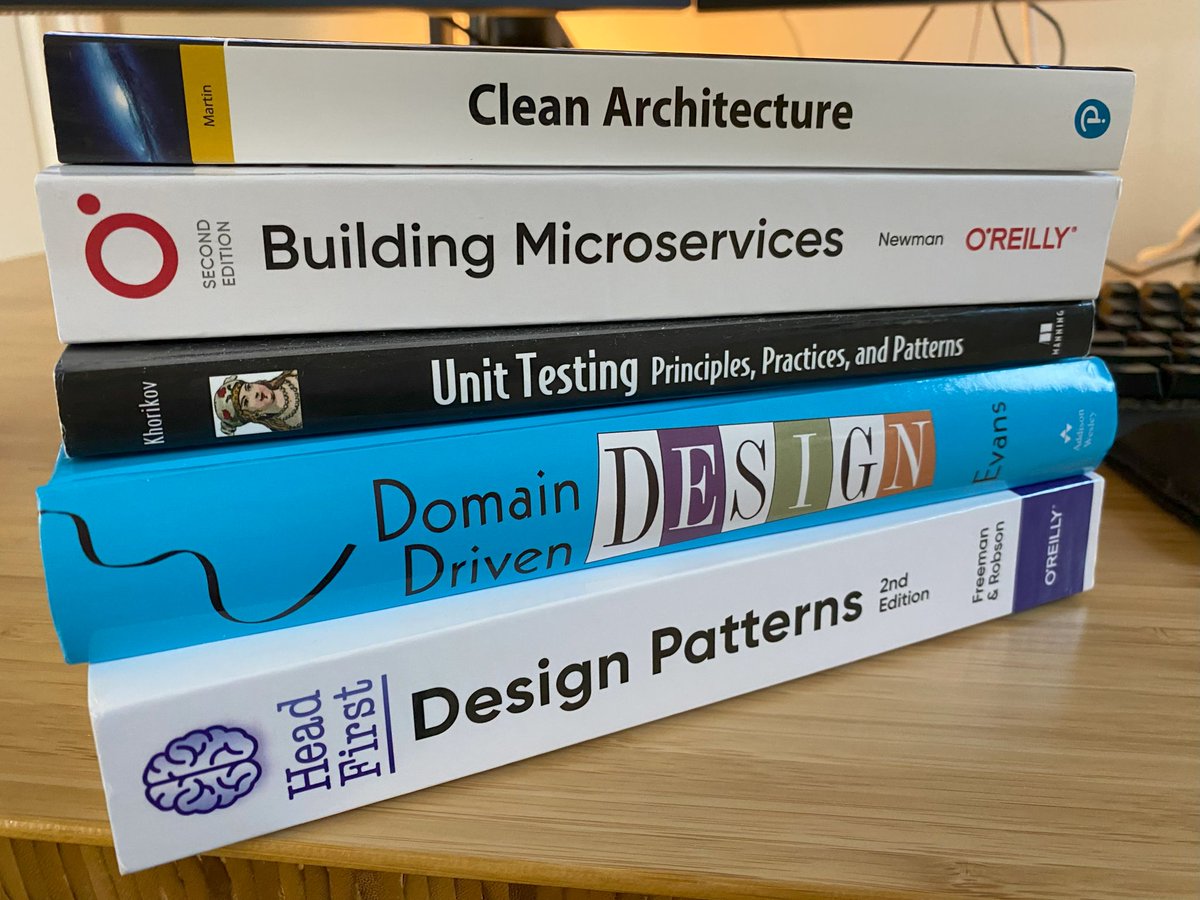
5 books I can't recommend enough:
1. Clean Architecture ( Robert Martin )
2. Building Microservices ( Sam Newman )
3. Unit Testing ( Vladimir Khorikov )
4. Domain Driven Design ( Eric Evans )
5. Head First Design Patterns ( Eric Freeman, Ph.D. & Elisabeth Robson )
Get my FREE .NET Backend Developer Roadmap 👇
https://t.co/Ed7r4wghUc