Working with HS ELA teachers on reducing feedback and lesson prep time + improving student 'critical' ELA skills;
Fellow @AlphaSchoolATX; UATX @uaustinorg
AI can generate an answer in 3 seconds.
But it can’t decide what’s true or what matters.
That’s why critical thinking isn’t optional anymore.
Students don’t build it by recognizing answers.
They build it by constructing arguments.
When students write, they:
• Evaluate claims
• Weigh evidence
• Consider counterarguments
• Defend their reasoning
Writing is thinking made visible.
You can’t outsource that struggle.
In an AI age, the advantage belongs to those who can judge what they read and defend what they believe.
Reading Rooms teaches structured argument.
Because the future rewards independent thinkers.
→ https://t.co/P54Xb15y2w
Excited to announce 'A Work A Week' -- Reading Rooms Community newsletter!
Already at 300 readers.
Every week: how to teach your child one great historically significant piece.
Latest article: https://t.co/tabziAI6tD
Come join the conversation and share with friends who love thoughtful writing!
Literacy isn’t an optional skill. It’s the foundation of your kid’s entire future.
Most parents think “eh, if they read enough books they’ll be fine.”
Wrong.
Real literacy in 2026 is reading the great authors, asking sharp questions, building strong arguments, connecting ideas to real life, writing clearly, and thinking for yourself,
Especially when an AI can make a mind for you.
Yet many parents stop at the basic reading and hope for the best.
That decision quietly changes everything.
What are some of the best skills that literacy actually gives a child?
#Literacy #Education #Reading #Homeschool #CriticalThinking
Ever notice how some teens can read…
but struggle to explain what they think?
A lot of homeschool curricula don’t build real argumentation or discussion skills.
My cofounder Max and I are building Reading Rooms, a tool to help parents teach their 7th–12th graders high-level literacy.
We’ve been working with mentors from Alpha Fellowship and modeling this after elite private school curricula.
Looking for homeschool moms to test it:
• Free access
• Direct support
DM me if you're interested.
@Shadow_Rebbe My apologies, I just assumed the stereotype, but yeah of course dads are invited. In fact, the more perspectives and help, the much better!
My goal is to make this the best for parents.
"With Reading Rooms, my goal is to use AI to strengthen critical thinking, support real reading, and preserve the humanity of learning, so that we don’t confuse intelligence with automation and productivity, while still raising people who can think for themselves and make decisions using the amazing opportunities that modern technologies provide." — @aknenivtilxam, UATX sophomore and cofounder of Reading Rooms
If you have the opportunity to get feedback from @austin_way please take the time to do so.
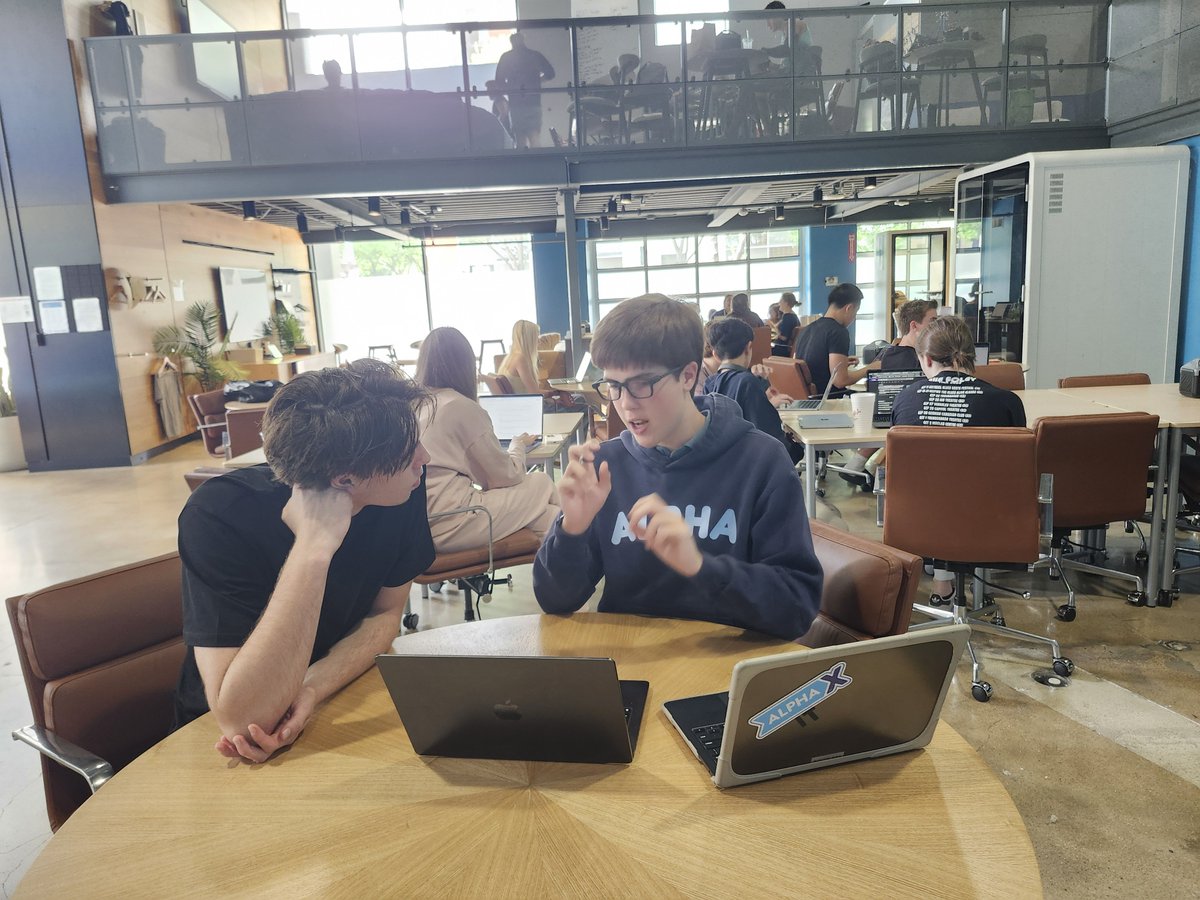
Here @uaustinorg student @almartishenko , a member of the Founding 100 and a UATX Alpha Fellow, is discussing how best to quantify the academic gains for students with his app.
Two 19-year-old, @uaustinorg, students interviewed 30+ teachers before building a single feature.
What they heard changed everything.
Grading is breaking the profession. They built the fix.
@almartishenko & @aknenivtilxam
Episode 358 of My EdTech Life is live. 🎧
https://t.co/E4Ex3YsknY
#myedtechlife #podcast #edtech
"We are building Reading Rooms, which gives homeschool families and educators a better way to teach high-level reading, writing, and critical thinking, while allowing them to allocate more time to their pupils, rather than grading long essays and answers. Instead of shallow multiple-choice learning, students get personalized, feedback-rich practice that helps them think clearly, write well, and prepare for SAT, AP, and the real world, with less burden and stress on the adults guiding them.
A year ago, I didn't know what the term startup meant. I had a classical education that did not focus much on business, but I always found interest in building companies. The @AlphaSchoolATX Fellowship opened the doors for me to pursue these dreams in ways I never thought possible. It gave me the ability to experiment, learn, fail, and improve all the way to the point where I am now actually selling to CEOs of schools and astonishing those around me with the developments my friend and I have built." – UATX sophomore @almartishenko with cofounder and peer @aknenivtilxam
Thanks to Dr. Alfonso Mendoza Jr., host of @MyEdTechLife podcast, for interviewing us!
Was a great time and would definitely recommend checking him out.
Coming out in two weeks!
Hot take: Avoiding technology in high school classrooms isn’t protecting students. It’s handicapping them.
This is from my perspective as a college sophomore:
To be clear, I’m not talking about young kids in elementary school. I’m more focused on high school students who are entering college and the real-world.
I went to a classical academy growing up.
Great books, discussions, writing, and philosophy.
But there was one thing missing:
Technology.
When I got to college, it felt like everyone else had a massive head start.
They already knew how to:
• Use AI tools effectively
• Build workflows with software
• Automate tasks
• Research faster with tech
• Navigate modern digital platforms
• Build companies
Meanwhile, I was learning all of this from scratch.
It's not that I wasn’t capable, I just had never been exposed to it.
So while others were growing exponentially…
I was climbing a steep learning curve just to catch up.
And honestly, I’m still climbing it!
AI is now a part of almost all projects.
Claude devs use claude to build it!
Because of this, we shouldn't ban technology from high school classrooms.
We must teach students how to use it well.
Technology is the environment this generation will work in, and shielding high school students from it doesn’t prepare them. Instead, it sets them behind, and with how rapidly AI is improving, is creating a larger and larger gap between entry level jobs and experts.
And when that moment hits, it hits all at once.