ORBIT ACHIEVED. 🚀
Vikram-1 Test Flight-1 has reached orbit. India's first privately developed orbital rocket has completed its final burn and injected its payloads into a ~450 km orbit, making India the third country in the world with private orbital launch capability.
History is made. 🇮🇳
#Vikram1 #JourneyToOrbit #SkyrootAerospace
Historically, semis were priced as a cyclical industry. As margins peaked, P/S ratios would fall.
Over the past year, though, semi multiples have exploded as margins hit all-time highs.
Either the industry has become less cyclical OR it is a sign of exuberance.
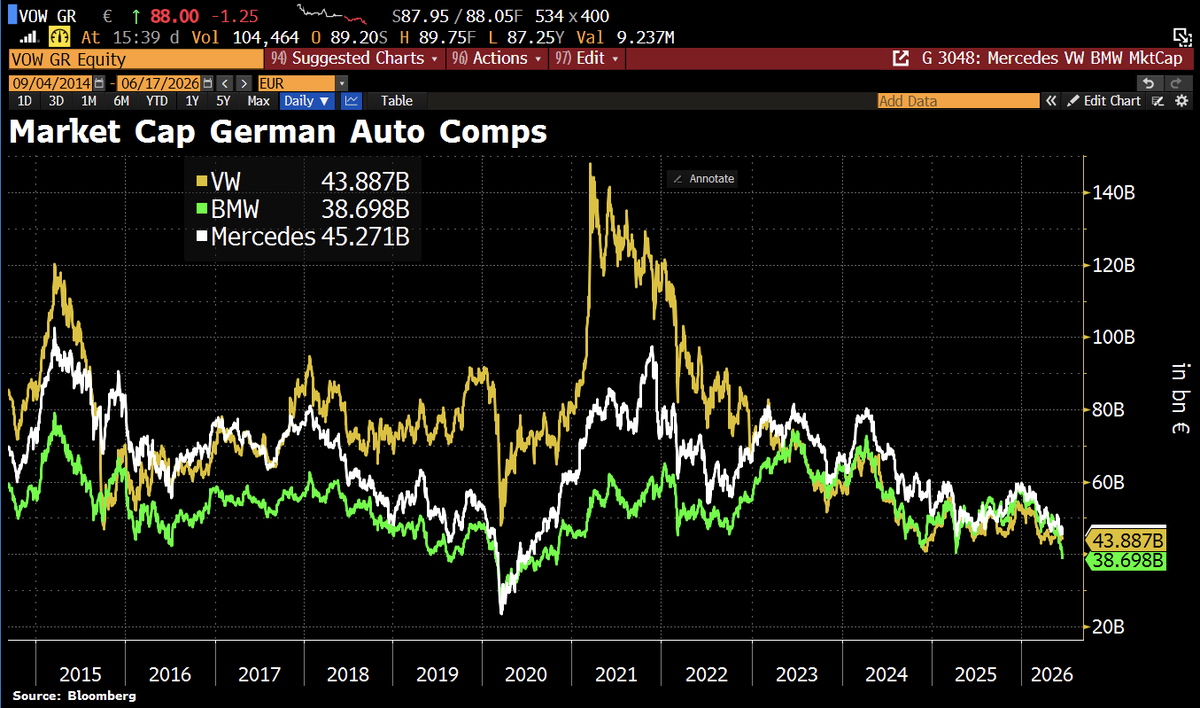
Hello from Germany, where the auto crisis just deepened. BMW has issued a major profit warning, implying a profit drop of >60%. Its EBIT margin is now expected at just 1–3%; a shocking level for a premium automaker that once stood for double-digit profitability. This comes only a day after VW executives reportedly described their own company as facing an existential threat, according to Manager Magazin. BMW is now worth less <€40bn.
One of the most powerful symbols of India’s unbroken civilizational continuity!
Discovered at Mohenjo-daro in undivided India this steatite seal, about 4,300-year-old, shows a seated figure in yogic posture (widely seen as Shiva-Pashupati) seated in Mulabandhasana, surrounded by animals.
While ancient sites may lie across modern borders, India remains the living custodian of this heritage. The yogic posture, Shaivite symbolism, and spiritual ethos seen in the Pashupati Seal continue to thrive in India’s temples, daily worship of Shiva, yogic traditions, and cultural life even today.
From the Vedic period to contemporary Bharat, this civilizational thread has remained alive and unbroken — deeply embedded in our philosophy, rituals, and collective consciousness.🇮🇳
#PashupatiSeal #IndusSaraswatiCivilization #LivingIndianHeritage
Boomers: “Young people are too lazy and don’t want to work anymore”
Meanwhile in 1990:
Median income: $23,000
Median house price: $117,570
How long you need to save: 5-6 years
Today:
Median income: $70,000
Median house price: $440,000
How long you need to save: 10–14 years
1994: Huge crowd outside Sterling Cinema, Mumbai for the release of Jurassic Park.
No online booking back then, just long lines, excitement, and love for movies.
#JurassicPark#stevenspielberg#OldMumbai
This is absolutely insane:
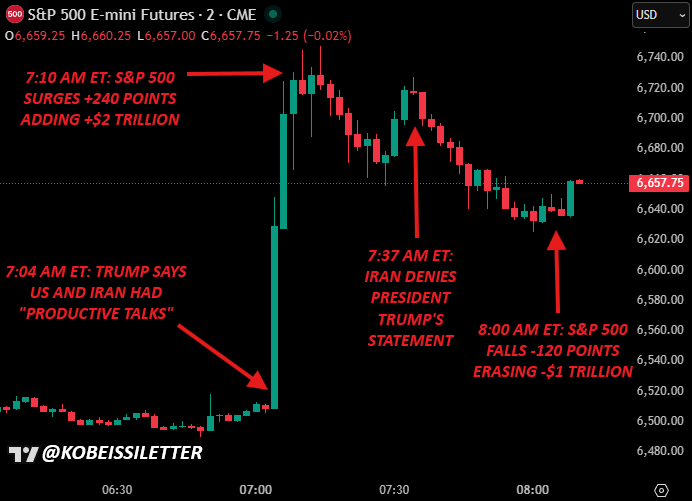
At 7:04 AM ET today, President Trump said “the US and Iran have had productive discussions" to end the Iran War.
By 7:10 AM ET, the S&P 500 surged +240 points adding +$2 TRILLION in market cap.
27 minutes later, Iran completely denied all of President Trump's claims and said there has been "no contact" with the US.
By 8:00 AM ET. the S&P 500 had fallen -120 points erasing -$1 trillion in market cap.
That's a $3 TRILLION swing market cap in 56 minutes, just in the S&P 500.
What is happening here?
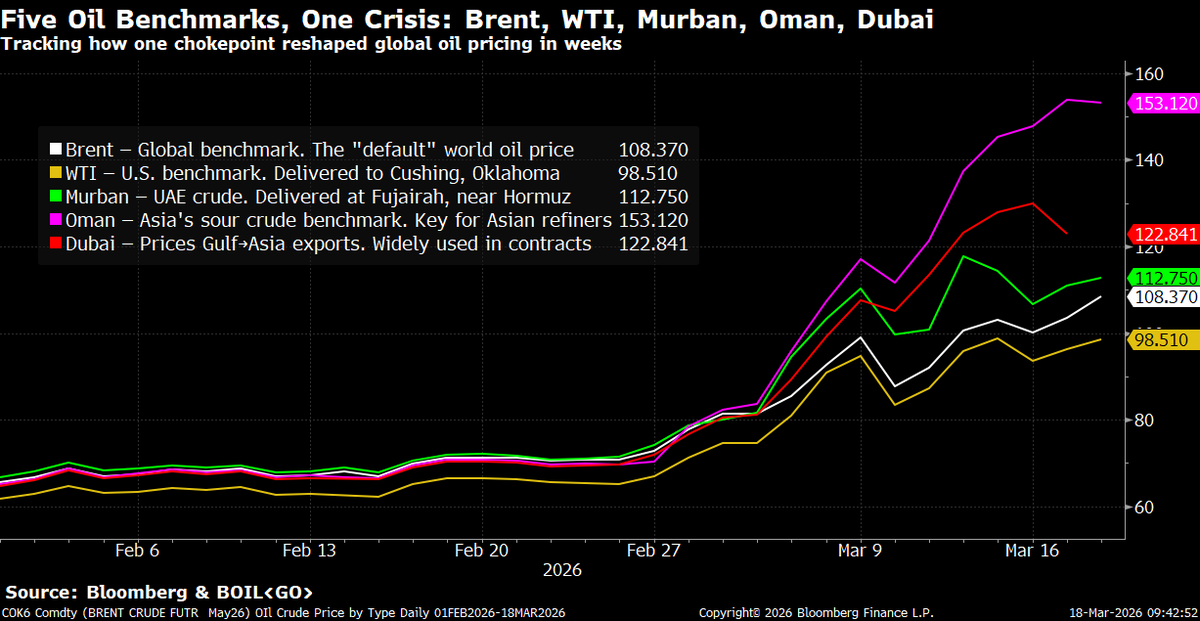
🛢️There's a lot being said about oil prices right now, so I put this chart together to help explain the major crude benchmarks and why they're all behaving differently.
⚪Brent (white) — The world's "default" oil price. Most global trade is priced off this. When the news says "oil is at $108," they mean Brent.
🟡WTI (yellow) — The U.S. benchmark, based on crude delivered to Oklahoma. It's the lowest line on the chart because American oil doesn't need to transit the Strait of Hormuz.
🟢Murban (green) — Crude from Abu Dhabi, delivered at Fujairah port, which sits just outside the Strait. Even though it technically doesn't have to pass through the chokepoint, drone strikes have hit Fujairah and nearby ports, pushing insurance and shipping costs up.
🟣Oman (purple) — The key benchmark for heavier crude sold into Asia. Many refineries in China, Japan, and South Korea are built specifically to process this grade. It's the highest line on the chart because Asian buyers are competing fiercely for a shrinking pool of cargoes.
🔴Dubai (red) — Used to price most long-term Gulf→Asia export contracts. It tracks alongside Oman as a measure of how hard Asian markets are being squeezed.
The story isn't any single price — it's the gap between them. In late February these five lines were within $6 of each other. Now the spread between WTI and Oman is over $50.
Since the U.S.-Israeli strikes on Iran began Feb 28, the Strait of Hormuz has effectively been closed. Daily transits have fallen from a historical average of ~138 ships to fewer than 5. The IEA has called it the largest disruption to global energy supply in history. Iran's IRGC has warned that not "a litre of oil" will pass for U.S. allies, while selectively allowing some Iranian, Indian, and Pakistani tankers through.
Saudi Arabia is rerouting oil to its Red Sea port at Yanbu, and the UAE is using a pipeline to Fujairah — but combined pipeline capacity is only 3.5–5.5 million barrels/day vs the 20 million that normally flows through the Strait. Meanwhile, the 400 million barrel emergency reserve release by IEA members covers roughly 4 days of global consumption.
Japan's refiners get ~95% of their crude from the Gulf. China receives 45% of its oil via Hormuz. South Korea, India, Thailand, Pakistan, and Bangladesh are all severely exposed. The wider the spread between the Asian benchmarks and Western ones on this chart, the more you're seeing that pain in real time.