MS, NAILD LS-I, Director of Conservation @IDADarkSky.
Sensory ecologist, night sky enthusiast, devoted to salsa dancing, obsessed with bees and succulents.
All this is to say: we're going to keep fighting for a modern, progressive, effective Outdoor Lighting Code in Tucson and Pima County despite the efforts of special interests that want to roll back its protections for the night sky. The facts are on our side. (13/13)
We're recruiting! The project I work on to study the ecological impacts of #alan#lightpollution is recruiting a research technician to work with us at @UoE_Physics@UoE_Astro until the end of 2024.
Details here and application link here: https://t.co/ScDLLnnzL8
;) This is a periodic reminder that from an environmental point of view 'all' artificial outdoor light is polluting or wasted. Use artificial light at night sensibly and with some restraint.
Details in arXiv (open access) https://t.co/pgvGRGg3wy or in the version of record (...)
@RestoringDrknss Although what the folks in Oregon have done and will continue to do is no small feat! Lots of promise to see in the future as the movement continues to build.
@RestoringDrknss Big bend is a Reserve spanning nearly 10 million acres and includes multiple counties and communities that actively worked to write effective policies and retrofit outdoor lights. The Outback is a Sanctuary and is only 2 million acres. No records have been broken here :)
France recently announced its intention to reduce light pollution nationwide by 50% by 2030. Even as a concept this is important because it is an recognition in law that reducing energy consumption should not result in a net increase in light pollution.
https://t.co/FOIMENsjX5
So excited to share this new piece on light pollution ecology for young readers! Open access publication that you could share with audiences of (almost) all age levels! 💡🐞🦋
https://t.co/LQMXdhjoSu
🦇📢🦇2 Bat Postdoc Jobs @ Cornell! 🦇📢🦇
1) Data manager/data visualization https://t.co/AFmPTXdd5e
2) Bat abundance/trends using mobile acoustic data https://t.co/7X7Wevukxw
Both supporting the North American Bat Monitoring Program (NABat) mobile acoustic surveys.
Please RT.🦇
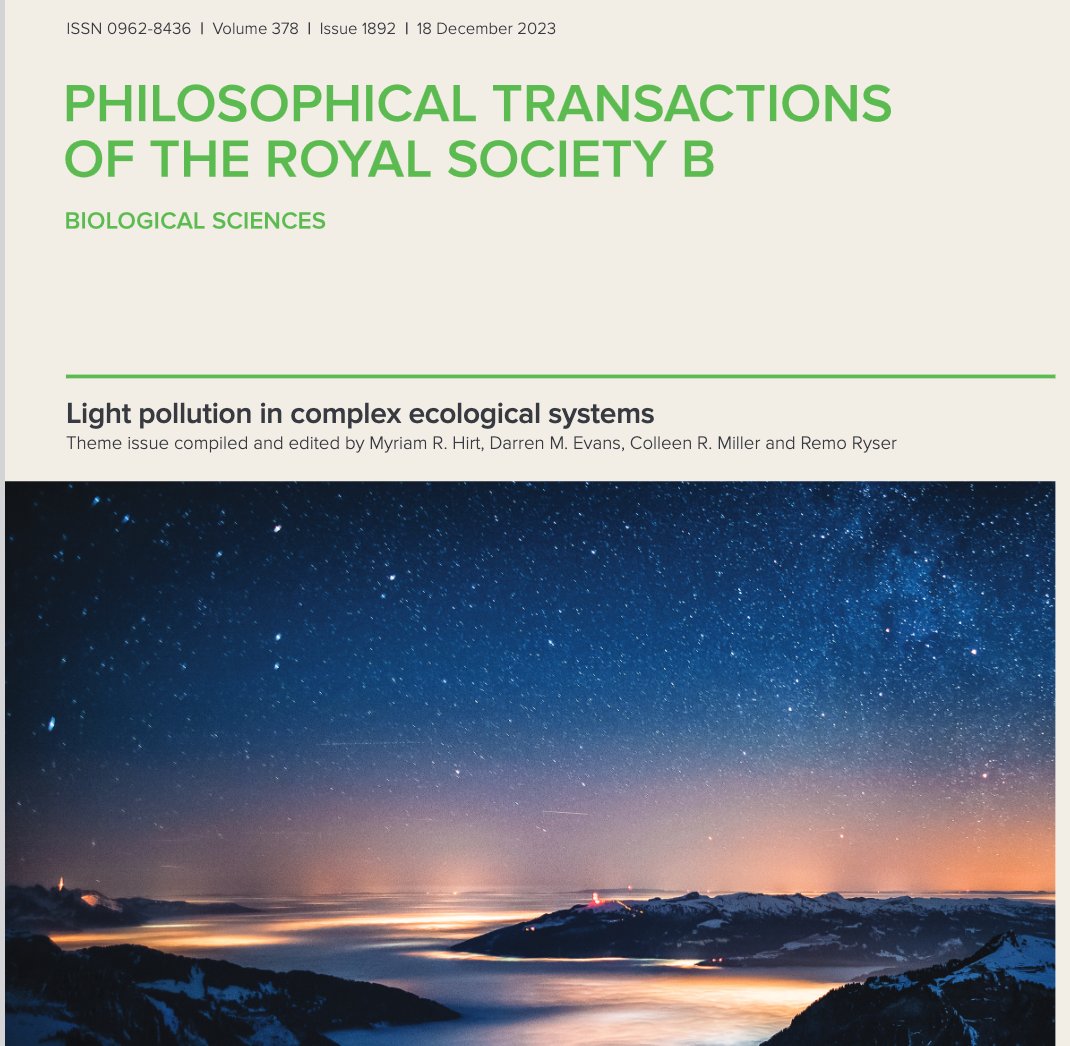
If you study #lightpollution and #ecology, drop everything and go read this special issue, edited by @MyriamHirt , @DarrenMarkEvans , @ColleenEcology , and @Remo_Ryser . https://t.co/FXzjei0jx2 An abundance of riches here!
We need to stop asking women how we make them ‘feel’ safe in the dark. ‘Feeling safe’ and actually being safe are two very different things.
You could stick a street light on my head and it ain’t keeping me safe if a man wants to hurt me.
This conversation needs to change.
The bright lights are causing a significant disruption in the migratory route of thousands of birds every night during the fall. We urge that, at the very least, this event be postponed until the fall migration is over #LightsOutNYC@NYCAudubon@wildbirdfund
Protecting the #DarkSkies is crucial not only for astronomical observations, but also for people's health & #biodiversity.
This is why #Chile —ESO's partner country and host to our observatories— has issued a new law to safeguard its dark skies, which are unique in the world. 1/
NEW PAPER in #ornithology highlights that the bycatch of #seabirds in #gillnets is not reduced by LED lights that deter #turtles - these lights may inadvertently attract plunge-diving birds: https://t.co/QTe2cy5z3g
Have you seen streetlights turning purple in your city?! This article in Scientific American @sciam discusses why — @ShrutiHariyani and I provided some of our thoughts with @XtlStruc quoted too!
https://t.co/cHdCbEozPC
Sadly, despite paying for Twitter Blue, people are still not seeing my tweets like they used to.😔
Can you please do me a favour? If you follow me and you see this tweet, can you please retweet it.🙏
To make it more worth sharing, here's a Kingfisher on a thorny branch. 🥰🐦
"This rule is not simply updating 'outdated and wasteful technology,' but rather a decision that reflects a narrow focus on reducing energy consumption while disregarding the full scope of potential public health concerns."
https://t.co/n7ciTJQqEU
There are several solutions to update this property, including blinds, shutters, or window tinting to reduce the amount of light escaping the building. Or even turning off lights when they're not needed, especially when stargazing. We can do better!
This is a good example demonstrating interior lighting that is not properly shielded contributes to #lightpollution and ignoring this source will not help protect night skies, something the 'experts' behind this certification should have accounted for...