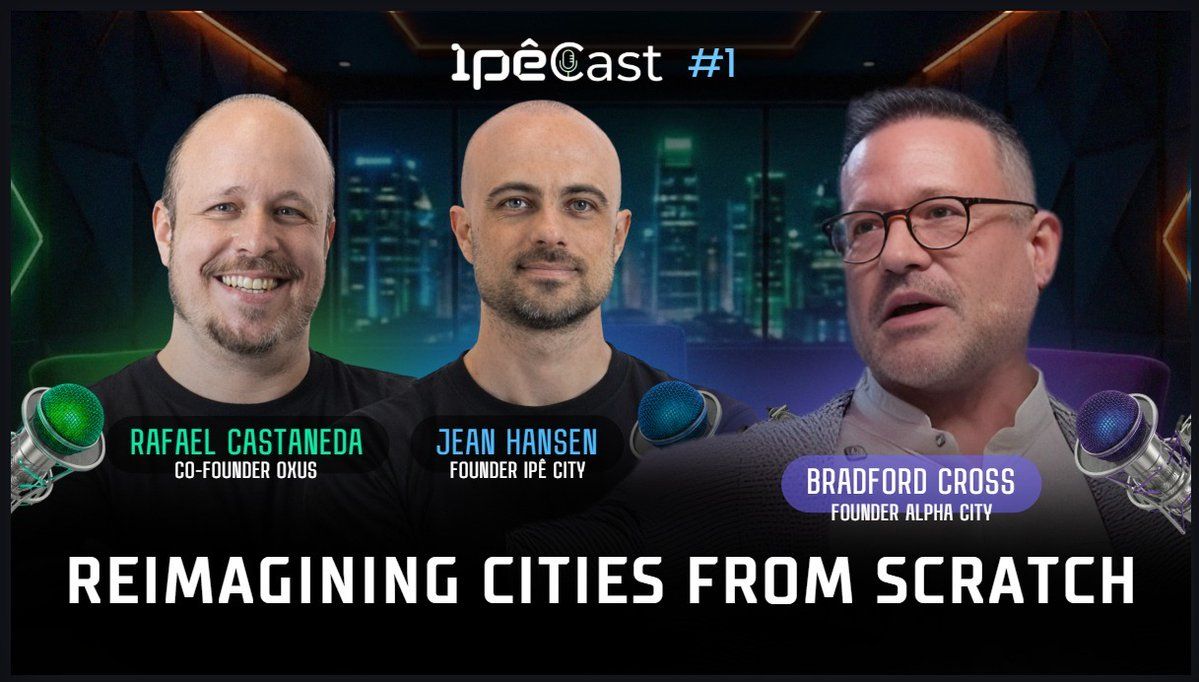
"I think we've built a lot of things wrong. We have sustainability challenges, cultural challenges, health epidemics, so many problems in the West. We can learn from those and try to develop Africa in a new way that avoids a lot of those types of problems."
— @bradfordcross , speaking about Africa's development opportunities
@Farooq_AI Exactly. Government sets the rules. Private operators execute. In too many places, politics absorbs the energy that should be going into building and delivery.
It's mostly a problem where a lot of the resources and energy are going into politics.
Much less is going into actually governance and execution that benefits the people.
And so for us, this movement of privately managed and operated cities is about having a little bit more separation, partnering with the government to agree on what kind of execution parameters we're all comfortable with and then delegating the execution more to the private sector.
In 50 years, over half of the world's largest cities will be African. Maybe 13 or 14 of the top 20 cities in the world will be here on the continent.
What's going to happen is this leapfrogging effect where a lot of the cities will be just super new, state-of-the-art, just amazing. Like some of the best cities on earth will be here in Africa. They'll be very futuristic.
As an entrepreneur, you accept uncertainty.
You know you're never going to be the best at everything, but you want to have at least enough expertise that you can do some damage.
You don't want to come in and be like pretty helpless and learning on the fly.
You don’t want it to swing between the right and the left or populist waves.
All of a sudden, you see a big push to try to undo what you’ve done or not finish what you started.
You’re stuck trying to push everything through during the window where your people are in power, because you’re doing partisan dealmaking with those particular guys.
And this is super problematic. It has long-term ramifications. Even in the short term, we saw this in our first country.
There was infighting within the same party. The president and the prime minister were from the same party. The prime minister had mentored the president and brought him into politics.
The president appoints the prime minister. Then the president fires him.
There was a scramble, reshuffling across the government.
This happened right before we were supposed to sign our most important commercial contract.
It caused a 10-month setback.
They were in the same party. This all happened within a two-year window where we were trying to get a deal done.
This is the reality. It’s messy.
The thing we’re focusing on with AI City is first of all cheap energy and building a place where you can create massive scale data centers.
In Africa, there are a few places where you can get access to some of the lowest cost geothermal and hydro power in the world. Kenya already generates nearly half its electricity from geothermal, and the East African Rift holds over 10 GW of potential.
And then we’re coupling it with an AI university.
This will be completely free tuition, fully based on commercializing tech developed at the university, and heavily focused on robotic research laboratories in every single STEM field.
So it’s not only about computer science, but automated research in biotech, material science, physics, and so on.
AI infrastructure is energy-intensive, with data centers driving a major share of costs, and global demand is set to double this decade.
Africa is more greenfield. You can build cities truly from the ground up. If you have more radical ideas that jump ahead of what we see in the West today, you can actually implement them.
In the West, we’ve built a lot of things wrong. There are sustainability challenges, cultural challenges, health issues, a lot of problems. We can learn from those and develop Africa in a way that avoids repeating them.
Let's jump to the future state which is more fully sustainable systems design: closed-loop ecosystems, waste management from the city connecting into agriculture, and building things that are more sustainable from the beginning instead of repeating the same mistakes.
It's a fertile field for innovating and building a different kind of a society that learns from what has not worked in the West.
@Bushii_94333 The opportunity is to design systems correctly from inception, rather than attempting to retrofit sustainability into structures that were never built for it.
If somebody launched an ICBM from Prospera in the direction of the United States and it hits Miami, Florida, everybody is going to be looking at the country of Honduras rather than just an individual from Prospera.
The host country maintains top-level liability for what occurs within the zone.
For example, if a gene-editing startup performed actions that were not robust and resulted in many deaths and massive issues years later, both the people operating the zone and the country itself would be held accountable.
The international community would question the country on why they allowed such activities.
Because of this, it is necessary to be mindful that operators are representing their government partners, who hold an abstract liability if something bad happens.
In a recent interview with Jean Hanson (@peerbase_) of @ipecity and Rafael Castaneda of Oxus Finance, @alphacityinc CEO @bradfordcross said:
“We can’t change the West,” comparing it to “a family member who has a drug addiction and they have to hit rock bottom and be willing to change.”
“Alpha is a dual level mission where we’re attacking what’s wrong in the West and what’s wrong in the developing world at once with a new kind of foundation that fixes the issues in the developing world so that they can grow much faster.
As we build these cities, we’ll use them as case study cities and bring people through from the developed world and say, ‘Hey, check this out. We could do the same thing in your country.’”
There are a couple of very strategic equatorial launch sites in Africa with very good proximity to extremely low-cost liquid natural gas and petrochemical industries.
At the equator, Earth’s rotation gives rockets a measurable boost, which is one reason equatorial launch sites matter. NASA puts surface speed at about 1,675 km/h at the equator.
So we can build modern methane-powered rockets and do space launch from Africa.
They’re already doing this in Kenya, so there’s some precedent for this. Kenya’s San Marco platform supported orbital launches for years, and a recent Kenya Space Agency presentation argues an equatorial Kenyan spaceport could deliver a 10-15% payload advantage over higher-latitude sites.
This is exactly why we must reinvent the concept of the state entirely and eliminate politics and politicians
Also why we believe the corporate model is a better model to form the basis of new experiments, and the CEO is the right primary leadership role to focus on, not the president, prime minister, etc
Thomas Sowell 🗣️
“I don’t want people making decisions who don’t pay the price of their decisions. That’s what politics is all about—you don’t pay the price of your decisions.”
1. The lost secret city of Bolama—built to rule an empire, then quietly abandoned.
Bolama lies just off the southern coast of Guinea-Bissau, a fully planned island capital that once served as the seat of Portuguese Guinea from 1879 to 1941.
1. The lost secret city of Bolama—built to rule an empire, then quietly abandoned.
Bolama lies just off the southern coast of Guinea-Bissau, a fully planned island capital that once served as the seat of Portuguese Guinea from 1879 to 1941.
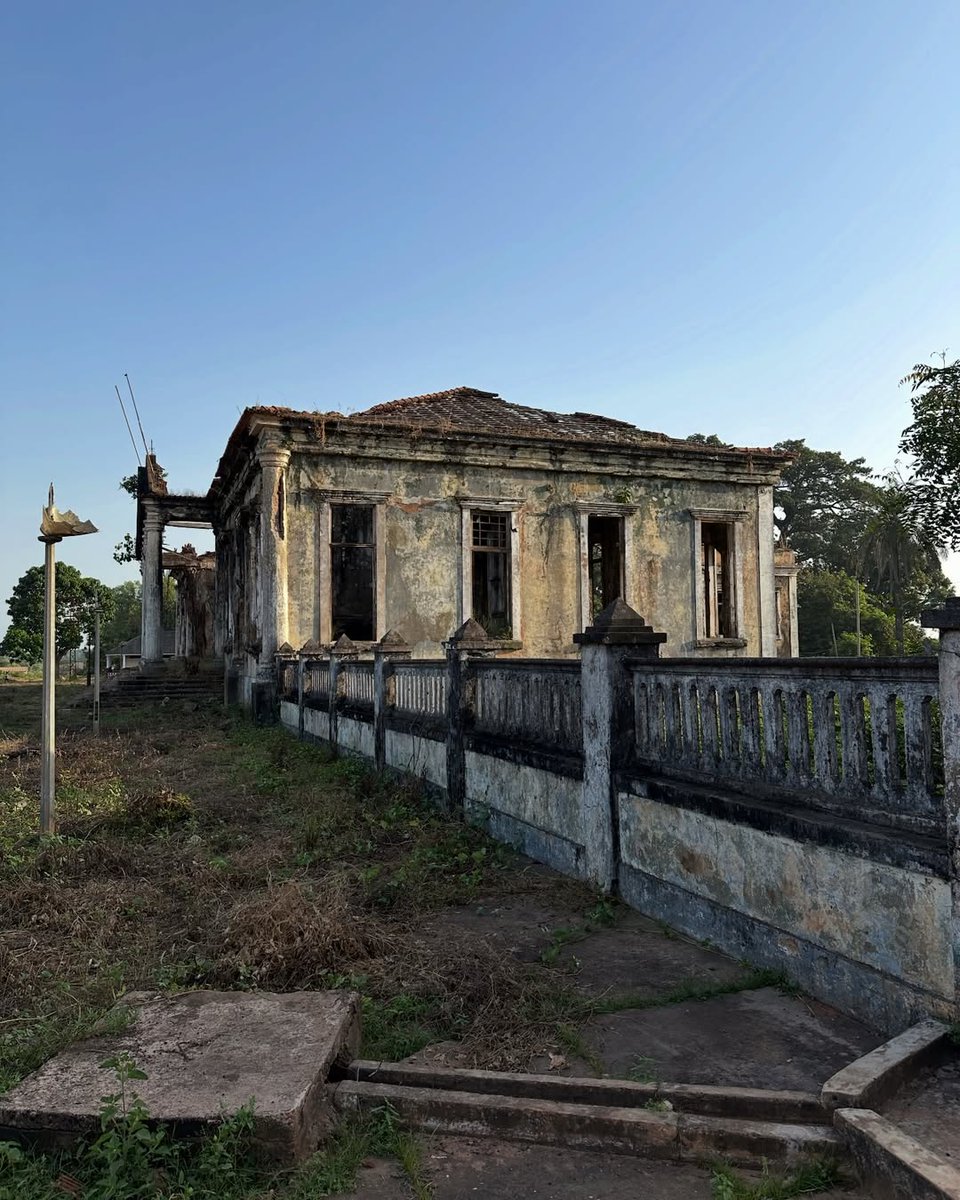
4. What remains today is an urban-decay landscape: monumental neoclassical buildings hollowed out and overgrown, silent civic halls, intact street grids with almost no traffic, and a harbor now serving local fishing boats.
Yet beneath the decay is a rare physical asset: a complete island-scale city skeleton with port access, walkable density, and total geographic containment in a tropical climate in the Bissagos Islands.
Bolama’s ruins outline a latent city rather than a failed settlement.