Happy to share that our manuscript "A Modular Scaffold for Triggerable and Tunable Nitroxyl (HNO) Generation with a Fluorescence Reporter" has been accepted for publication in Chemical Communications https://t.co/D8VBEYdwNh @IISERPune@serbonline@DBTIndia@ChemCommun
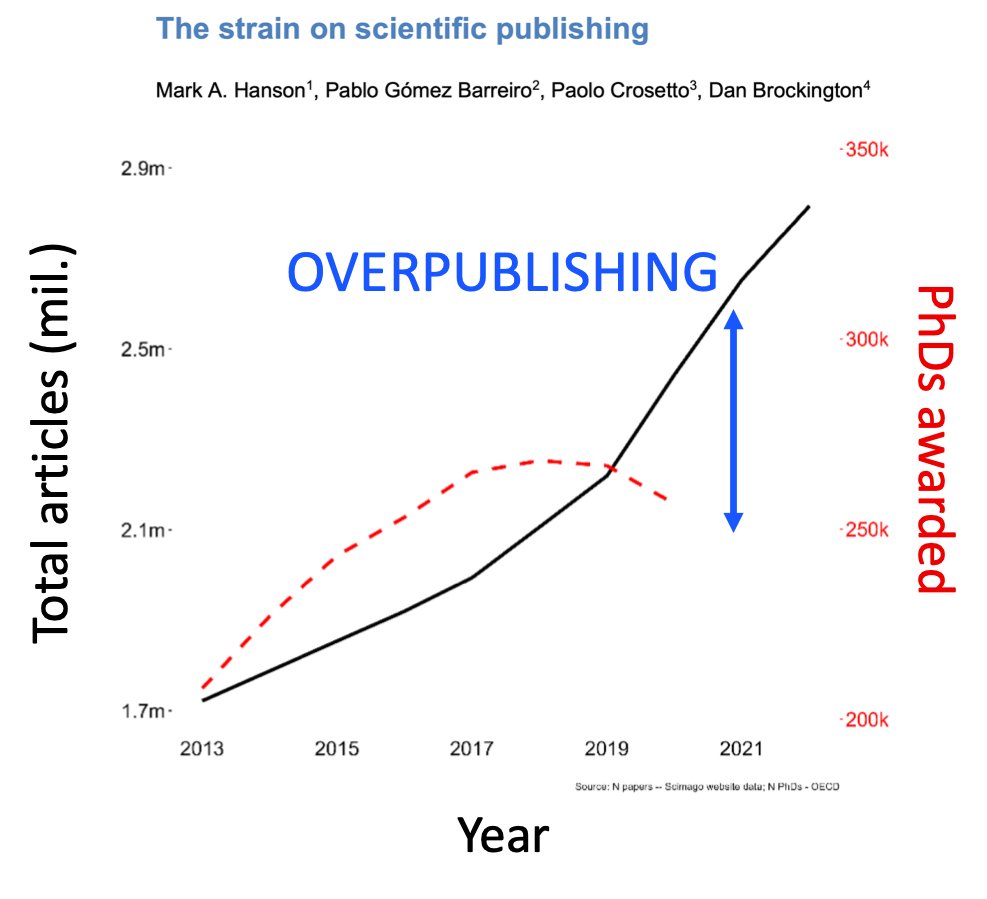
Overpublishing puts enormous stress on students and PIs.
And brings tons of money to publishers in STEM.
A new study shows that the number of papers is increasing FASTER than the number of #PhD graduates.
It’s an amazing work with very useful statistics. Huge kudos to the authors!
▫️
Main outcomes:
1️⃣ In 2022 the number of articles is 47% higher than in 2016. The amount of writing, reviewing and editing workload per scientist is increased enormously.
2️⃣ “Special issues” is a strategy for publishing lots of papers with reduced review time. This is possible due to the “publish or perish” pressure and clearly benefits the publishers.
3️⃣ The publishing time varies widely!
MDPI = 37 days. Frontiers = 72 days. Elsevier = 134 days. Springer = 157 days. Nature = 185 days.
4️⃣ The article rejection rates do not seem to correlate with publisher growth. However, rejection rates decline with increased use of special issue publishing.
5️⃣ Certain for-profit gold-open-access publishers create an increasing number of special issues, with uniquely reduced turnaround times, and in specific cases, high impact inflation and reduced rejection rates.
6️⃣ The authors suggest a new metric - Impact Inflation, which is reflected in self-citation within the same journal. For example, MDPI has a high impact inflation due to excessive self-citation compared to other publishers.
Conclusions and my opinion:
- Scientists have to spend a lot more time on reviewing and writing than before (on average).
- The more papers are published, the more the quality is compromised.
- Scientific progress has become partially bound to the business models of publishers and their revenue (a sad reality today).
- There is a huge lack of transparency. Much of these data had to be ‘web-scraped’ from numerous sources in order to get a full picture. We clearly need regulators to mandate open access to publisher’s statistics.
- Reduce the number of special issues! Those typically have low standards.
▫️
Science, publishing and funding make a trio that is very hard to disentangle.
However, research quality is controlled by the community.
This is why preprint + community review can make a big difference.
#AcademicTwitter #AcademicChatter
Synthesis and characterization of naphthodithiophene-fused porphyrins, plus impact of their extended conjugation on aromaticity (DSouza, Wang et al. @UntWang@UNTChemistry) https://t.co/DOU2I8F4WR
Just a gentle reminder that #PhD students are not ‘just employees’.
Even though their duties may involve extensive multitasking - lab work, data analysis, purchases, writing, travel, organizing social outings, etc…
They are also scholars who aspire to gain new knowledge and experience.
Which means they need YOUR attention in return.
Your knowledge, your experience and advice.
It’s called mentorship.
▫️
There are no lazy students.
There are students who lack proper support.
#AcademicTwitter #phdlife
Genuinely caring about students should be a non-negotiable qualification for a career in academia. Full stop.
No amount of research achievement or creativity can substitute for caring about the professional development and well-being of those we teach and mentor.
Every day I am in awe of international students. Doing a PhD in your native language and home country is hard. Doing it in a non-native language, in a different country and different culture is so much harder. You are not stupid. You are legends.
Happy to share that our manuscript "A Modular Scaffold for Triggerable and Tunable Nitroxyl (HNO) Generation with a Fluorescence Reporter" has been accepted for publication in Chemical Communications https://t.co/D8VBEYdwNh @IISERPune@serbonline@DBTIndia@ChemCommun
Check out 'A modular scaffold for triggerable and tunable nitroxyl (HNO) generation with a fluorescence reporter' by @Hari_Chakrapani and colleagues at @IISERPune.
https://t.co/ysA7spXs9i
"You can find the role models you are looking for."
2022 chemistry laureate @CarolynBertozzi shares an important message to all who don't see themselves represented in mainstream science. Who is your role model?
#IWD2023#InternationalWomensDay#WomenInScience