Stage Analysis Platform inspired by Stan Weinstein - for markets, sectors, industries & stocks. Screen any Stage, 30-week MA proximity, breakouts & more.
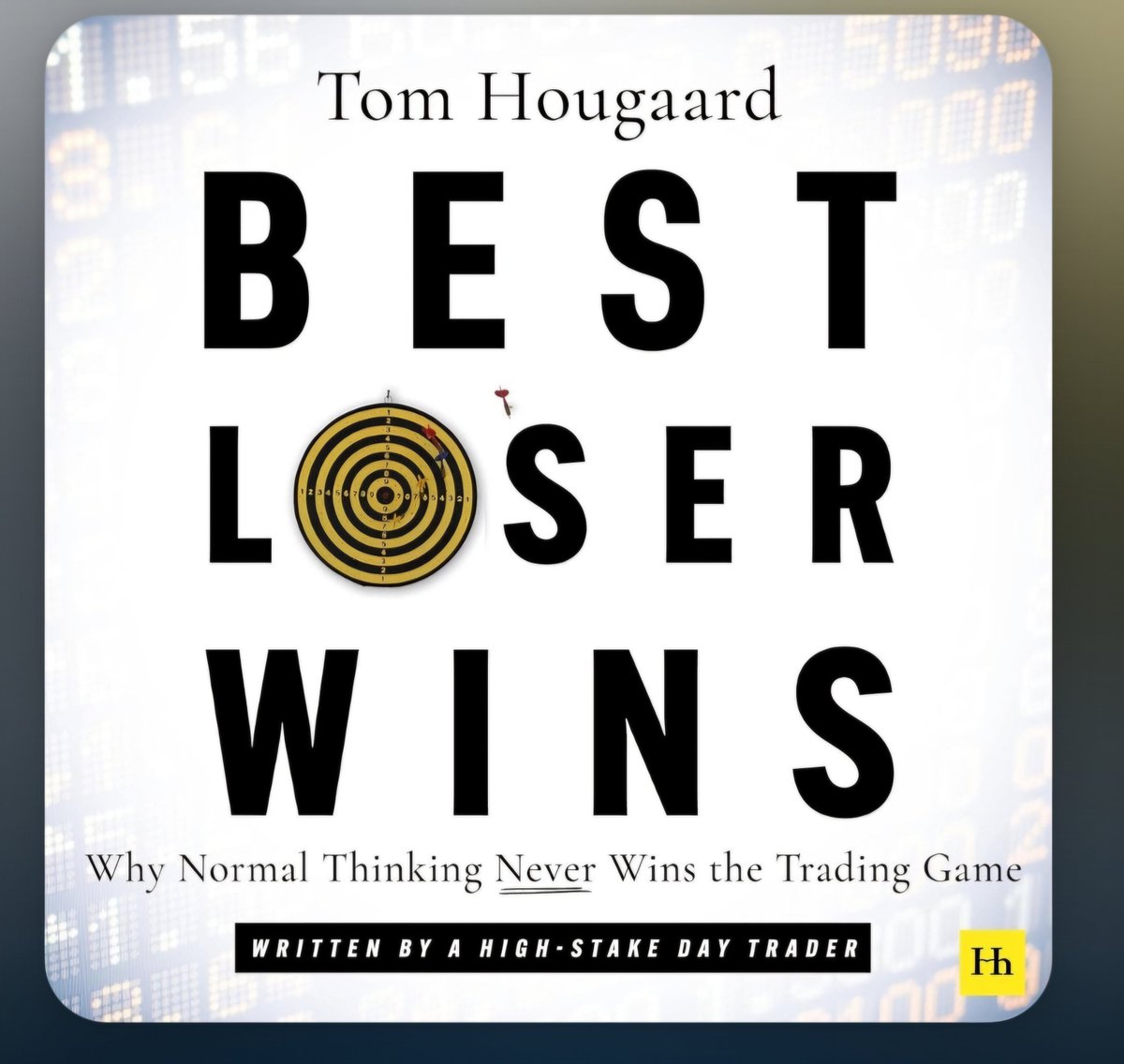
In Best Loser Wins, @TomHougaard starts from a hard number: about 90% of traders don't make money. His fix is to watch what that majority does and do the opposite.
"Why don't we observe what everyone else is doing, and then do the opposite of what they are doing?"
What he saw the losing majority do:
• Add to losing trades, because a lower price feels like a bargain
• Skip placing a stop-loss, because an open loss still has hope
• Take half profits on winners
• Never add to a winner
So he flips all four. He adds to winners, keeps a stop on every position, never averages down, and holds the whole position instead of half.
The number that stuck with me comes from 43 million trades placed by 25,000 retail FX traders. 62% of those trades made money, and the group still lost, because the average loss was nearly twice the average win.
I call it the Costanza method.
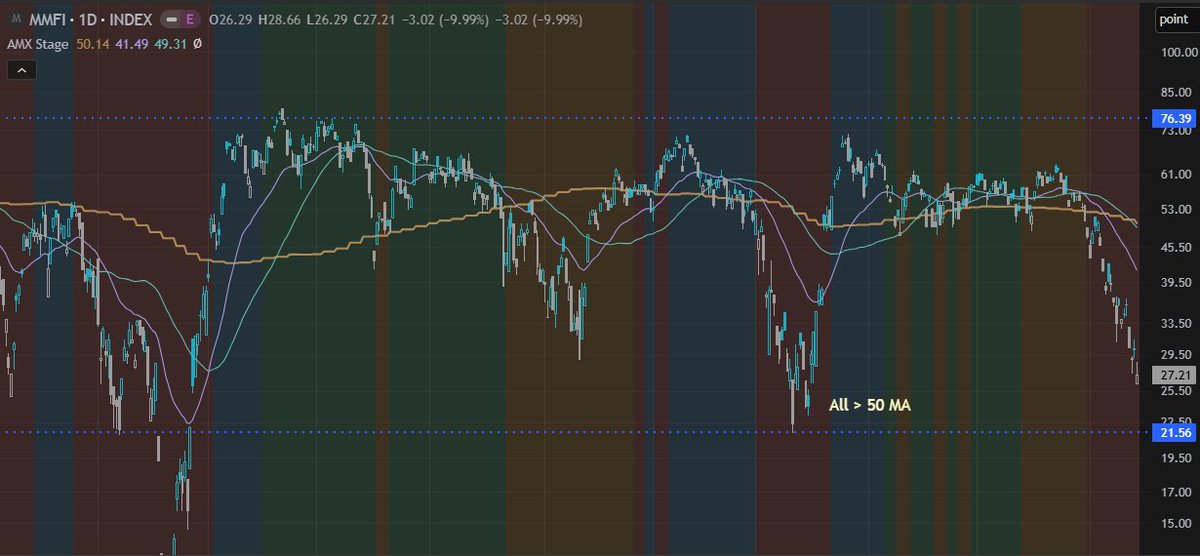
27% of stocks are over the 50 day moving average, and many times we see this bottoming around 20% but on panics it can sink further.
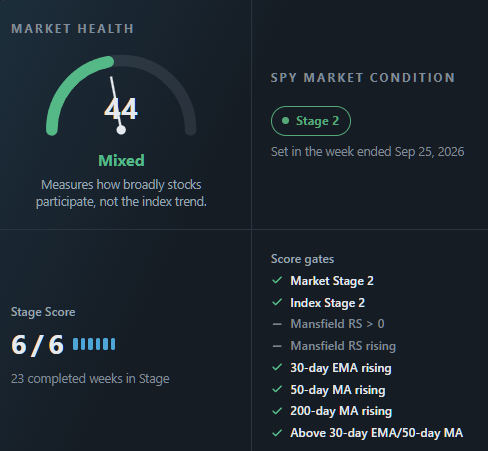
$SPY is remains in Stage 2 and back to a stage score of 6 out of 6 with the 30 week MA turning back up.
We are still seeing overall weakness with 74% stocks declining and 26% rising today.
What turns a loser to a winner?
Not a losing trade, but a trader that losers more than winning. It all comes down to our thinking. There are many great books on trading psychology.
Which trading psychology book should I read first?
It depends on the problem. Trading in the Zone is about accepting that any trade can lose. The Mental Game of Trading gives a step-by-step way to work on a specific emotion. Best Loser Wins is about taking losses and adding to winners. Trade Your Way to Financial Freedom covers risk and position sizing. Reminiscences of a Stock Operator is a trader's story rather than a method.
This blog post covers some key ideas from top traders and authors.
https://t.co/mlBa1utn59
$NKE: A textbook case for why stage analysis keeps you out of falling knives
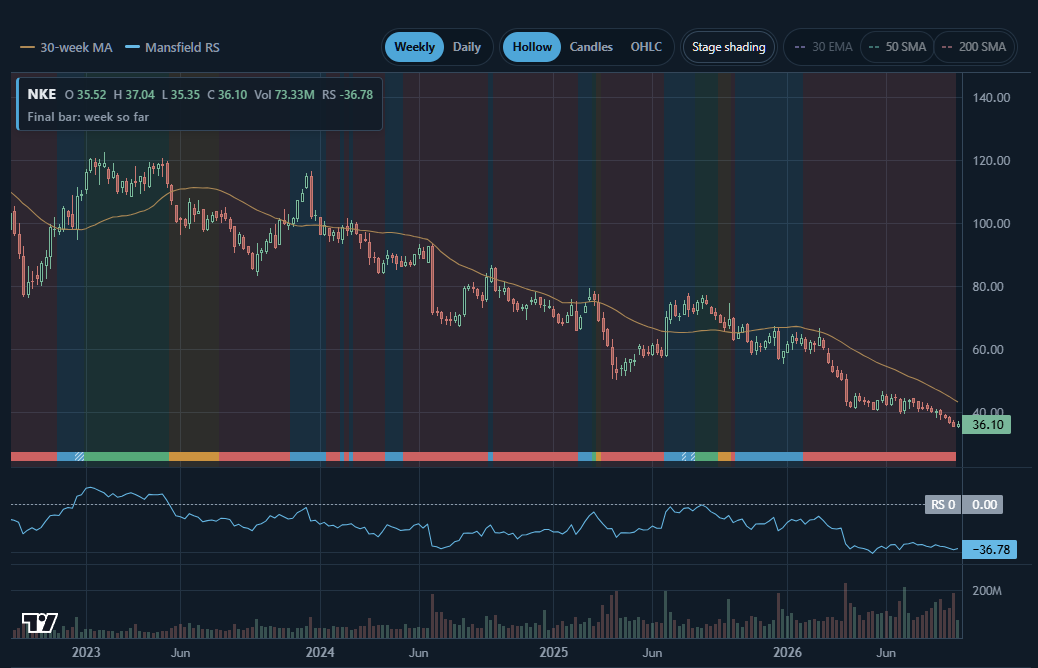
Look at this weekly chart since 2023. Stage shading tells the whole story:
- Peaked in Stage 2 (Advancing) near 120 in mid-2023
- Rolled into Stage 3 (Topping) as the 30-week MA flattened
- Has spent the overwhelming majority of the last 2+ years in Stage 4 (Declining)
- Currently sitting at 36.10, down roughly 70% from the highs
- Relative Strength (Mansfield RS): -36.78, deeply negative and making new lows alongside price
This is exactly the scenario stage analysis is built to protect you from.
A trend follower using stages doesn't ask "is this cheap yet" or try to call a bottom. They watch the stage. When a stock rolls from Stage 2 into Stage 3, that's the signal to start tightening up or exiting longs and not adding to them. Once it confirms Stage 4, new long positions are off the table entirely, no matter how "oversold" it looks on a bounce.
Our stage analysis platform gives you multiple ways to screen and scan for stocks in any stage.
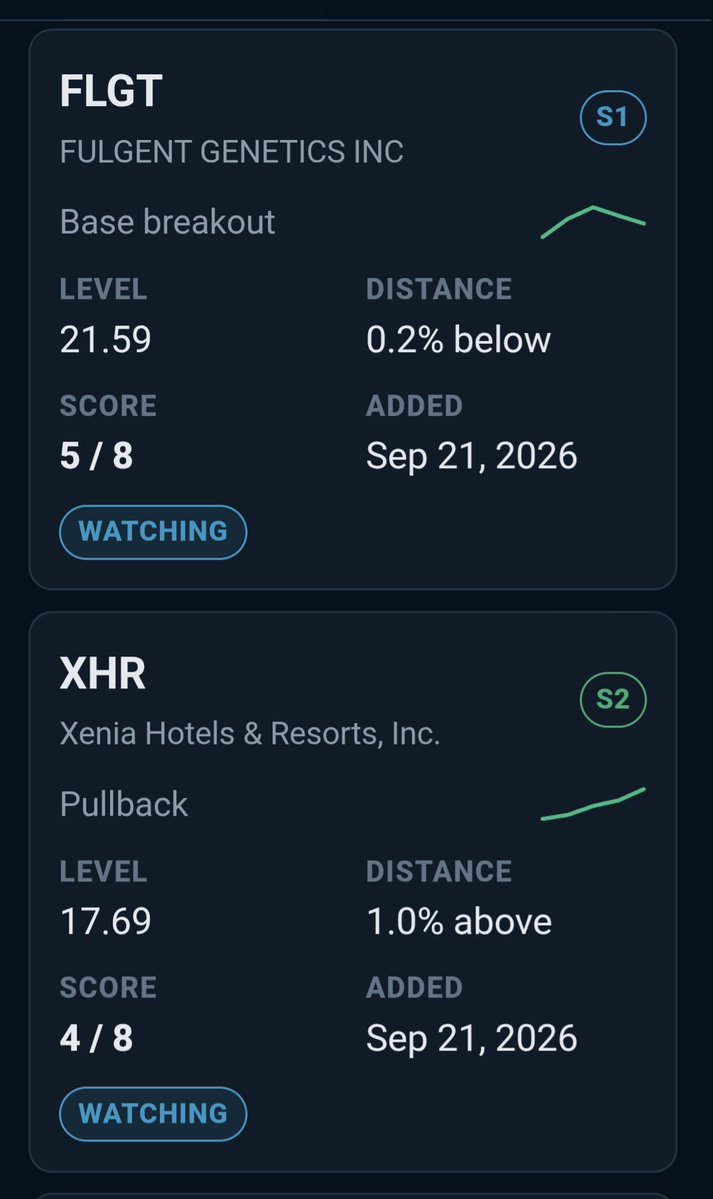
We recently added a "Setup" scan that runs each night, listing up to five stocks that are approaching a Stage-1-to-Stage-2 transition, or nearing a Stage 2 breakout or pullback entry.
Our Methodology scans offer similar filtering, but this new Setup scan is fully automated, it pulls in the top setups forming each night without you having to run a search.
No entries, no returns, and not recommendations.
$FLGT $XHR $RXRX $FORM $USPH
Even with the gap up in $SPY and $QQQ the market breadth was weak.
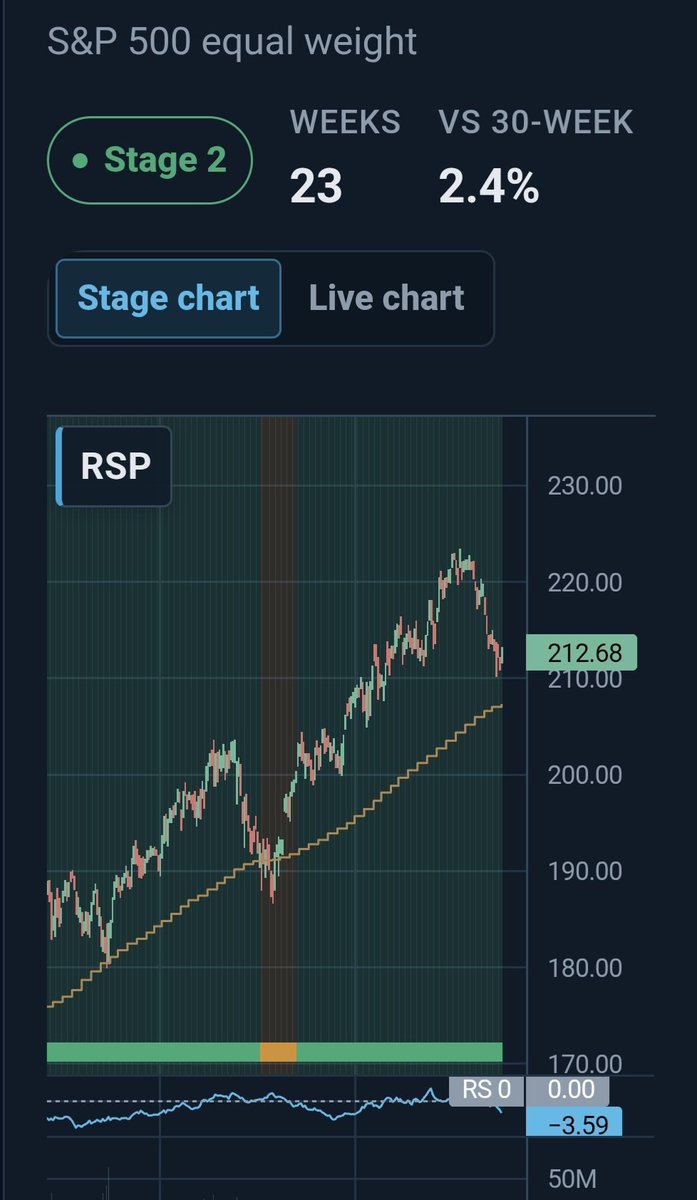
$RSP SP500 equal weight basically closed flat, showing the move was not across the board.
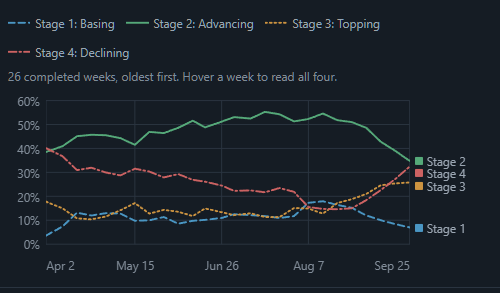
Stage 2 (advancing) stocks are still on the decline while more stocks move into Stage 3 (topping) and Stage 4 (declining).
New on AlphaMethodX: Setups.
Every evening it lists the five charts closest to the price their setup is waiting on, with the level and how far price still has to go. Use the screener or scans to screen for stage setups.
$USPH 0.6% below 82.94, $XHR 0.5% above 17.62, plus $FDX, $DDS and $AMPH.
Candidates, not recommendations.
Try it free, no credit card required. https://t.co/xMMqRBITXT
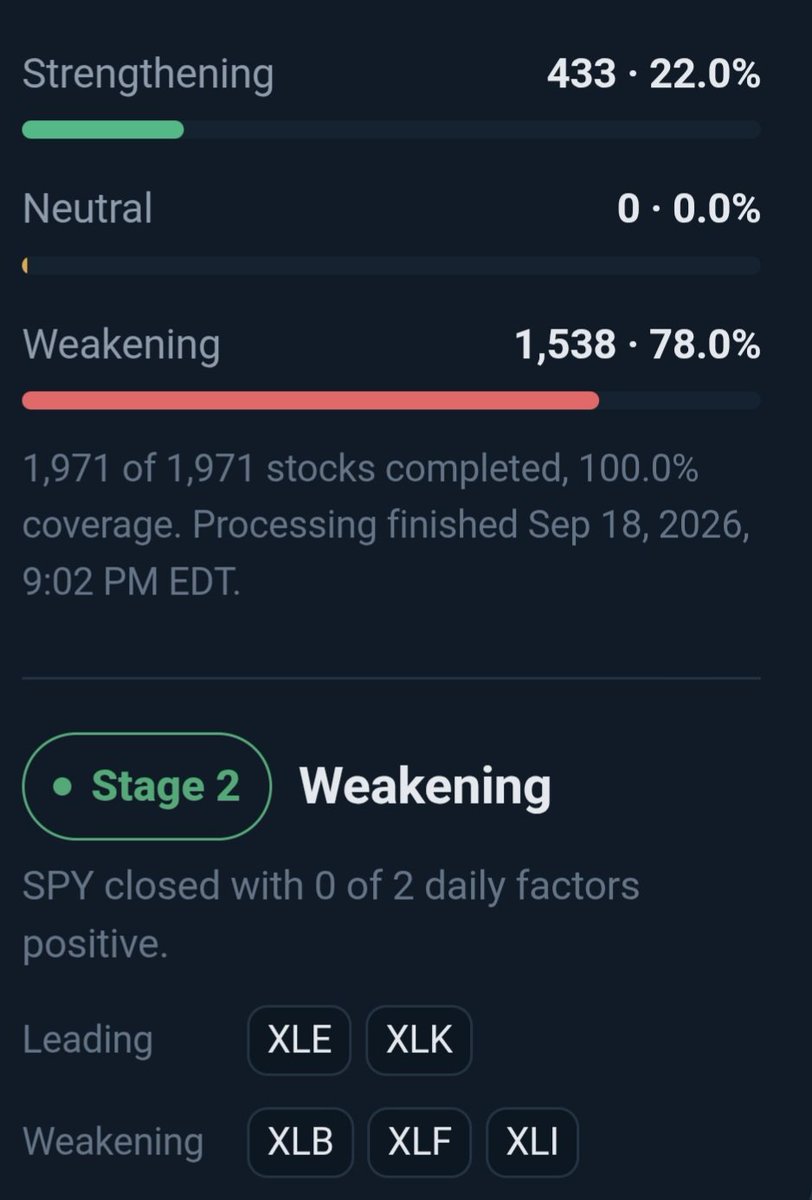
$SPY remains in its published weekly Stage 2 with a Stage Score of 6/6; its latest daily factors are weakening.
Weakening conditions covered 78.0% of the universe versus 22.0% strengthening. Daily factors were strongest in $XLE and $XLK and weakest in $XLB, $XLF, and $XLI.
Weinstein's requirement for a stock's group was that it should be strong. Not topping, not declining.
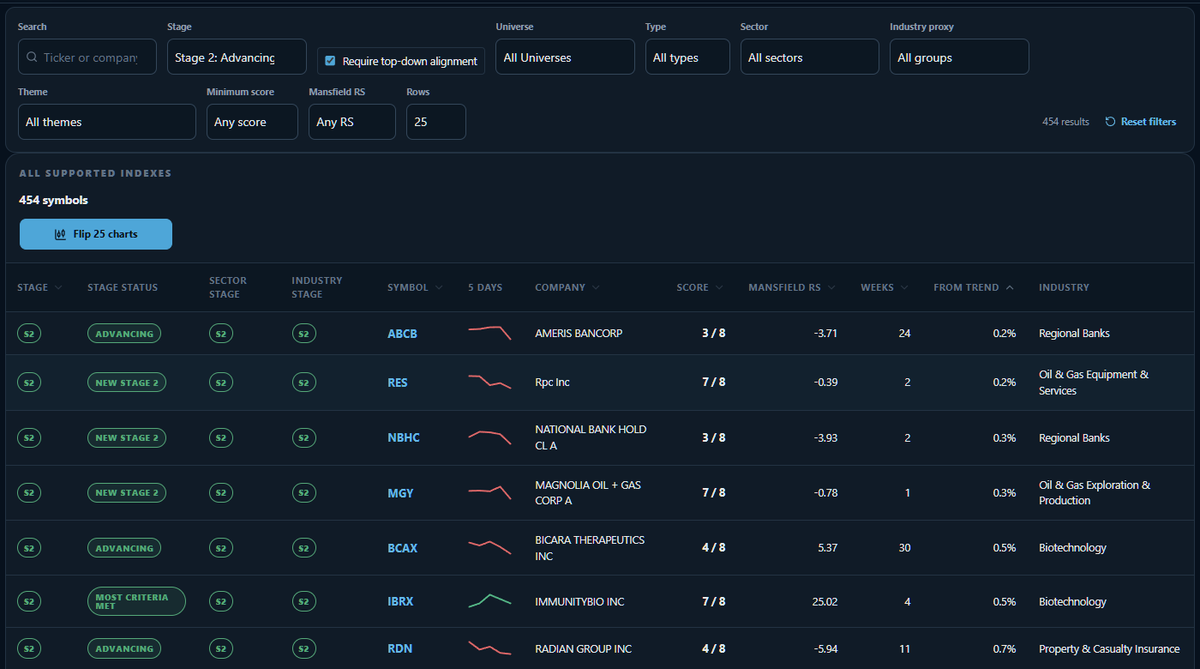
The screener now carries the Sector Stage and the Industry Stage beside every candidate, and filters to the rows where the market, sector and industry are all in Stage 2.
That full agreement is the best case Stan described.
Read More: https://t.co/WGEfkRcRO8
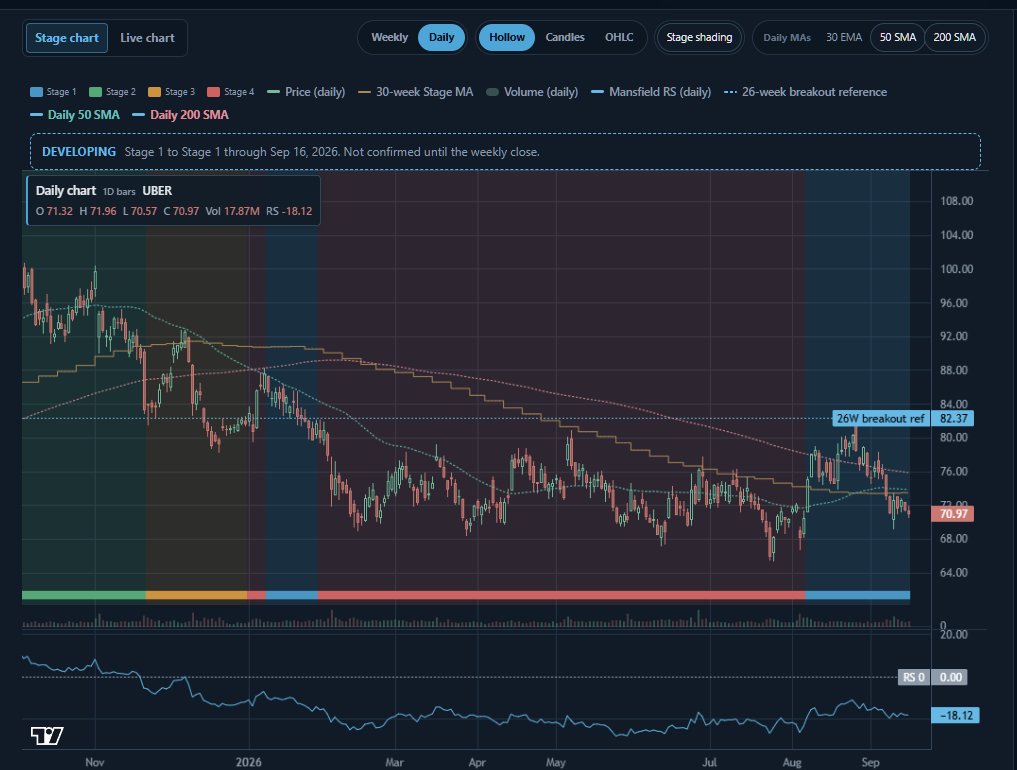
$UBER is currently developing Stage 1 (Basing), not confirmed until the weekly close.
The stock spent most of the year in Stage 4 (Declining) before this recent attempt to base out. Still needs to prove itself. Basing attempts can fail and roll back into Stage 4.
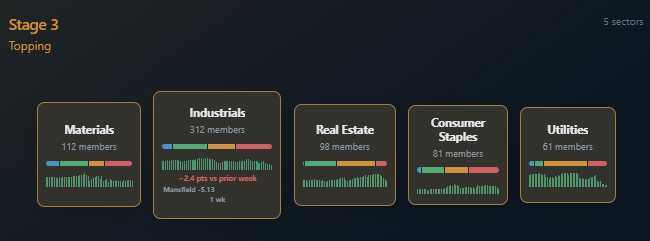
Stage analysis (Stan Weinstein) says it's best to buy strong names in strong sectors and industry groups. $UBER is in Stage 1, but sits under Industrials, which is in Stage 3 (Topping).
Stocks can outperform the sector they're in, but it's an uphill battle, you're fighting the tape instead of riding it.
Worth watching whether UBER can decouple from a topping sector, or whether sector headwinds cap the base before it ever confirms.
Everyone's watching $SPY and nobody's watching the 148 stocks that just left Stage 2 (advancing) for Stage 3 (topping) this week.
Price can grind higher on fewer and fewer leaders for a while. That's exactly how tops get built.
Why this matters more than the $SPY print: only 19.5% of 1,971 stocks score 7+. The median is 4.0. Fewer stocks earning "buy" scores even as more roll toward topping.
$SPY remains in its published weekly Stage 2 with a Stage Score of 6/6; its latest daily factors are weakening.
Weakening conditions covered 75.9% of the universe versus 24.2% strengthening. Daily factors were strongest in $XLC and weakest in $XLB, $XLF, and $XLI.