Should You Buy Microsoft?
This is one of the strongest, most predictable businesses in the market. It dominates enterprise software, prints cash, and keeps stacking new growth engines like cloud and AI on top of an already massive base. If you're looking for stability, scale, and long-term relevance, Microsoft checks every box.
But the stock already reflects all of that. It's priced for continued execution, not for surprises. There's no "value story" here, just a great company with a full price tag.
This is for investors who measure success in decades, not quarters. You're paying up to own the digital plumbing of modern business (cloud, Office, AI), knowing the valuation could cap near-term returns. If you're okay giving up some upside in exchange for business durability, Microsoft earns its spot in a long-term portfolio.
Read Research: https://t.co/A7ki6hQHlA
MSFT • Intrinsic Value
Microsoft's stock isn’t cheap. It trades well above its intrinsic value, and that premium reflects just how much investors trust the business. They're not just paying for stable revenue; they're paying for a future where Microsoft stays central to AI, cloud, and enterprise software for years to come.
To justify the price, Microsoft needs to keep executing across multiple fronts:
• AI features like Copilot must drive meaningful upsell.
• Azure must keep taking share from AWS and Google.
• And Microsoft 365 must remain the default for business productivity.
That's all achievable, but the price leaves little room for disappointment. You're not buying a turnaround story or a hidden gem. You're buying one of the most widely owned, well-run companies in the world, and paying up for the quality.
The risk isn't that the business fails. It's that it performs well… and the stock doesn't go anywhere.
Read Research: https://t.co/A7ki6hQHlA
MSFT • Long-Term View
This is a bet on Microsoft staying essential. Not flashy, not disruptive - just necessary. If the world keeps shifting toward cloud-based work, AI-powered tools, and tightly integrated systems, Microsoft keeps winning. It already powers company email, meetings, documents, files, and internal systems. If Microsoft keeps layering value into that system (like Copilot) customers won't want to leave, and revenue keeps compounding.
What Could Break the Story: The risk isn't a sudden collapse, it's erosion. If smarter AI-native tools steal attention, or if regulators force Microsoft to unbundle key services, the moat could shrink. Customers might start mixing vendors or moving to simpler tools with less lock-in. Microsoft doesn't need to fail; it just needs to fall behind. Long-term success depends on staying useful, improving fast enough, and making sure its system always feels like the easiest path forward.
Read Research: https://t.co/A7ki6hQHlA
Satya Nadella: The Architect of the Turnaround
When Satya Nadella became CEO in 2014, Microsoft looked like a company stuck in the past. Windows was fading, mobile had failed, and the future was unclear.
Nadella changed everything. He shifted the company's focus to the cloud, turned Office into a subscription, bet early on AI, and pushed Microsoft to be more open, partner-driven, and cloud-native. Today's Microsoft - cloud-first, AI-enabled, subscription-based - is a direct result of his leadership.
Microsoft's leadership isn't chasing fads or trying to be flashy. They've executed a clear, long-term strategy with discipline and turned one of tech's slow giants into a modern powerhouse. This is a team that knows how to build, scale, and allocate capital, and they've earned investor trust.
Read Research: https://t.co/A7ki6hQHlA
MSFT • Free Cash Flow
Free cash flow is the money a company keeps after running the business and reinvesting in things like servers, office space, and new products. It's what's left over to pay dividends, buy back stock, or invest in the future. For Microsoft, this number is massive, and that matters more than earnings on paper.
Microsoft's free cash flow is strong, stable, and deeply tied to how the business works. This isn't a company burning cash to grow. It's one that earns real money, reinvests wisely, and still has plenty left over.
Read Research: https://t.co/A7ki6hQHlA
MSFT • Growth Performance
Microsoft 365 (the company’s subscription for Word, Excel, Teams, Outlook, and more) keeps growing. New businesses are still signing up, but most of the growth now comes from selling more to existing customers. Microsoft does this by offering higher-tier plans, adding extra tools like security features, storage, and now AI-powered assistants. Once companies are inside the ecosystem, upgrading is easy, and that drives steady revenue growth.
Microsoft isn't chasing one big hit. It's growing by stacking new value - cloud, AI, gaming - on top of tools businesses already depend on. That makes its growth not just strong, but hard to disrupt.
Read Research: https://t.co/A7ki6hQHlA
MSFT • Positioning & Economic Moat
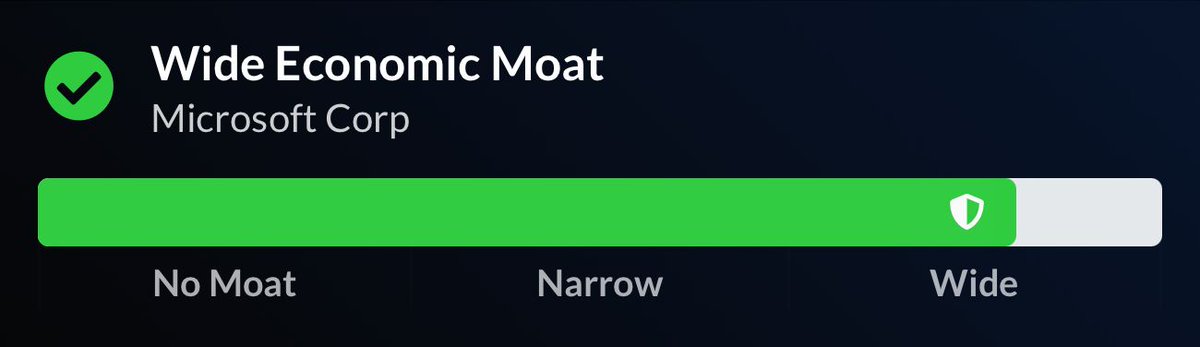
Microsoft has a wide economic moat, one of the strongest in big tech.
This moat is built on three things: switching costs, tight product integration, and network effects. Once a company starts using Microsoft, it rarely stops at just one tool, and the deeper it goes, the harder it is to leave. That gives Microsoft strong pricing power, sticky revenue, and long-term customer lock-in.
Microsoft wins by making its products work better together. The more you use, the harder it is to leave, and that’s the moat.
Read Research: https://t.co/A7ki6hQHlA
MSFT • Competitive Landscape
Microsoft doesn't compete with one company, it competes with many of the biggest tech giants across different markets. Each one is strong in its own category. But what makes Microsoft different is that it connects everything into one system, while most of its rivals focus on a single layer.
Most competitors beat Microsoft in one slice of the market. Google has strong search. AWS leads in cloud. But Microsoft connects it all - productivity, cloud, AI, and developer tools - into a single experience that's hard to match and even harder to rip out. It's not about winning every fight. It's about owning the system everything plugs into.
Read Research: https://t.co/A7ki6hQHlA
MSFT • What Bears and Bulls Say?
BEAR Theses:
Valuation leaves little room for stumbles. The stock already prices in near-perfect execution; even solid results could disappoint if growth or AI adoption slows.
BULL Theses:
Deep, sticky ecosystem drives recurring cash. Microsoft 365, Azure, LinkedIn, and Xbox/Game Pass reinforce one another, making it painful for customers to leave and allowing steady price increases.
Read Research: https://t.co/A7ki6hQHlA
MSFT • Competitive Landscape
Microsoft doesn't compete with one company, it competes with many of the biggest tech giants across different markets. Each one is strong in its own category. But what makes Microsoft different is that it connects everything into one system, while most of its rivals focus on a single layer.
Most competitors beat Microsoft in one slice of the market. Google has strong search. AWS leads in cloud. But Microsoft connects it all - productivity, cloud, AI, and developer tools - into a single experience that's hard to match and even harder to rip out. It's not about winning every fight. It's about owning the system everything plugs into. Read Research
Read Research: https://t.co/A7ki6hQHlA
A business that rarely misses, and rarely comes cheap
Microsoft is strong in all the right places: cloud, business software, and AI. The company has a real advantage, strong leadership, and a strategy that builds momentum over time. But the stock price already expects near-perfect results. If everything goes right, that may be fine. If not, there is little room for mistakes. This is a great business, but it only makes sense if you are thinking long term and willing to be patient.
Should You Buy Nike?
Nike is a world-class brand stuck in a rebuild: inventory misfires, muted product launches, and hungry competitors nipping at its heels. The stock price already assumes management will fix the basics - leaner inventory, hotter releases, a China rebound - and get growth compounding again.
If that reset works, investors regain a high-margin cash machine. If it drags, you're left with a great name delivering only average returns.
• Suits patient holders who trust Nike's brand power and believe the product engine will click back into gear.
• Works for those comfortable paying a premium for durability, not for bargain hunters chasing deep value.
Read Research: https://t.co/hjeYAXk40j
NKE • Free Cash Flow
Free cash flow is the money left after a company pays its bills and reinvests to stay competitive. It shows how much real cash Nike can spend on growth, dividends, or buying back its own stock.
Nike doesn't hold onto its cash for long; it actively puts it to use. Some of it goes back into the business, paying for new stores, digital upgrades, and better logistics. The rest returns to shareholders through regular dividends and share buybacks, which help increase the value of the remaining shares.
This balance makes sense, but only works smoothly if Nike keeps cash flowing steadily. To avoid big swings, Nike needs disciplined planning, making the right amount of product at the right time, without overshooting demand.
Read Research: https://t.co/hjeYAXk40j
NKE • Margins & Profitability
Nike remains a high-margin business by industry standards, but cracks are showing. What used to be a clean, efficient engine is now sputtering under inventory bloat, discounting, and strategic complexity.
Nike has historically delivered excellent return on invested capital - a key reason investors were willing to pay a premium. But that edge is fading. Slower growth, weaker margins, and rising investment have pulled ROIC down to more average levels.
This isn't permanent, but it's not a blip. To rebuild capital efficiency, Nike needs more than cost cuts. It needs products that sell at full price, cleaner inventory, and a business model that scales profitably again. The brand is still strong. But right now, the economic behind it is not.
Read Research: https://t.co/hjeYAXk40j
NKE • Growth Performance
Nike isn’t just growing slower - it's shrinking. And not because of a pandemic hangover or one bad quarter. The brand is under real pressure, and the drivers of that pressure are structural: shifting consumer behavior, stronger competitors, and strategic missteps. For a company that once set the pace for the entire industry, the momentum has clearly reversed.
What once worked no longer does. China, Nike's most important growth market, is now a liability: Local champions like Anta and Li-Ning are winning with speed, pricing, and cultural fit. Meanwhile, in performance categories like running, Nike is losing relevance to fresher, more focused brands like On and Hoka. Even longtime strengths like Jordan and Air Max feel overplayed in North America.
Nike's direct-to-consumer push, once hailed as a margin savior, has stumbled. Pulling back from wholesale left gaps on shelves, and digital hasn't scaled as smoothly as expected. The brand still dominates shelves, but not the cultural conversation.
Read Research: https://t.co/hjeYAXk40j
The Comeback CEO
Elliott Hill returned as President and CEO in October 2024 - a notable move. Hill spent decades inside Nike, led global categories, and previously oversaw product, marketing, and retail. He retired before John Donahoe took over in 2020, but was brought back when the board decided the company needed sharper product focus and deeper brand instinct.
Hill is seen as a Nike insider with credibility in sport, not just systems. His return signals a shift away from tech-first thinking and back toward product, athletes, and cultural leadership - the core of what built Nike.
Read Research: https://t.co/hjeYAXk40j
NKE • Positioning & Economic Moat
Nike's edge comes from three places: brand, scale, and habit. The Swoosh is recognized globally and associated with performance and cool. Its supply chain and retail network are massive. And millions of customers are used to buying Nike, again and again.
But this moat isn't bulletproof. Consumers are more price-sensitive, more trend-driven, and more open to trying new brands. Nike's direct relationships with customers (through its apps and membership program) help deepen loyalty, but if it stops innovating or misreads culture, others are ready to move in.
Read Research: https://t.co/hjeYAXk40j