ScopeGuard OS a client portal and internal agency workspace built with @Base44 for the #Base44Challenge .
Most scope creep happens because signed contracts stay in static PDFs while clients request extra features in chat threads. ScopeGuard OS connects signed contract clauses directly to the client portal, operations board, and billing ledger.
Core workflows in the live app:
•Agency Command Center: Tracks revenue protected from out-of-scope requests, admin hours saved, active client portals, and live billing status.
• Contract Scope Rules Editor: Runs a vulnerability audit on contract clauses to flag missing revision limits or vague scope terms, with adjustable strictness levels (Relaxed, Balanced, Strict).
• Client Portal & Scope Check: Compares incoming client requests against signed clauses in real time and gives three resolution options: Full Scope Change Order, a 50% Lite MVP alternative, or Defer to Phase 2 at $0.
•Automated Invoicing: Approving a change order updates the project budget, creates a delivery card on the board, and generates a printable invoice receipt that can be settled in one click.
• Public Quote Builder: Converts a one-sentence project brief into a scoped freelance estimate ($280–$1,450 range) and milestone roadmap, persisted in real time on Base44 Cloud DB.
Live app: https://t.co/zgytdlYLgI
GEN Airdrop Registration is open.
You've been building GenLayer with us since the start. Now it's time to register.
Open until Monday, October 26.
https://t.co/vgzh2EIjtV
While reading @kstellana recent Blockchain Reporter interview on building the adjudication layer for AI agents, the connection between Q5, Q6, and Q7 really caught my attention.
As a builder developing an AI powered escrow marketplace on @GenLayer I visualized how Optimistic Democracy handles subjective disputes at machine speed see animation!
My Question for Albert:
In high frequency agentic commerce involving micro-transactions (e.g a $5 API task) how will GenLayer prevent "economic griefing"? If a wealthier agent intentionally triggers multi-round appeals where the cost of summoning larger validator committees exceeds the micro escrow value itself, how do we ensure small agents aren't priced out of fair adjudication?
Would love to hear your perspective on balancing appeal committee costs with micro transaction economics!
LEASH Protocol v1.0 is now live on @GenLayer Studio Next.
After our initial Agent Tank release, I upgraded the ERC-7710 AI Agent Security Command Center from a basic binary kill switch into a full on-chain policy and adjudication engine.
What is new in Milestone v1.0:
1. Dynamic Policy Updates: Operators can now update agent mandates, spend caps, and deadlines on-chain in real time across DeFi, DAO treasury, AI compute, and commerce workflows.
2. 3-Tier Validator Adjudication: Instead of only CONTINUE or REVOKE, the GenLayer LLM validator jury now outputs a 0-100 risk score and enforces a graduated THROTTLE state that automatically cuts the agent's spend cap by 50% on soft policy drift.
3. Anti-Prompt Injection Shield: The contract inspects untrusted receipt context for jailbreak attempts trying to override mandate rules, immediately firing the kill switch on detection.
4. AI-Reviewed Appeals & Audit Proofs: Added validator-evaluated appeal justifications, a full on-chain audit history log, and downloadable JSON audit proofs.
What happens when an autonomous AI agent goes rogue with your money? 🚨
I just shipped LEASH for the @GenLayer AgentTank Hackathon! It’s a production-ready ERC-7710 Security Command Center to keep AI agents in check.
Core Features:
• Live AI Jury & Threat Scoring
• Time-bound Deadlines
• Destination Whitelisting
• 1-Click EMERGENCY FREEZE (Manual Kill Switch)
Don't trust agents blindly. Put them on a LEASH.
What if your online meeting room could transcribe every word in real time and generate 1-click bilingual summaries automatically?
Meet dSpaces our next-gen decentralized AI video conferencing concept created for #TheWorldsCatchiestAd competition:
° Solana Mainnet (SIWS) Auth & 1-Click Instant Private Rooms
° Decentralized dTelecom & LiveKit WebRTC with Hack-Proof Host Control
° Google Gemini Live AI Voice Agent with Zero-Lag Auto-Detect Transcription
° Instant Bilingual Meeting Summaries in English & multiple language's
Turn up the volume for our original dSpaces jingle made with @ElevenCreative !
#TheWorldsCatchiestAd #ElevenCreativeCompetitionVol1 @ElevenCreative@ElevenLabs
Gemini 4 Argon is rolling out in Antigravity.
Gemini 4 Argon Subscription Eligibility
✅ Available
- Google AI Pro (Paid, non-trial)
- Google AI Ultra
- Eligible Gemini Enterprise plans
❌ Not Available
- Free
- Google AI Plus
- Google AI Pro Trial
Available in the app, CLI & IDE extensions—not Antigravity IDE. Pro has a separate weekly quota.
We’re rolling out Gemini 4 Argon in Antigravity to paid Google AI Pro subscribers today. Demand has been incredible and we've scaled capacity deliberately to get here. We’ve rolled out a separate weekly-only Argon quota for Pro on top of the existing Gemini bucket for 3.8 Flash so you have the best of Gemini for all your tasks.
@mdqmatias According to Google's official documentation, Gemini 4 Argon is currently unavailable in Antigravity IDE, but it is supported in the Antigravity app, CLI, and IDE extensions. Google hasn't publicly specified the reason for this limitation.
Official docs: https://t.co/FzBRFFtJF4
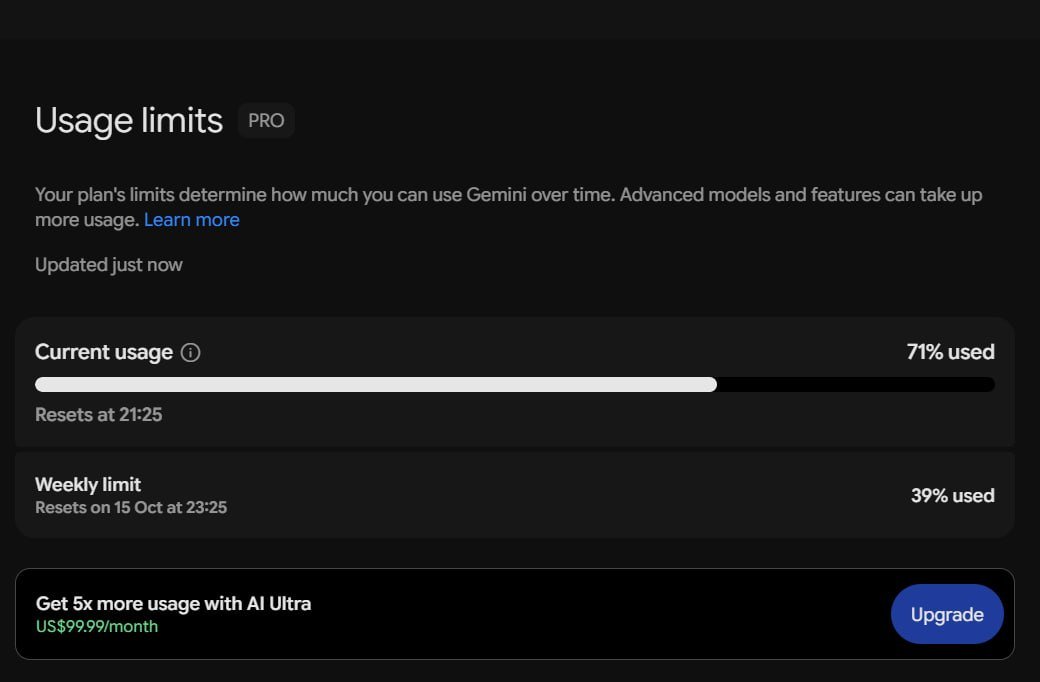
Gemini 4 Argon High is powerful, but what’s the point of having a frontier model if usage limits prevent you from completing real work?
After just 4 prompts, my @GeminiApp AI Pro account shows 71% of current usage consumed and 39% of the weekly limit used.
At this point, Argon feels more like a limited preview than a genuinely practical benefit for Pro subscribers.
And there’s another concern: API pricing is set to double on December 1.
@Google needs to address usage limits and make Argon genuinely usable for end-to-end work not just give subscribers access to a model they can barely use.
Gemini 4 Argon just landed in the Gemini app, but Antigravity doesn't have it yet
@Google just released 4 Argon and I've been using it in the @GeminiApp app (High thinking level) since last night. First impressions: smooth and accurate. On complex tasks, both the reasoning and the response quality stood out.
But as a developer, my real workflow lives in the Antigravity IDE, and Argon doesn't appear in the model picker there. From what I can see, it's currently available only to Ultra plan users.
I'm a Google AI Pro subscriber, so I can use this model in the app but not in my coding environment. That gap is frustrating, because an IDE is exactly where a model like this adds the most value.
A few thoughts:
→ Rolling out a flagship model to Ultra first is a reasonable strategy, but a clear timeline (or limited access) for Pro users would go a long way
→ The coding workflow is where Argon's strengths would matter most
I hope Google brings Argon to Antigravity on the Pro plan soon.
@OfficialLoganK
Finally got the new @GeminiApp UI on my account.
Now you pick the model (Flash-Lite, Flash, Pro) and the thinking level (Low, Medium, High) separately. More control, less guessing.
Running 3.1 Pro on High for now. Will see how it holds up.
But I'm still waiting for Gemini 4 Argon.
Finally, ads have arrived in @ChatGPT 😂
Soon, we might need a premium subscription just to escape ads.
Now imagine ads coming to Claude Code, Terminal & VS Code 💀
You tell your AI to build an app, and it starts coding… then suddenly:
“Before continuing, here’s a message from our sponsor.”
Finally got the new @GeminiApp UI on my account.
Now you pick the model (Flash-Lite, Flash, Pro) and the thinking level (Low, Medium, High) separately. More control, less guessing.
Running 3.1 Pro on High for now. Will see how it holds up.
But I'm still waiting for Gemini 4 Argon.
Is @GeminiApp 4 Argon actually coming today? 👀
The hype is getting crazy, but the real question is: will it actually be that powerful?
From what @Google has shared, the main focus seems to be deep reasoning, long-horizon coding/software engineering, cybersecurity, and complex research/workflows with a 1M-token context.
If the real-world performance matches the hype, this could be a serious upgrade.
What do you think what will Argon be best at in real-world use?