🔢 A Sandia computer scientist formulated a way to check the basic building blocks of modern computing, opening the door to more precise arithmetic from computers.
Read more about his work with @NASA: https://t.co/AizttJAg1O
Researchers, including a team from MIT, created a new algorithmic approach that pinpoints the minimum dataset required for optimal solutions, frequently needing much less data than standard techniques assume.
tells you the smallest set of measurements needed to guarantee the exact best decision.
The big deal is that it turns “how much data do we need” into a provable design problem, so you can measure only what can change the optimal choice and still get certainty.
challenges the usual habit of collecting lots of data to estimate everything, since the method only targets the information needed to separate competing optimal solutions.
The research gives a guarantee, because it is not an average-case or best-effort claim, it is a mathematical proof that the chosen small dataset is enough.
It matters so much because in settings like routing, supply chains, and power grids, each measurement can be expensive, slow, or risky, and this gives a principled stop rule.
---
news. mit .edu/2025/bigger-datasets-arent-always-better-1118
1/ We found that deep sequence models memorize atomic facts "geometrically" -- not as an associative lookup table as often imagined.
This opens up practical questions on reasoning/memory/discovery, and also poses a theoretical "memorization puzzle."
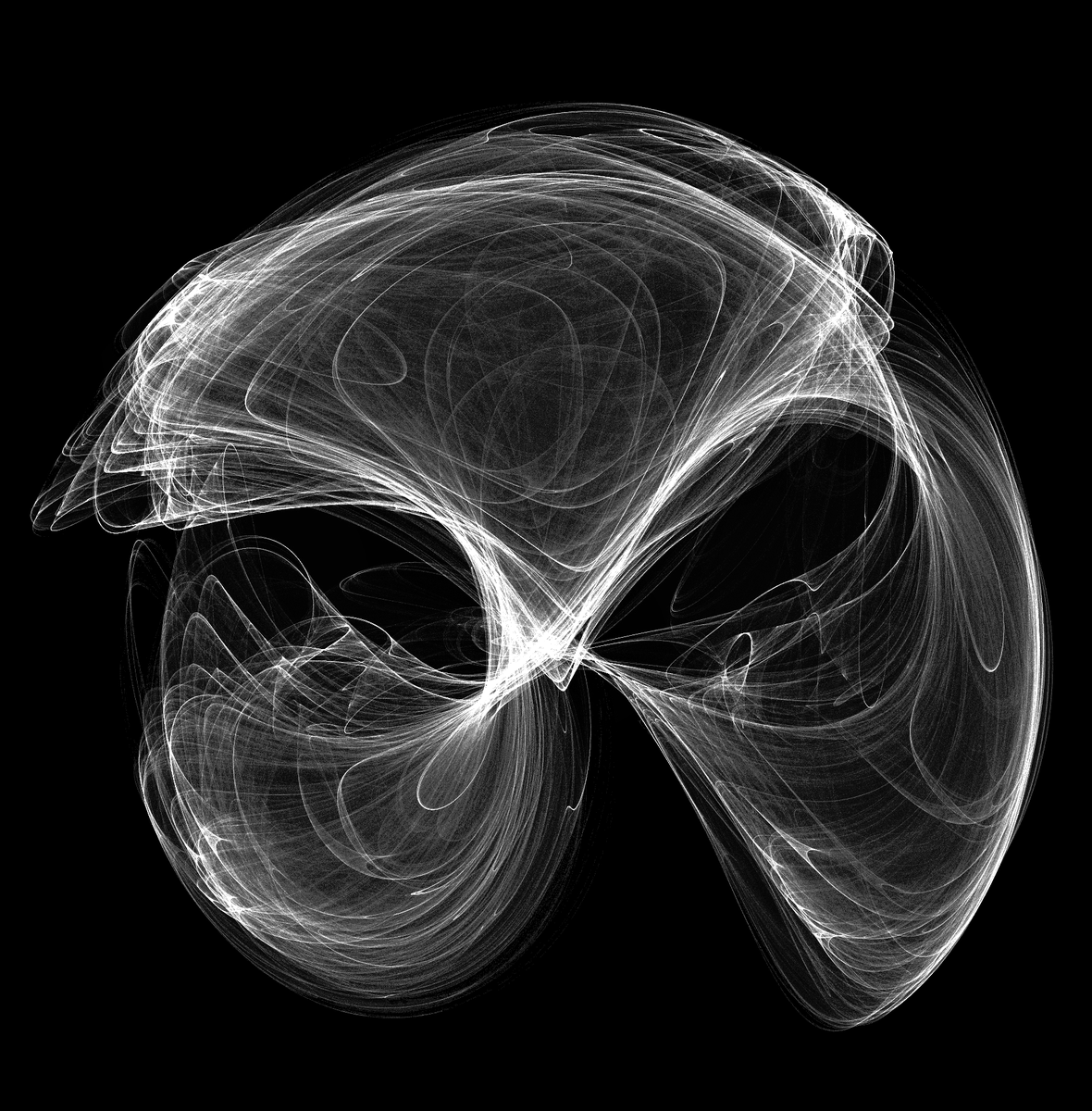
Mathematics, Chaos, Geometry. These are called "Clifford Attractors."
Whispers of Chaotic Smoke. Vortex of Infinite Particles. Fractal Ghost from Equations.
By Andrea Belloni, @Waterflowing0, https://t.co/h54JbEFkur, Used with permission
Generated by simple, iterative equations involving sine and cosine functions, creating intricate, self-similar shapes. It attracts points to a complex pattern but never repeats exactly, resulting in beautiful, dream-like designs whose specific forms depend on four chosen parameters (a, b, c, d).
Fusion of 𝗥𝗔𝗚 (Retrieval Augmented Generation) and 𝗖𝗔𝗚 (Cache Augmented Generation). How can you benefit from it as AI Engineer?
Let’s see what it looks like and what additional considerations should be taken into account.
Here are example steps to implement CAG + RAG architecture:
𝘋𝘢𝘵𝘢 𝘗𝘳𝘦𝘱𝘳𝘰𝘤𝘦𝘴𝘴𝘪𝘯𝘨:
𝟭. We use only rarely changing data sources for Cache Augmented Generation. On top of the requirement of data changing rarely we should also think about which of the sources are often hit by relevant queries. Once we have this information, only then we pre-compute all of this selected data into a KV Cache of the LLM. Cache it in memory. This only needs to be done once, the following steps can be run multiple times without recomputing the initial cache.
𝟮. For RAG, if necessary, precompute and store vector embeddings in a compatible database to be searched later in step 4. Sometimes simpler data types are enough for RAG, a regular database might suffice.
𝘘𝘶𝘦𝘳𝘺 𝘗𝘢𝘵𝘩:
We can now utilise the preprocessed data.
𝟯. Compose a prompt including user query and the system prompt with instructions on how cached context and retrieved external context should be used by the LLM.
𝟰. Embed a user query to be used for semantic search via vector DBs and query the context store to retrieve relevant data. If semantic search is not required, query other sources, like real time databases or web.
𝟱. Enrich the final prompt with external context retrieved in step 4.
𝟲. Return the final answer to the user.
𝘚𝘰𝘮𝘦 𝘊𝘰𝘯𝘴𝘪𝘥𝘦𝘳𝘢𝘵𝘪𝘰𝘯𝘴:
➡️ Context window is not infinite and even while some models boast enormous context window sizes, the needle in the haystack problem has not yet been solved so use available context wisely and cache only the data you really need.
✅ For some business cases, specific datasets are extremely valuable to be passed to the model as cache. Think about an assistant that has to always comply with a lengthy set of internal rules stored in multiple documents.
✅ While CAG has been popularised for Open Source just recently, it is already viable for some time via Prompt Caching features in OpenAI and Anthropic APIs. It is really easy to start prototyping there.
✅ You should always separate hot and cold data sources, only use cold (data that changes rarely) in your cache, otherwise the data will go stale and the application will go out of sync.
❌ Be very careful about what you cache as the data will be available for all users to query.
❌ It is very hard to ensure RBAC for cached data unless you have a separate model with its own cache per role.
Learn how to apply the technique in my End-to-end AI Engineering Bootcamp. Next cohort kicking off on January 12th: https://t.co/gWBu8OLTzn
🎁 Code LASTCHANCE for 10% off.
Mathematics, Physics.
This is Dr. Matthew Henderson's (@matthen2) animation modeling a lightning strike by finding the shortest path in a random maze, first by sending out a frontier through the maze — and then tracing it back. (Used with permission)
Eigenvectors of the Laplacian on compact planar domains define an orthogonal basis of oscillating functions, which generalize Fourier sinusoids. https://t.co/uEUf57RqXV
Homology is a fundamental concept in algebraic topology. It allows you to quantify how many holes a space has.
When I first learned it, however, it was very mystifying. It took me years to understand the intuitions behind it. In this thread, I wanted to share this intuition at a very high level.
Homology, a very short primer - a 🧵
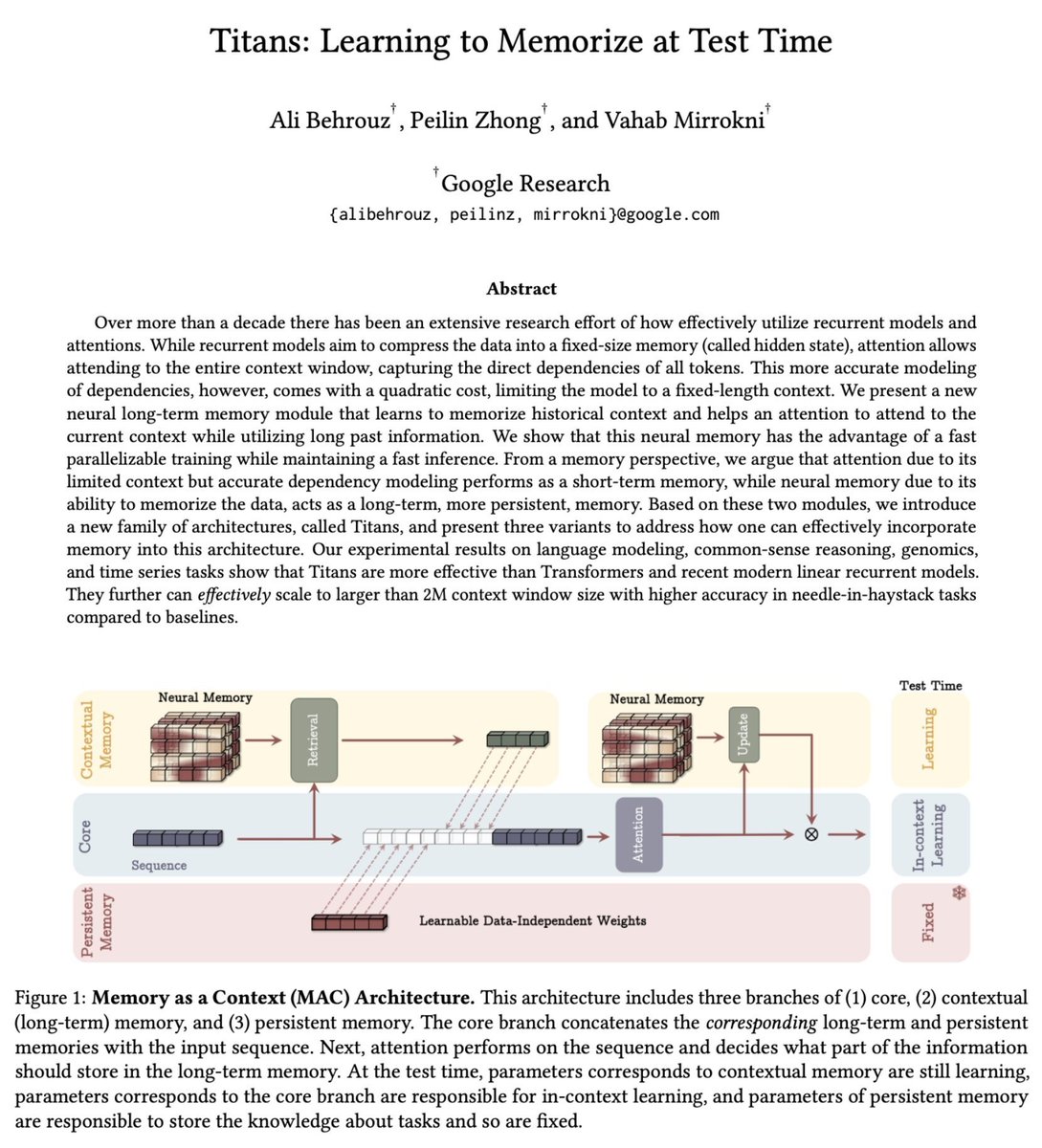
This can be big. Google unveils the successor to the Transformer architecture
"We present a new neural long term memory module that learns to memorize historical context and helps an attention to attend to the current context while utilizing long past information. We show that this neural memory has the advantage of a fast parallelizable training while maintaining a fast inference."
"From a memory perspective, we argue that attention due to its limited context but accurate dependency modeling performs as a short term memory, while neural memory due to its ability to memorize the data, acts as a long-term, more persistent, memory. Based on these two modules, we introduce a new family of architectures, called Titans, and present three variants to address how one can effectively incorporate memory into this architecture."
"Our experimental results on language modeling, common sense reasoning, genomics, and time series tasks show that Titans are more effective than Transformers and recent modern linear recurrent models."
"They further can effectively scale to larger than 2M context window size with higher accuracy in needle in haystack tasks compared to baselines."
Today in @Nature: Our MatterGen model represents a paradigm shift in materials design, applying generative AI to create new compounds with specific properties with unprecedented precision.
Introducing AlphaQubit: our AI-based system that can more accurately identify errors inside quantum computers. 🖥️⚡
This research is a joint venture with @GoogleQuantumAI, published today in @Nature → https://t.co/AtbWuddxxe
What happens if your CPU gets something wrong? If it wakes up one day and decides 2+2=5?
Well, most of us will never have to worry about that. But if you work at a company the size of Google, you do, which is why this paper on "mercurial cores" is so fascinating.
What the authors report--and supposedly this is common knowledge at the hyperscalers--is that a couple cores per several thousand machines are "mercurial." Due to subtle manufacturing defects or old age, they give wrong answers for certain instructions. These can cause all sorts of impossible-to-diagnose issues. Some rare problems at Google that were traced back to bad CPUs include:
- Mutexes not working, causing application crashes
- Silent data corruption
- Garbage collectors targeting live memory, causing application crashes
- Kernel state corruption causing kernel panics
What makes CPUs go bad? It's very hard to tell. The authors posit that issues are becoming more frequent as CPUs get more complex, but there aren't solid numbers behind that. There are certainly strong relationships between frequency, temperature, voltage, and bad CPU behavior--most mercurial CPUs only cause problems under very specific conditions, but those conditions vary from CPU to CPU. Age is another source of problems, as older CPUs are more likely to exhibit problems.
Bad CPUs are an especially serious problem because they're very hard to detect. If cosmic rays flip bits in storage or on the network, that can be detected through error coding. But there's no analogy for a CPU that allows cheap online verification of its correctness. Instead, the best detection techniques involve monitoring for symptoms. If a core exhibits exceptionally high rates of process crashes or kernel panics relative to its fellows, that's a strong indication something is wrong with it. For the most critical applications, the authors propose triple modular redundancy--redoing each of its computations on three cores and majority-voting a reliable result.
More than anything, this paper is a call to action--letting everyone know that CPUs can fail. So now, if you ever find a bug you can't diagnose, you can blame the CPU! 🙂