THE OBSIDIAN GRAPH IS NOT A PRETTY NOTE MAP, IT IS A SELF-MAINTAINING AI WIKI THAT CAN TURN 120 SAVED SOURCES INTO 700 LINKED PAGES WHILE YOU ONLY KEEP ADDING NEW MATERIAL
00:11 the graph opens and the trick becomes obvious: every dot is a saved idea, every cluster is a topic, and every line is context the AI no longer has to rebuild from scratch every morning
most people use chatgpt like a disposable memory slot. they upload 1 pdf, ask 3 questions, close the tab, and the next day the model knows nothing unless they feed it the same context again
karpathy’s LLM wiki pattern changes the game. the model reads each new source, pulls out claims, updates old pages, creates entity files, links concepts, and marks places where newer info breaks older notes
with claude code and obsidian, a single clipped article can expand into 8-20 markdown files: source summary, concept pages, people, tools, comparisons, open questions, and a running index
after 60 sources, this is no longer “note taking.” it becomes a private research machine that remembers your old thinking, catches repeated angles, and gives you cited answers from your own archive
bookmark this before your notes turn into a graveyard again
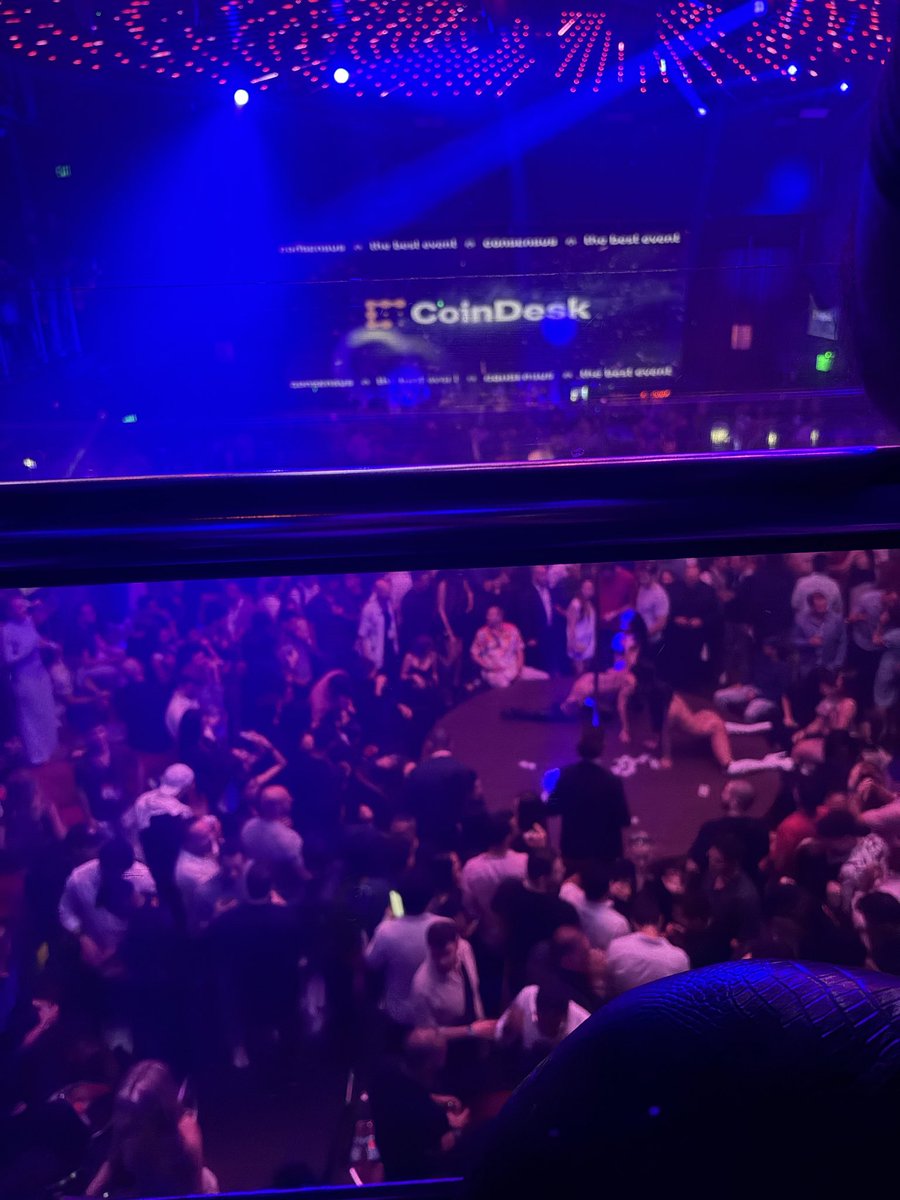
1/ This year’s official @consensus2026 closing party by @CoinDesk was a massive step backward. Hosting the flagship event at E11even — a strip club — wasn't just inappropriate; it was incredibly low-brow for an industry trying to grow up.
2/ Let’s be clear: I’m all for alcohol, music, and a good time. Hire a world-class DJ. Throw a massive rave. Go to Club Space. But choosing a strip club as the official venue for a global conference is a choice that reflects poorly on all of us.
3/ Just because this happened in 2021 doesn't mean it should happen in 2026. Back then, Coinbase, FTX and Binance execs were there, but the industry has evolved. We are supposed to be moving toward institutional maturity, not leaning into "bro-culture" clichés.
4/ I’ve always been an advocate for sex work. I have zero issue with women making $40k–$80k on their own terms. The issue is the context.
5/ When an official event for a top-tier conference — filled with institutional partners and people of all genders and religions — centres on women shaking for dollars, it diminishes women to sexual objects and enforces a stale, exclusionary culture.
6/ It’s honestly boring. I guarantee brands like @MetaMask and CoinDesk will one day look back at their logos plastered on those walls with genuine embarrassment.
7/ We had international attendees flying in from across the globe. Is this really the best US crypto has to offer? Working the pole is a skill, but watching it in a professional context just left most people looking dazed and awkward.
8/ The vibe was off. I ran into my banker and some mid-tier hedge fund guys there. We can talk millions on Wall Street or over steak, but meeting at a strip club is unnecessary. We could’ve hit a polo club, a baseball box, or played padel.
9/ Even the economics were a "bear market" vibe. Most people were just watching with a mix of shock and intrigue. The girls weren't making much. They used to take crypto; now they don't. The floor was dry. No fiat moving. Why were we even there?
10/ Seeing a banker film the stage (until security stepped in) while seeing my bankers logos walk around in a strip club is the peak of industry cognitive dissonance.
11/ This industry is capable of so much more, yet we keep tripping over our own feet. We want to be taken seriously on the world stage, but we’re still acting like we’re in a basement. We must do better.
Special shoutout to @SolanaFndn, @amystreet, and @SuperteamUSA. Your Accelerate vibe was immaculate, paired with the best Mario Kart-themed afterparty. 🏎️💨
It was the perfect illustration that "crypto culture" doesn’t have to mean "bro culture." You can have high-energy, high-intelligence fun without… whatever E11even was.
Let’s talk economics: A single sponsorship for that E11even event costed roughly $90k. The entire Mario Kart event? Maybe $50k. Using a massive brand budget to alienate half your audience is a spectacular waste of capital.
📣📣📣
Conference organizers and sponsors: we have to do better. If we want to move millions on Wall Street, we need to stop acting like we belong in a basement. ✌️
TWO MISSILES HIT US WARSHIP AFTER IGNORING IRAN WARNINGS
Here are the details:
Two missiles reportedly struck a US warship after it continued operations despite Iranian warnings.
Markets reacted immediately as crude oil surged 4.5% in just 3 hours.
This comes right after Trump announced “Project Freedom”.
This is a US-led mission to escort ships through the Strait of Hormuz.
The operation includes:
- US destroyers and aircraft
- Around 15,000 troops
- Coordinated safe navigation lanes for commercial vessels
Iran is calling this a violation of the ceasefire.
And today’s strike appears to be a direct response.
After issuing warnings, Iran escalated with force.
Now, the Strait of Hormuz is back at the center of global risk.
Higgsfield MCP now connects to Claude! 🧩
The first way to generate visuals on Claude, powered by Seedance 2.0, GPT Images 2.0, Marketing Studio and Cinema Studio.
Research on Claude. Polish your prompts. Generate ads, videos and brand content via the Higgsfield connector.
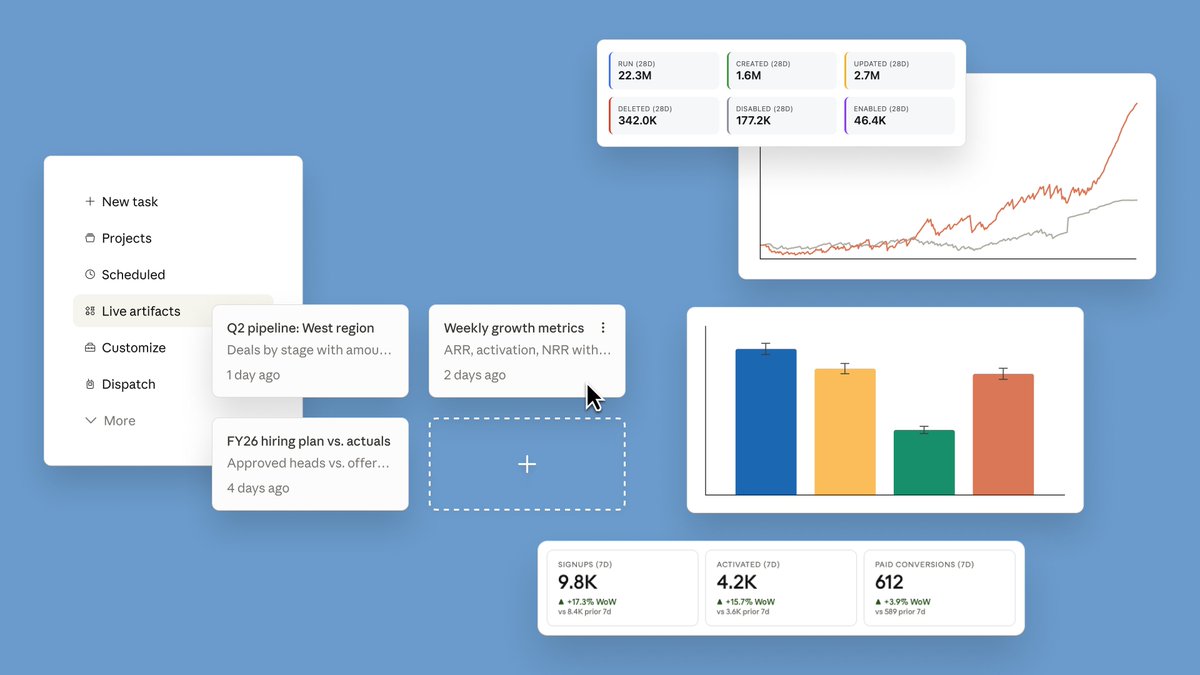
In Cowork, Claude can now build live artifacts: dashboards and trackers connected to your apps and files.
Open one any time and it refreshes with current data.
Introducing our new collaboration with Anthropic: Canva is now in Claude Design! Generate ideas in Claude. Edit in Canva. No friction. No starting from scratch.
https://t.co/f220BR4AZk
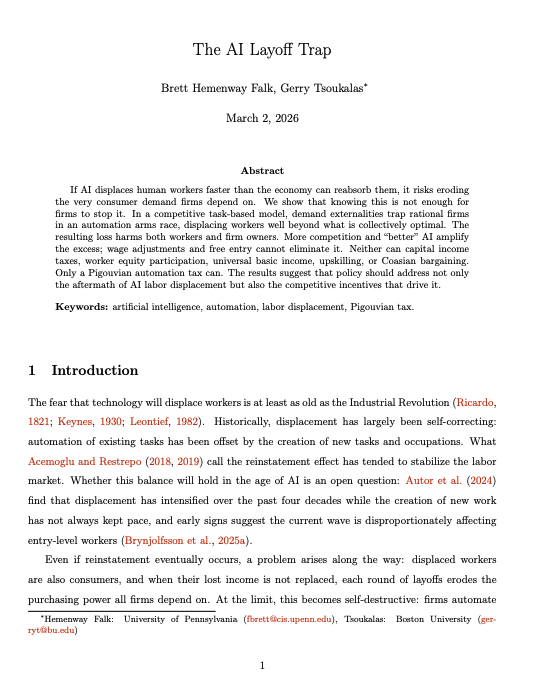
🚨BREAKING: Two researchers from UPenn and Boston University just published a paper that should be uncomfortable reading for every CEO automating their workforce right now.
The argument is straightforward. Every company replacing workers with AI is also eliminating its own future customers. Laid off workers stop spending. Enough of them stop spending and nobody can afford to buy anything. The companies that fired everyone end up selling into an economy with no purchasing power left.
Every executive can see this. The math is not complicated. But here is why nobody stops.
If you do not automate, your competitor does. They cut costs, lower prices, take your market share, and you collapse anyway. So every company automates knowing it is collectively destructive because the alternative is dying alone while everyone else survives. The researchers proved this is a Prisoner's Dilemma playing out in real time.
The numbers are already moving. Block cut nearly half its 10,000 employees this year. Jack Dorsey said AI made those roles unnecessary and that within the next year the majority of companies will reach the same conclusion. Salesforce replaced 4,000 customer support agents with AI. Goldman Sachs deployed a coding tool that lets one engineer do the work of five. Over 100,000 tech workers were laid off in 2025 and AI was cited as the primary driver in more than half those cases. 80% of US workers hold jobs with tasks susceptible to AI automation.
The researchers tested every proposed solution. Universal basic income does not change a single company's incentive to automate. Capital income taxes adjust profit levels but not the per-task decision to replace a human. Collective bargaining cannot hold because automating is always the dominant strategy.
They also identified what they call a Red Queen effect. Better AI does not solve the problem, it accelerates it. Every company chases faster automation to gain market share over rivals but at the end everyone has automated equally, the gains cancel out, and the only thing left is more destroyed demand.
The one thing the math says could work is a Pigouvian automation tax. A per-task charge that forces companies to account for the demand they destroy each time they replace a worker.
The conclusion is that this is not a transfer of wealth from workers to owners. Both sides lose. Workers lose income. Companies lose customers. It is a deadweight loss with no market mechanism to stop it on its own.
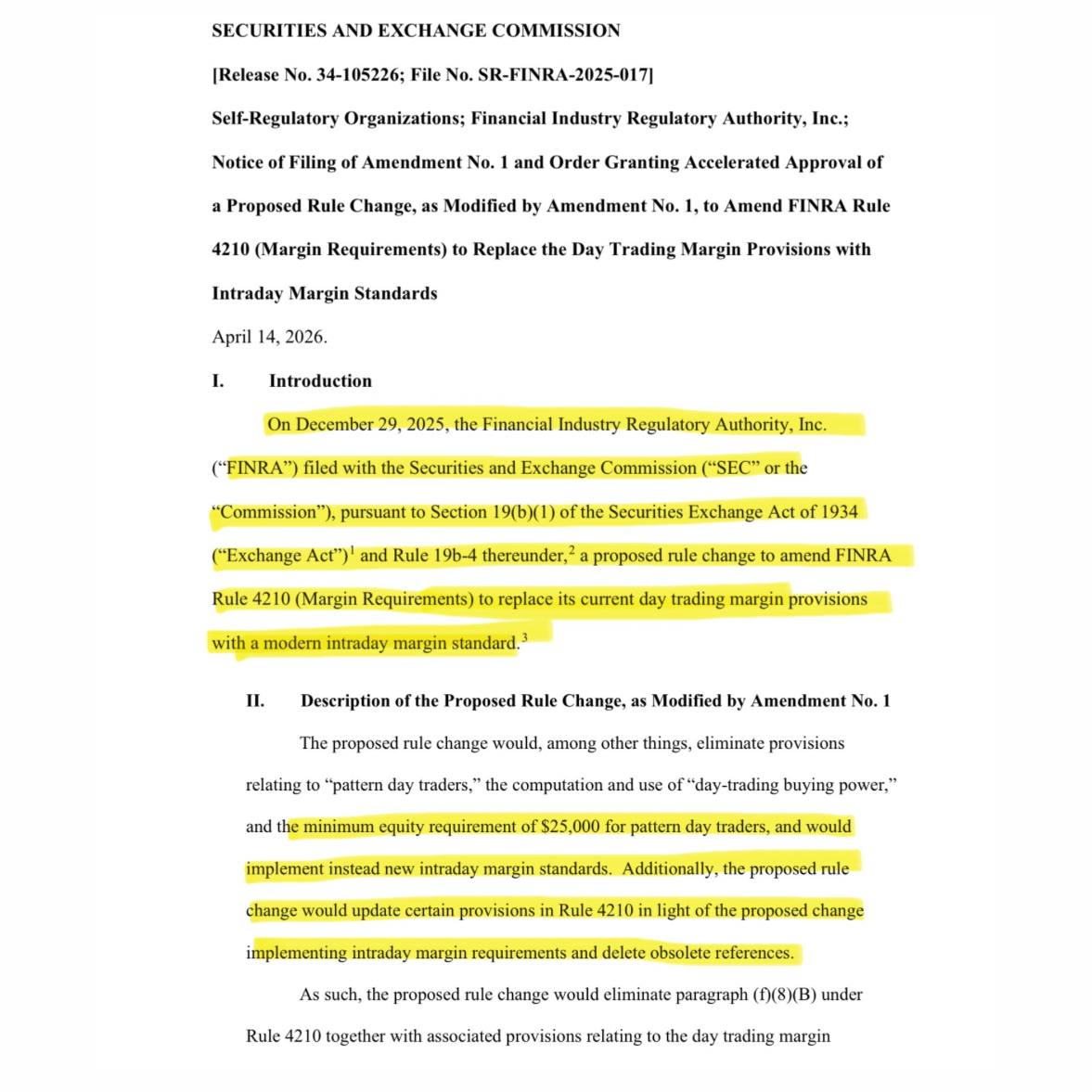
BREAKING: The SEC just officially eliminated the $25,000 minimum rule for day trading.
This is the biggest change to retail trading in 24 years.
Since 2001, if you wanted to make more than 3 day trades in a 5 day period, you needed at least $25,000 sitting in your account at all times. If you dropped below that, your broker would lock you out of day trading completely.
This rule blocked millions of retail traders from actively participating in markets simply because they did not have enough capital.
That rule is now gone.
The SEC today approved FINRA's proposed change which replaces the fixed $25,000 requirement with a real time margin system.
Instead of a fixed dollar threshold, brokers will now monitor your actual risk exposure throughout the day and adjust your buying power based on the real risk of your positions, not an arbitrary account balance.
Now you no longer need $25,000 to day trade. You just need enough margin to cover the actual risk of your open positions.
Claude Mythos is like Hiroshima for software.
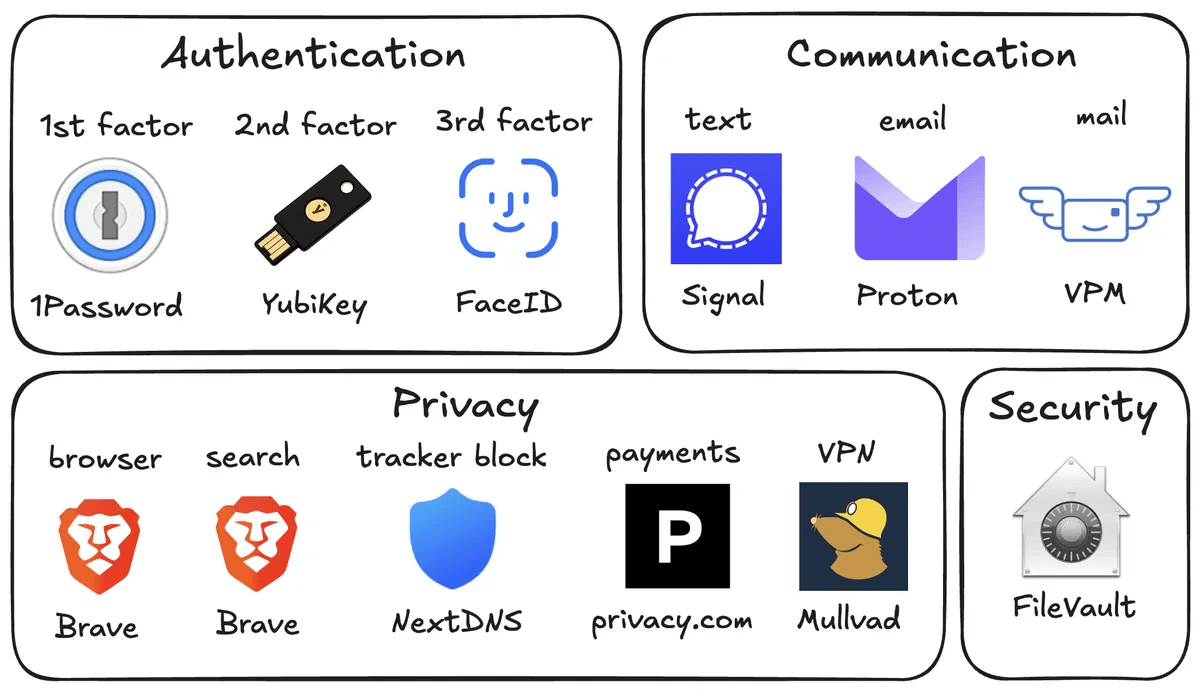
everything you own online, your bank, your email, your photos, your identity, is now dangerously exposed in ways that didn't exist 48 hours ago
that's why Karpathy's digital hygiene guide is probably the most important thing you can read this week
here's every step to protect yourself in these uncharted times:
> use a password manager for every account
> set up physical security keys so attackers can't log in
> enable face id and fingerprint everywhere
> randomize your security question answers
> encrypt your hard drive
> get rid of unnecessary smart home devices
> switch to signal for private messaging
> use brave instead of chrome
> switch to brave search instead of google
> mint virtual credit cards for every purchase
> get a virtual mailing address
> never click links inside emails
> use a vpn on public wifi
> block ads and trackers at the dns level
> install a network monitor to see which apps are spying on you
full breakdown of each step below:
There's a physicist at Stanford named Safi Bahcall who modeled this exact principle and the math is wild.
He calls it "phase transitions in human networks." When you're stationary, your probability of a lucky event is limited to your existing surface area: the people you already know, the places you already go, the ideas you've already been exposed to. Your opportunity window is fixed.
When you move, your collision rate with new nodes in a network increases nonlinearly. Double your movement (new conversations, new cities, new projects) and your probability of a serendipitous encounter doesn't double. It roughly quadruples. Because each new node connects you to their entire network, not just to them.
Richard Wiseman ran a 10-year study at the University of Hertfordshire tracking self-described "lucky" and "unlucky" people. The single biggest differentiator wasn't IQ, education, or family money. Lucky people scored significantly higher on one trait: openness to experience. They talked to strangers more, varied their routines more, and said yes to invitations at nearly twice the rate.
The "unlucky" group followed the same routes, ate at the same restaurants, and talked to the same 5 people. Their networks were closed loops. No new inputs, no new collisions.
Luck isn't random. Luck is surface area. And surface area is a function of movement.
The lobster emoji is doing more work than most people realize. Lobsters grow by shedding their shell when it gets too tight. The growth requires a period of total vulnerability. No protection, no armor, soft body exposed to the ocean.
That's the cost of movement nobody posts about. You have to be uncomfortable first. The new shell only hardens after you've already moved.