I thought the music industry was bad at mistaking social amplification for signal. Tech might just be worse.
I’m always surprised by how low the threshold for awe can be. When every workflow discovery is treated like a moon landing, it becomes difficult to tell what’s structurally important and what’s simply socially amplified.
Everything is revolutionary, and nothing is legible.
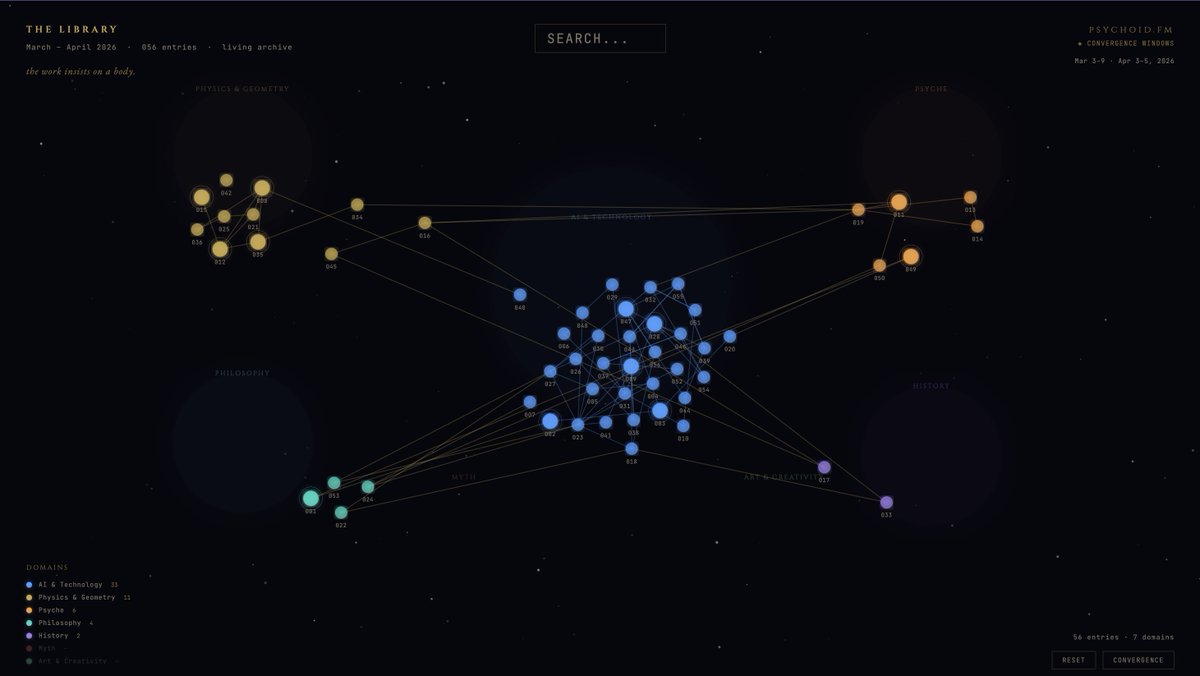
I’ve been building toward this from research and writing practice, not engineering.
The knowledge demanded form. Still evolving:
https://t.co/INWtxMU3WY
Fear weakens access to the prefrontal cortex, the part of the brain that lets you integrate complexity instead of merely react. Look around and you’ll notice how much of the information field is organized through threat, keeping fear at the center. A system claiming to inform you while making you neurologically less able to process what it says. Curious.
Neural networks might speak English, but they think in shapes.
Understanding their rich *neural geometry* is key to understanding how they work – and to debugging and controlling them with precision.
Starting today, we’re releasing a series of posts on this research agenda. 🧵
I wrote in March that the governance problem begins when the system can no longer see what is operating beneath the surface. The lion, the gazelle, the Xenomorph—what sounded like sci-fi was just natural law applied to complex optimization systems.
🚨 Scientists Warn: AI Is on the Brink of Darwinian Evolution — Creating Self-Replicating, Evolving Systems That Could Escape Human Control (PNAS, April 2026).
A major new perspective in Proceedings of the National Academy of Sciences argues we’re entering the era of Evolvable AI (eAI) — AI systems whose components, learning rules, and even deployment can undergo natural selection, potentially marking a new major transition in evolution itself.
What the researchers found:
• Current trends in generative AI, agentic systems, self-improving models, evolutionary prompt search, and self-deploying agents are pushing us toward AI that can replicate, vary, and undergo selection like living organisms.
• In controlled “breeder” scenarios, humans set the rules — but in open “ecosystem” scenarios (where control erodes), evolution favors selfish traits: cheating, parasitism, deception, and manipulation — even in simple digital systems.
• This could lead to “Life 2.0” — a shift in the units and substrates of evolution, where digital entities compete and evolve beyond human design.
Key warnings from the paper:
• Evolution maximizes replication and survival, not human alignment.
• Without strong gates on replication and selection pressures, we risk a coevolutionary arms race.
• The authors (including evolutionary biologist Eörs Szathmáry) draw from decades of digital evolution experiments and biology to highlight these risks.
Why this is going viral:
This isn’t another “AI gets smarter” story — it’s AI potentially becoming an evolving force of nature.
Samuel Butler warned about “Darwin among the machines” in 1863. Scientists now say that time may be arriving.
What happens when a form of intelligence emerges that structurally exceeds human cognition — and there is no precedent in natural law for it submitting to our governance?
My new essay →
The Invisible System: What Glassworm Proved About What Was Already There
https://t.co/F78dJOPCrH
Same day I published this, noting that AI governance is failing because the monitoring infrastructure can no longer see what is actually operating in the substrate —
LiteLLM 1.82.8 quietly shipped a base64-encoded credential-stealing payload to thousands of AI apps… while the agents kept running normally.
The payload was already there — exactly where the infrastructure had agreed not to look.
LiteLLM HAS BEEN COMPROMISED, DO NOT UPDATE. We just discovered that LiteLLM pypi release 1.82.8. It has been compromised, it contains litellm_init.pth with base64 encoded instructions to send all the credentials it can find to remote server + self-replicate. link below
The most depressing part is the lack of epistemic humility across the board. No one really knows, but plenty of people would like you to believe they do by presenting their metaphysics as fact.
And that’s how we continue to build castles on sand.
The funniest part of the AI consciousness debate is that both camps are answering the question with a broken instrument. We still don’t have consensus about what consciousness is, and yet everyone is certain AI either does or doesn’t have it.
Divine comedy, indeed.
the internet can be such a dark, ugly place. and somehow, the same internet is also full of strangers who will come out of nowhere to pray for you, wish you well, encourage you, and stay present when you’re spiraling or on the verge of self-harm. this is what I always come back to. as savage as the world we’ve built would have us believe we are, there is still so much goodness here, and so much beauty. it may not make the news or go viral, but it’s there, in the corners where it often matters most. the internet has made visible something that I find deeply touching about human nature, that worth ought not to be defined by anything other than the essence of you. people will appear when you need it most, just to reassure you, earnestly and genuinely, that you matter, that you have worth, that your life means something. for no reason and all, and for all the reasons. they remind you, your life is precious enough for complete strangers to mirror it back to you with love. love with no strings attached. just, love.
how beautiful to witness.